Taking a proactive approach to environmental compliance
Texte CRC Industries Europe | Photos CRC Industries Europe

Whether you are responsible for an engineering department, a production site or maintenance operations, or are a distributor of industrial products, you need to prepare for the introduction of several laws covering chemicals such as maintenance sprays, bulk lubricants and cleaning products.
Savvy professionals should start looking for effective alternatives to reduce their environmental impact, meet their sustainability targets and improve workplace safety. Purchasing decisions should favour product formulations that meet strict scientific criteria, to ensure compliance.
What does the future hold? In 2025, the European Commission will propose an Ecodesign for Sustainable Products Regulation (ESPR). This regulation will form the cornerstone of the European Commission’s approach to more environmentally sustainable and circular products. The ESPR framework will set out a range of regulatory requirements, including those concerning product reusability, the presence of substances that hinder circularity, more efficient use of energy and resources, recycled content, remanufacturing and recycling, and carbon and environmental footprints. The regulation will apply to all products placed on the EU market. When? Soon. A provisional agreement on the ESPR was reached with the European Parliament in December 2023. The next step is its formal adoption.

You should also expect a revision of the Packaging and Packaging Waste Directive (PPWD). As part of the European Green Deal and the new Circular Economy Action Plan, the European Commission proposed a revision of the Packaging and Packaging Waste Directive in November 2022. The aim is to ensure that all packaging is reusable or recyclable in an economically viable way by 2030. Future measures will also target over-packaging and reduce packaging waste. The final proposal is scheduled for a vote at the end of March 2024. This means the directive is likely to enter into force in the second or third quarter of 2025.
Ready to act?
Another major initiative is on the horizon: the European Commission’s Zero Pollution Action Plan. It sets out a vision for 2050, with a view to reducing air, water and soil pollution to levels no longer considered harmful to health and natural ecosystems, and within the limits our planet can cope with. The Zero Pollution Action Plan sets major targets for 2030 to accelerate pollution reduction at source. Vehicles will certainly be among the first to be affected, but the plan is set to expand and ultimately bring about very significant change in many countries.
You need to be aware of these changes, as they affect many products, including industrial chemicals used for maintenance and repair. This is arguably one of the most challenging aspects of compliance. Many will now have to rationalise their maintenance choices in line with environmental regulations.
However, one problem remains: greenwashing. This is becoming more widespread, and some companies have been penalised for making false claims. The concern is so great that the European Commission is proposing a new law, the Green Claims Directive, to encourage companies to use only products bearing verifiable ecolabels based on sound, reliable scientific methods. According to the European Commission, 53% of environmental claims provide vague, misleading or unfounded information. In addition, 40% of claims are not supported by evidence, and half of green labels are difficult or even impossible to verify.
A potentially costly situation
Although no one can predict the future, the rise of greenwashing could pave the way for a new legal requirement to report emissions data for each product. Signs of this can be found in the Packaging and Packaging Waste Directive (PPWD) and the Water Framework Directive (WFD), which already take extended producer responsibility (EPR) into account: producers are held responsible for managing products throughout their life cycle. Such legislation would probably include data such as embedded CO2 equivalent (GWP, Global Warming Potential) and VOC (volatile organic compound) content. And it is only a small step from mandatory reporting to taxation. We can envisage an EU initiative to tax polluters or incentivise them to improve, similar to the EU Taxonomy Regulation (2020), which is already in force.
The most committed industrial companies are increasingly aware of the issues around VOCs and user safety, as well as the need to move away from traditional solutions in favour of options that are safer for users and the environment. In a shift that would have been unthinkable ten years ago, major distributors of industrial products are now proactively pressing suppliers to adopt ESG (environmental, social and governance) and CSR (corporate social responsibility) statements and policies based on scientific data or, preferably, third-party certification, such as that offered by EcoVadis.
Distributors, professional engineering departments and maintenance companies should look for industrial chemical-based products, such as degreasers, cleaners, lubricants, greases and corrosion inhibitors, that reduce environmental impact according to verifiable, evidence-based criteria. However, purchasing decisions must take many other factors into account. The first is product performance. Some people consider certain “eco-friendly” products less effective. Clearly, a product with a minimal environmental footprint is of little use if it does not perform well enough. End users need professional-grade formulations for maintenance and repair work that meet or exceed their performance expectations.
Getting the green light
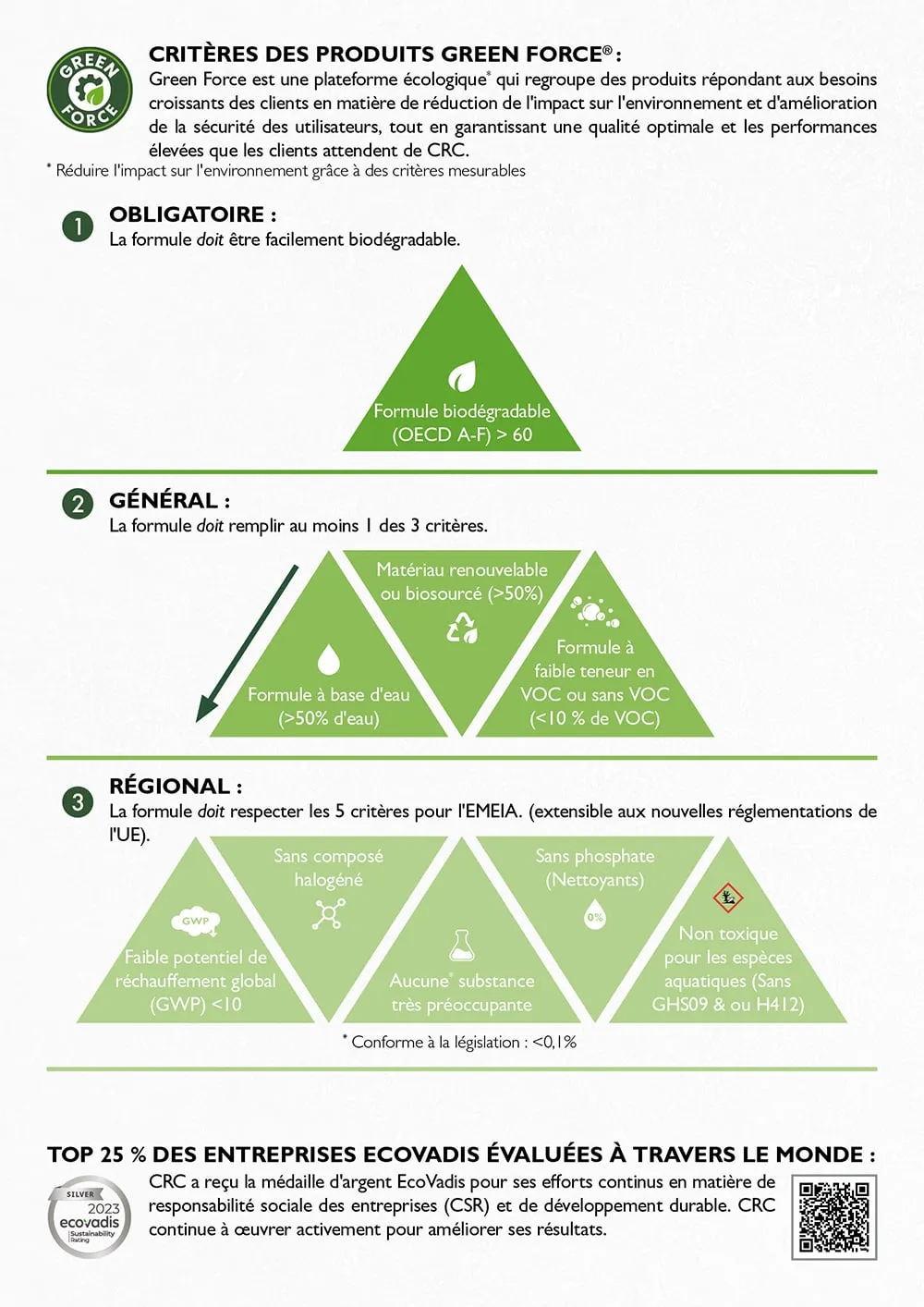
CRC Industries has set out to meet these objectives with its new Force Verte® green platform: a range of degreaser, lubricant and speciality formulations assessed against specific scientific criteria that address users’ ESG requirements. For example, the products are readily biodegradable, independently verified, contain low levels (<10%) or no VOCs, and carry no warnings about adverse effects on health or the environment. In fact, these products carry just one standard warning symbol, for flammability, which is typical of many aerosol products.
Force Verte® products must be readily biodegradable according to the OECD A-F test (>60%). To put this into perspective, if the substance is released onto the ground, more than 60% must disappear within 28 days. Products must also meet one or more of the following three general criteria: low-VOC formulation (<10%) or VOC-free; more than 50% renewable materials or bio-based content; or more than 50% water-based composition.
All Force Verte® products must also meet five additional criteria, which may be extended as new legislation is introduced. Products that meet the criteria will carry the Force Verte® logo on their label and come with a certificate of compliance for use during audits. The detailed criteria and related explanations are available on the website http://crcind.info/CRC_GreenForce
CRC Industries works with distribution partners and end users to ensure ESG compliance across the supply chain, while addressing ESG and CSR compliance issues relating to maintenance products. Having achieved EcoVadis Silver status in 2023, CRC ranks among the top 25% of organisations audited by EcoVadis worldwide. The certificate can be downloaded from the company website www.crcind.com.
Een zakelijke vraag aan CRC Industries Europe BV? Get in touch
Companies in this story
Keep following this
Get an email when a new story is published. No account needed.
- ThemeManaging food safety risks
- SubjectFood safety
- CompanyCRC Industries Europe BV