Hybrid steam production: a model for the modern boiler house
Texte Dr. ir. Marnix Van Belleghem | Photos Belgian Boiler Company
The transition to carbon-neutral heat production is not without its challenges. A wide range of technologies is available, but each has its own physical and economic limitations. That is why the future lies not in a single solution, but in a flexible combination of technologies. Flexibility will truly be the key, particularly given the current volatility of the energy market. Sometimes electricity prices reach record highs, while at other times they turn negative. Companies that adapt their heat production to these conditions stand to gain considerably. Belgian Boiler Company will be pleased to help you find the best route to sustainable heat production.
When a company invests in its own solar panels or wind turbines, an e-boiler (electric boiler) is the ideal way to convert surplus electricity into steam. This increases self-consumption and avoids feeding electricity into the grid at unfavourable rates. Conversely, ‘peak shaving’ is also an option: this involves not using the e-boiler when the grid is under too much strain. The e-boiler helps keep the capacity charges for the grid connection under control. These ‘upstream’ measures are entirely in your hands: with the help of software and control systems, electrical applications such as an e-boiler are switched on or off according to your own production and consumption needs.
Strengthening the business case
However, the main benefits lie ‘downstream’. By making the e-boiler available to the energy market through a Balancing Service Provider (BSP), the company can help stabilise the electricity grid. When there is a surplus of electricity, grid operator Elia looks for large consumers able to increase their consumption at short notice. This is known as aFRR (automatic Frequency Restoration Reserve). Able to respond and adjust within seconds, the e-boiler is ideally suited to this market. The payments made by Elia for this service are substantial and significantly shorten the payback period for the entire installation. Alongside grid balancing, congestion management is also emerging as a way to prevent transformer overloads. If companies can switch flexibly between electricity (for example, e-boilers) and other energy sources (such as gas or cogeneration), this can lead to financially attractive flexible connection agreements. These are currently being developed.
How do you choose the right e-boiler?
When choosing an e-boiler, power output is naturally the first criterion to consider. The potential for integration into the system is just as important. Four parameters are key to integrating an e-boiler into a boiler house: the available electrical connection, water quality, turndown and performance.
Electrical connection
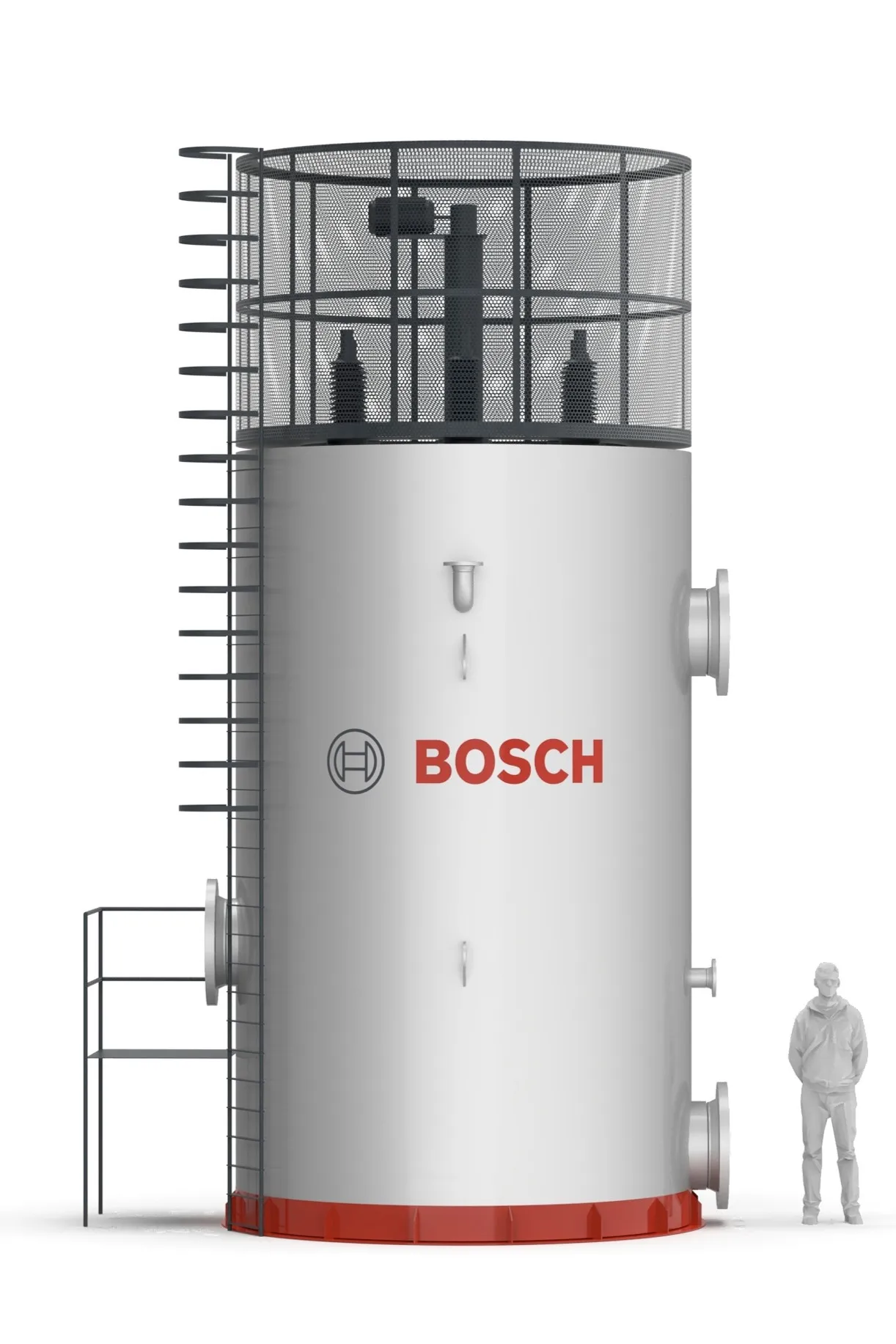
E-boilers can be divided into two main groups. The first is resistance boilers. These steam or hot-water boilers use electrical heating elements to heat water and, if required, produce steam. They operate almost exclusively at low voltage (three-phase, 400 V to 690 V) and therefore have limited power output. However, with applications of up to 5.5 MW (equivalent to 7.5 tonnes/h of steam), they already cover an interesting market segment. The second group consists of electrode boilers, which operate at medium voltage (6 kV to 36 kV). In this design, a voltage is generated between two immersed electrodes, with the water itself acting as the conductive medium. The electrical resistance of the water provides the heat and, where required, generates steam. This technology can be used in applications of up to 90 MWe. Low-voltage boilers have the advantage that this voltage level is commonly available in industry, but the required electrical power should not be underestimated. An electric boiler needs around 650 kWe to produce 1 000 kg/h of steam. In addition, low voltage has the disadvantage that cable cross-sections increase rapidly. Above 6 MW, it becomes difficult to make an economic case for staying at low voltage. At that point, switching to medium-voltage boilers should be considered. Higher voltage levels allow smaller cable cross-sections to be used for the same power output.
Moreover, these installations are not affected by harmonics or phase shifts. However, medium-voltage connections are still far from readily accessible to all SMEs.
Water quality
Existing boiler houses equipped with gas-fired steam boilers, such as shell boilers, already comply with EN12953-10, which defines water quality requirements for shell boilers. Depending on the feedwater quality, this standard allows boiler water conductivity of up to 6 000 µS/cm at 25 °C. In addition, residual oxygen is often removed during boiler water treatment by means of extra chemical dosing, while pH values are controlled and the pipes and boiler are protected against corrosion. If an e-boiler is to be installed alongside an existing gas boiler to supply steam to the same steam network and use feedwater from the same system, compatibility is an important factor. In this respect, resistance boilers have a major advantage, as they can be used in existing boiler houses without any modifications and with the same water treatment as conventional gas boilers. The situation is more nuanced for electrode boilers. There are two common technologies: immersed-electrode boilers and jet-type electrode boilers. Depending on the manufacturer, immersed-electrode boilers require low to very low conductivity, while jet-type boilers need higher values.
Turndown range
To make full use of an e-boiler’s flexibility, a wide turndown range, preferably from 0 to 100%, is essential. Most e-boilers have a wide turndown range. In any case, this is often greater than that of conventional gas boilers. Basic electric resistance boilers use switching relays to control boiler output in steps. Typical step sizes are 50 or 100 kW. This is not a problem for simple applications, but it becomes difficult if you want the boiler to follow a specified load profile as closely as possible. In that case, it is preferable to use a thyristor, which can adjust output continuously. Jet-type electrode boilers have the advantage of also being capable of 100% modulation. Immersed-electrode boilers, on the other hand, pose a problem at low loads below 10%. At that point, it becomes difficult to operate at zero load without switching off the main circuit breaker. Unfortunately, frequent switching has an adverse effect on the service life of this component.
Performance and maintenance
With an efficiency of 99.5% or more, almost all the electrical energy supplied to an e-boiler is converted into heat. These installations are also emission-free: when the electricity comes from renewable sources, they produce no CO₂, harmful NOx or fine particulates. In addition, the absence of a burner, fuel supply and chimney substantially reduces maintenance costs compared with a conventional gas boiler. There is no mechanical wear on the burner fan, no soot build-up and, above all, the installation is much quieter.
A future-proof boiler house for the food industry
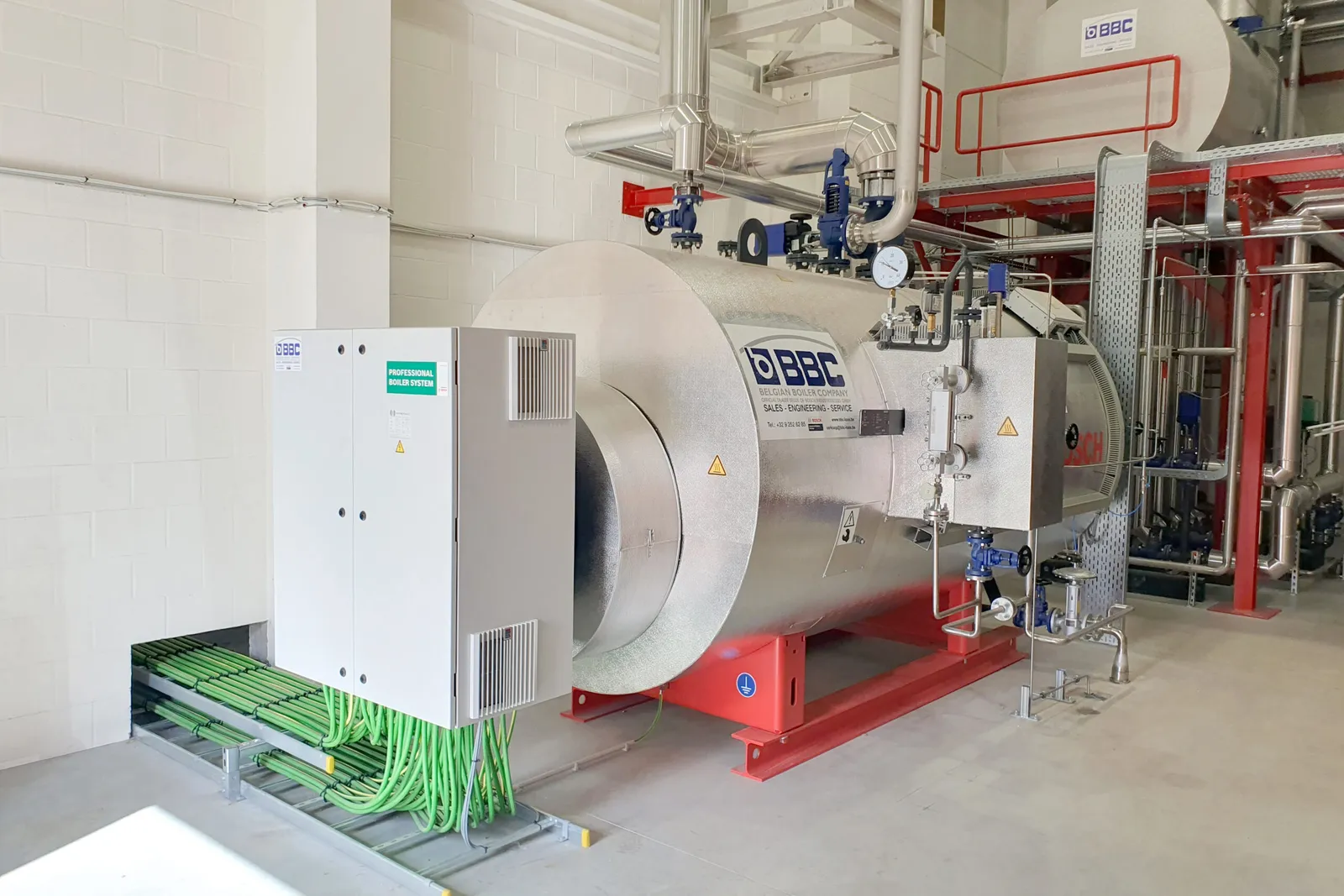
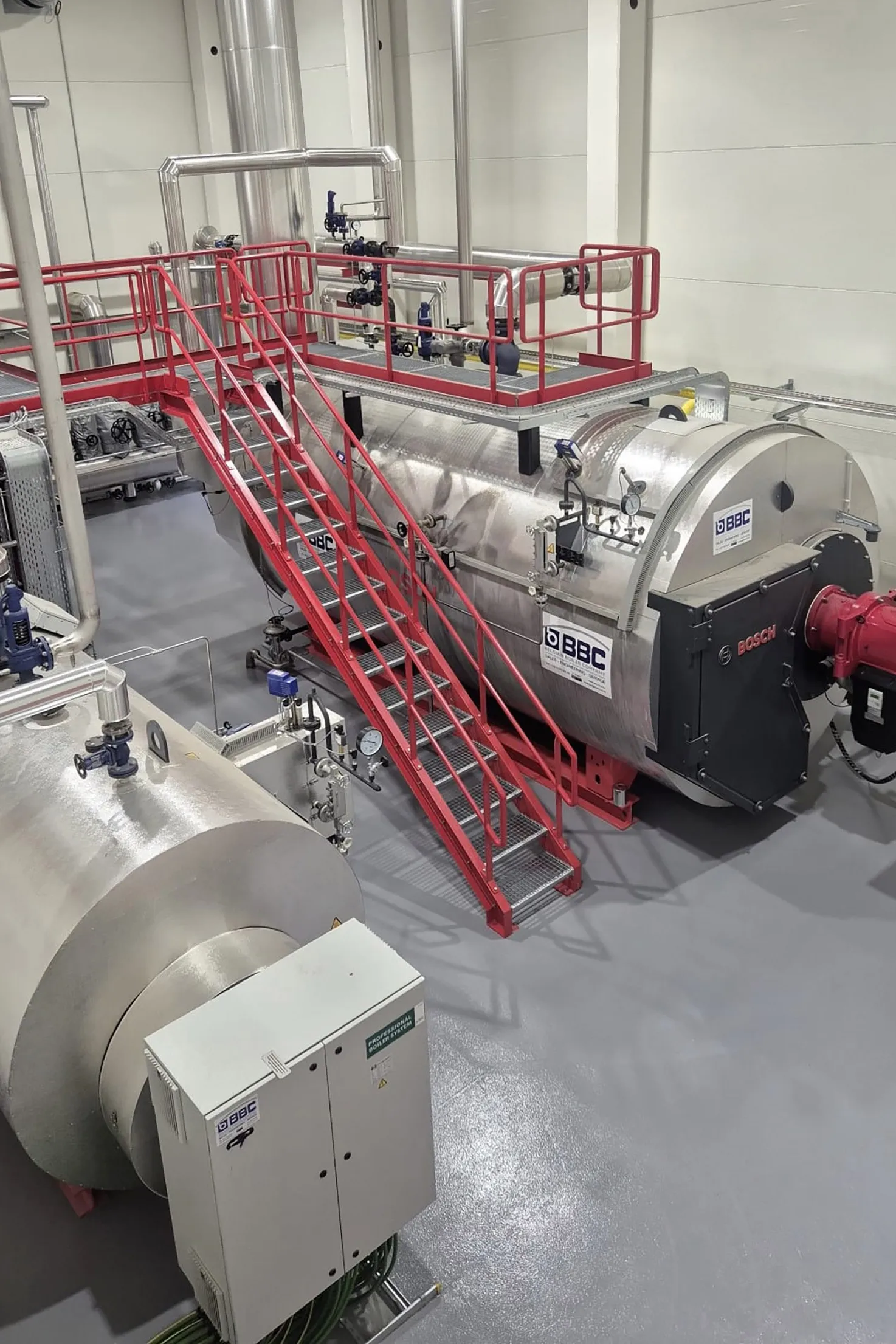
To meet flexibility requirements fully, a boiler house needs to be designed as a hybrid system. A good example of this type of project was recently delivered by Belgian Boiler Company for a global leader in bakery products. When designing a new boiler house, BBC installed a Bosch low-voltage e-boiler alongside a conventional gas boiler capable of meeting the entire steam demand. Thanks to the intelligent integration of the two boilers, the installation can operate in different modes and the e-boiler’s efficiency is maximised.
Mode 1: Conventional master-slave operation. The priority here is production security. The e-boiler supports the gas boiler during demand peaks or takes on the base load when technically appropriate.
Mode 2: Self-consumption. The e-boiler prioritises electricity generated on site from renewable energy sources.
Mode 3: Variable energy tariffs. Control is based entirely on the electricity market’s Day-ahead prices.
Mode 4: Grid balancing. Some or all of the e-boiler’s capacity is reserved for aFRR signals. The gas boiler supplies the steam, but as soon as the e-boiler is dispatched by the grid operator, it takes over and the gas boiler’s output is reduced.
This integrated solution was only possible thanks to the combination of the right technologies. The gas boiler chosen was a Bosch UL-S steam boiler with a capacity of 9 000 kg/h, equipped with an integrated economiser and a feedwater cooler. This resulted in boiler efficiency of over 96%. At the same time, burner modulation greater than 1 in 8 was achieved, which is important for ensuring stable control even at low consumption. Alongside the gas boiler, BBC installed an ELSB 5 electric steam boiler with an electrical output of around 3.3 MW and a steam production capacity of 5 000 kg/h. A thyristor integrated into the boiler’s power cabinet allows output to be controlled continuously from 0 to 100%, providing precise control of the electrical load. Today, this hybrid boiler house ensures steam production while enabling a significant reduction in CO2 emissions and optimising energy costs.
Question about this story? Ask your question
Keep following this
Get an email when a new story is published. No account needed.
- ThemeReducing the environmental footprint of factories
- SubjectSustainability