Recyclability and functionality of coated paper and food packaging board
Paper and board are ideal packaging materials thanks to the renewable origin of their cellulose fibres, their high specific strength and their light weight. To protect the quality and extend the shelf life of packaged foods, paper performance must be tailored using barrier coatings that are impermeable, gas-permeable or preserve aromas. But how recyclable are these coated materials? Can they be reused in paper production? The Recap2 project aims to assess the functionality and recyclability of food packaging paper.
Packaging plays a crucial role in the food industry today by protecting food quality, ensuring safety and extending shelf life. Alongside these functions, environmental impact is another factor to consider when choosing packaging materials.
Every day, the food packaging industry must choose the most suitable packaging material for each specific food product. The packaging and food industries must also be able to demonstrate that their packaging materials are recyclable. Ambitious targets have been set at both European and Belgian level. European legislation requires 65 per cent of all packaging waste to be recycled by 2025, rising to 70% by 2030 (under European Directive 2018/852). In Belgium, the Federation of the Belgian Food Industry (FEVIA) requires all food packaging to be recyclable, reusable or biodegradable by 2025. Recyclability is also an important factor in the transition to circular packaging.
To be suitable for food packaging applications, paper and board materials are coated with one or more layers to provide good sealing properties and a barrier to gases and/or moisture. Many coated paper and board materials for food packaging applications are now coming onto the market. Plastic films have traditionally been laminated onto paper, but in recent years, alternative coatings based on aqueous polymer dispersions have been developed. However, it is not always easy to determine whether these coating materials deliver the desired properties and are fit for their intended purpose. As a general rule, a coating is considered to be limited to 5 per cent of the packaging if recyclability is to be ensured. New procedures have recently been developed, based on European recommendations, to assess the recyclability of coated paper and board packaging materials. However, these still need to be implemented universally for both new and existing products.
REPAC² to the rescue
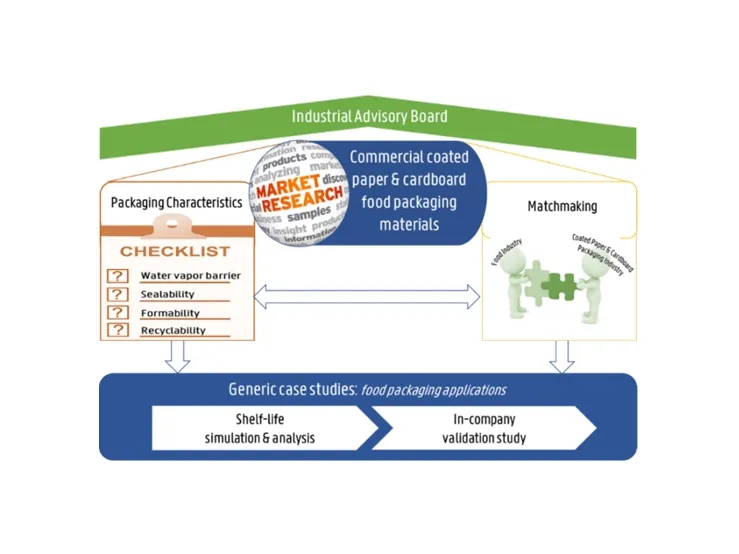
The Cornet-Tetra REPAC² project (“Functional & recyclable coated paper packaging for food products”), which began in January 2022, brings together European research partners including UHasselt, Sirris, Fraunhofer, Pack4Food, Flanders’ FOOD, Natureef and West Pomeranian University of Technology. The steering group also comprises 16 Flemish companies from a range of sectors, including material suppliers, packaging manufacturers and food retailers. The project aims to support industrial partners in accelerating the uptake of coated paper and board materials that offer good barrier properties for food contact and are also recyclable under current legislation. The knowledge generated by the project will help companies choose materials and accelerate the potential uptake of recyclable coated materials in the food industry.
The first step is a market study of coated paper and board for food packaging available on the market. A method will be developed to determine the recyclability of coated paper and board. This will make it possible to assess commercial packaging materials. Next, a matchmaking event will be organised between food companies and the coated paper and board packaging industries. This is expected to lead to generic case studies to inform further research. A sustainability simulation tool will first be used for these case studies, followed by joint sustainability studies. Finally, validation studies at companies will be carried out.
Working with MPR&S, Sirris will take responsibility for cataloguing existing materials: coatings and coated materials currently on the market or due to reach it in the short term. Sirris is also focusing its research on the recyclability of these materials in line with the latest European recommendations. This research will be carried out at the Sirris Coating Lab in Diepenbeek, where an experimental pilot line has been set up to pulp the materials and assess the quality of the recovered paper fibres.
Target audience
REPAC²’s target group includes the food industry, manufacturers and converters of coated paper and board packaging, and recycling companies. Close interaction with this group is essential to maximise the project’s industrial relevance.
Your views matter!
Through a survey, we aim to build an overall picture of coated paper-based packaging and coatings for paper and board food packaging applications that are currently available on the market, as well as new developments expected to reach the market within 1 to 2 years.
There is something in it for you if you take part in this survey! By completing the form, you will help build knowledge of products internationally. The products will be included in a publicly accessible online inventory and featured in a white paper on coated paper-based packaging, which will be widely distributed across the sector. The coating or coated packaging you submit may also be selected as one of the 15 materials whose functionality and recyclability will be assessed as part of the project. You will also have access to international matchmaking with potential end users.
You can find the questionnaire here!
This project is being carried out with financial support from VLAIO.
Question about this story? Ask your question
Keep following this
Get an email when a new story is published. No account needed.
- ThemeDesigning hygienic factories
- SubjectNews