Successive crises put 4 in 10 food businesses at risk of going under

Two in three Belgian food businesses have sounded the financial distress signal in recent months, and 4 in 10 could even go under if there is another economic shock. These are the alarming findings of a study into shock resilience commissioned from Graydon by Fevia, the sector federation. Fevia CEO Bart Buysse is therefore calling on policymakers and supply chain partners to act now in the face of the gravity of the situation: « The combination of historically high costs for raw materials, energy and wages is becoming unsustainable for our businesses, especially if they cannot pass them on to their customers, mainly supermarkets. Our businesses have been providing jobs and investment in our country for years, but today they need support and practical solutions. We have been raising the alarm for months. The situation is serious. Failing to act now is a case of neglecting someone in danger!
Healthy before the COVID crisis, now at risk
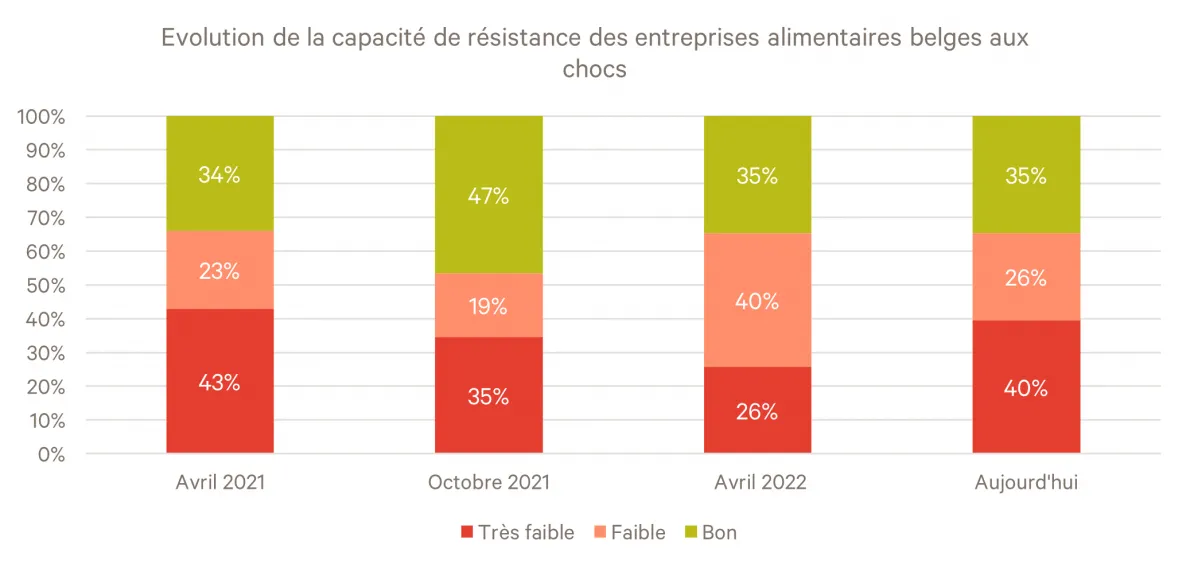
Graydon’s shock resilience score measures the extent to which a business can absorb one or more shocks. In the food and drink sector, 87% of businesses were in very good health before the COVID crisis. Today, 66% of Belgian food businesses are not sufficiently resilient to shocks.
For 40% of businesses, the situation is now downright precarious. The impact of the war in Ukraine and the cumulative surge in the costs of raw materials, energy and wages have of course played a part. With reserves depleted by successive crises, these businesses could go under in the event of another shock. As 97% of Belgian food businesses are SMEs (with fewer than 100 employees), they are the most exposed.
The surge in costs is unsustainable for food businesses
Graydon’s study clearly shows that food businesses have yet to fully recover from the negative effects of the COVID crisis. On the one hand, the proportion of Belgian food businesses with an alarming shock resilience score has fallen thanks to the COVID support measures. On the other, many of these businesses remain in the danger zone, partly because of the impact of the Omicron variant.
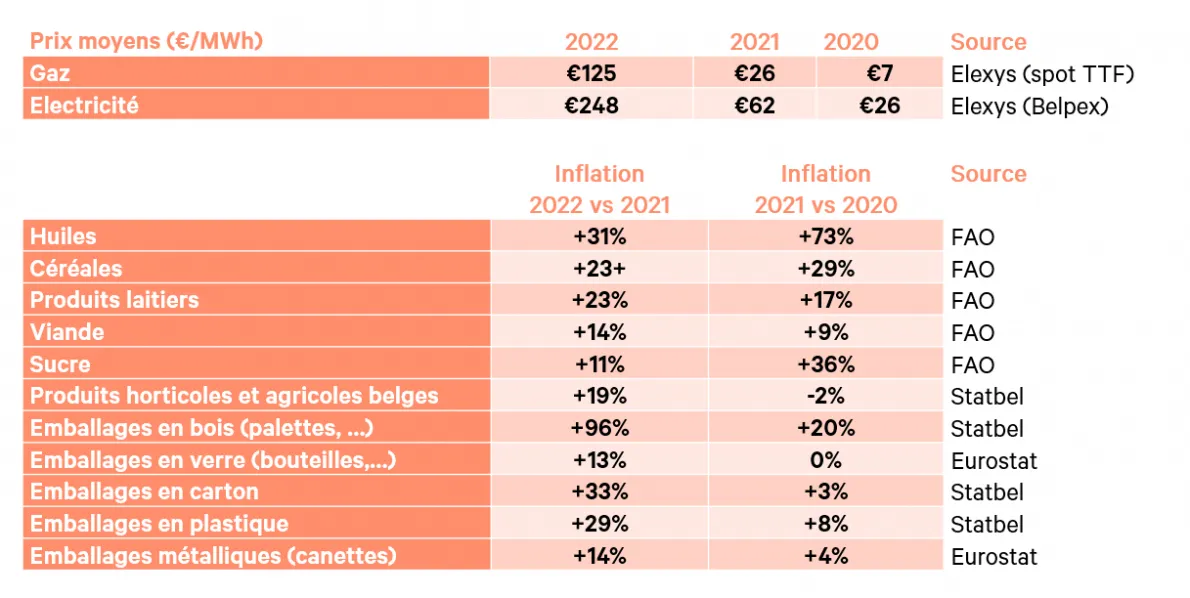
Meanwhile, almost all costs have reached unprecedented highs. A comparison of price movements from January to August 2022 with the same periods in 2021 and 2020, when our businesses were already facing shortages and steep price rises, shows that the situation risks becoming unsustainable for many food businesses:
In addition, a survey of Fevia members shows that barely half of food businesses secured a price increase from supermarkets in 2022. In most cases, the increase was less than half of the rise in costs. Fevia members are also concerned about the meagre margins they have left to invest and innovate. For many, it is simply a matter of survival.
Belgian food businesses also face a wage indexation of more than 10%, due in January 2023. This risks making them less competitive, as wage increases in neighbouring countries, to which our country traditionally exports a great deal, are much smaller. Combined with Belgium’s tax burden, this is also encouraging more and more cross-border shopping.
Urgent solutions are needed now!
Fevia president Anthony Botelberge is therefore asking whether policymakers and supply chain partners want an agri-food chain to remain in our country in the future: « Over the years, the Belgian food industry has become our country’s largest industrial employer and investor, and is a central link in the essential agri-food chain. But today we need support and practical solutions to deal with an exceptional crisis. We are calling on our policymakers and supply chain partners to act now so that affected businesses do not go under! ».
Fevia has therefore put forward practical proposals in recent weeks, which it has shared with the government(s).
1. The priority now is to bring energy costs under control and reduce them, both temporarily and structurally. Our businesses urgently need targeted support today to survive tomorrow!
- Fevia is calling on Belgium to urgently make full use of the options provided by the European temporary crisis framework. Specifically, the sector is asking the three regions to provide direct support to food businesses whose energy bills have risen by more than 100% compared with 2021.
- The federal government can grant a tax credit to businesses whose financial situation has deteriorated sharply because of rising production costs and their inability to pass those costs on in their selling prices. This would be a tax credit to safeguard businesses and jobs.
- Fevia also calls for the essential nature of the food industry to be taken into account, for example in the event of potential supply disruptions. Cutting off water and energy to food businesses is not an option!
- Fevia is also calling for greater flexibility in permits and standards: food businesses wishing to switch temporarily to alternative energy sources should be able to do so by simple notification.
- Fevia is also calling for measures at European level to control energy prices.
2. Fevia is also calling for businesses to be given some breathing space to help them weather this crisis. This could be done, for example, by deferring payments (tax, social security contributions, etc.) and refraining from introducing further legal obligations, administrative burdens or tax increases.
3. For businesses experiencing a fall in activity, Fevia is calling for a flexible system of temporary unemployment for economic reasons.
4. Fevia also stresses the importance of restoring our businesses’ competitiveness on a structural basis by controlling labour costs and removing tax disadvantages. This must be one of the central aims of tax reform.
5. In future, we want better mechanisms to protect our businesses from the impact of crises on (production) prices and give them the ability to pass on those costs: through consultation where possible, and legislation where necessary. In the event of an unexpected and considerable increase in costs, these mechanisms should allow contracts and prices to be adjusted more quickly. They should also prevent supermarkets from imposing excessive logistical penalties.
Question about this story? Ask your question
Keep following this
Get an email when a new story is published. No account needed.
- SubjectNews