World first: fully automated robot-powered kebab skewer machine
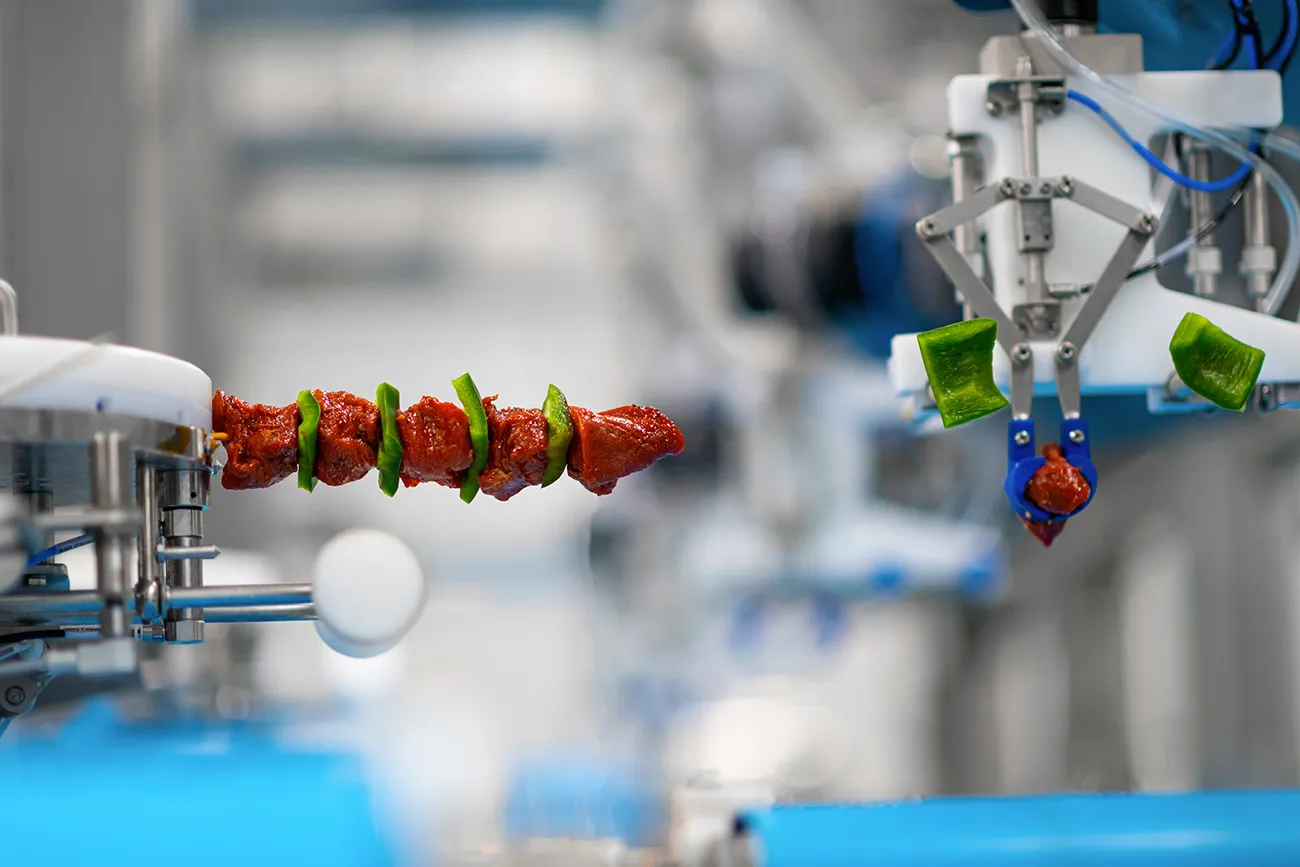
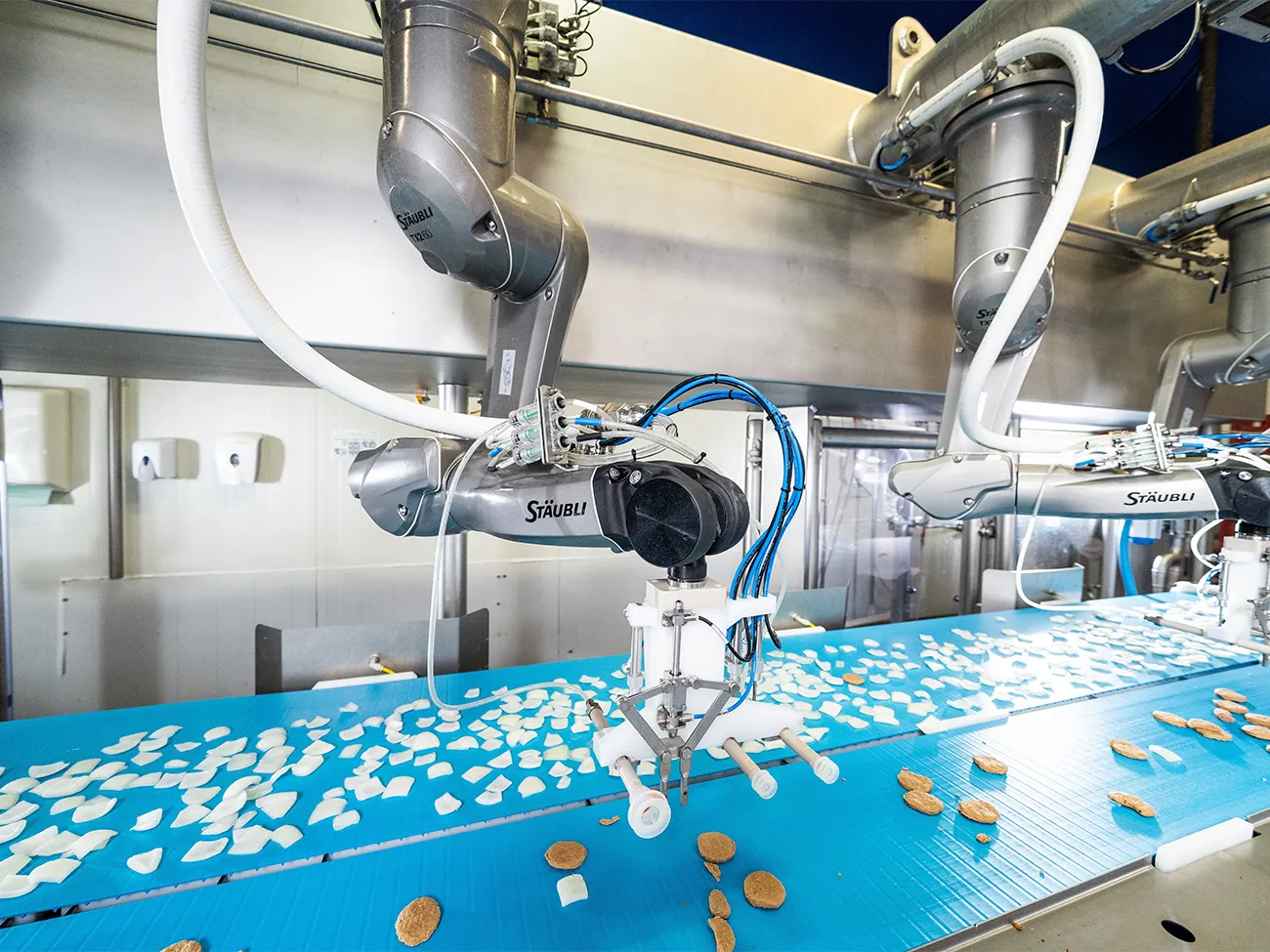
Automating production in the food industry poses enormous challenges for manufacturers, particularly because of strict hygiene standards and the difficulty of handling products. PINTRO bv, a Belgian specialist in the design, manufacture and supply of machinery for the food industry, has developed an innovative solution. Its fully automated Pick & Skewer system for preparing kebabs is a world first. Stäubli TX2-60L robots, with their washable, hygienic design, are used to handle the ingredients and skewer them with precision.
The various types of meat kebab, such as shashlik, souvlaki, kebab and satay, are hugely popular with consumers. At Beltaste in Morahalom, in southern Hungary, 160 employees mainly produce shish kebabs. For automation experts, the company is a pioneer of ‘Food Processing 4.0’, or fourth-generation production technology. A year and a half ago, the company commissioned the world’s first fully automatic kebab machine. Since then, a second unit has also been installed.
Rapid kebab preparation
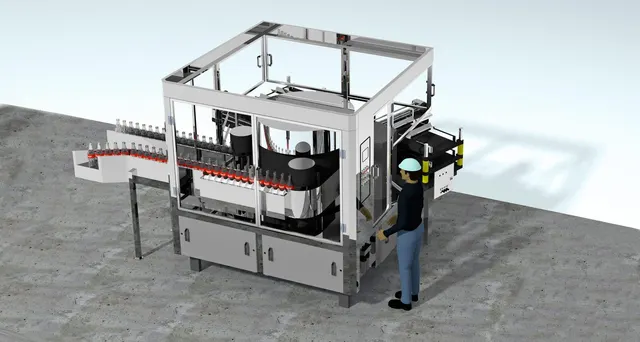
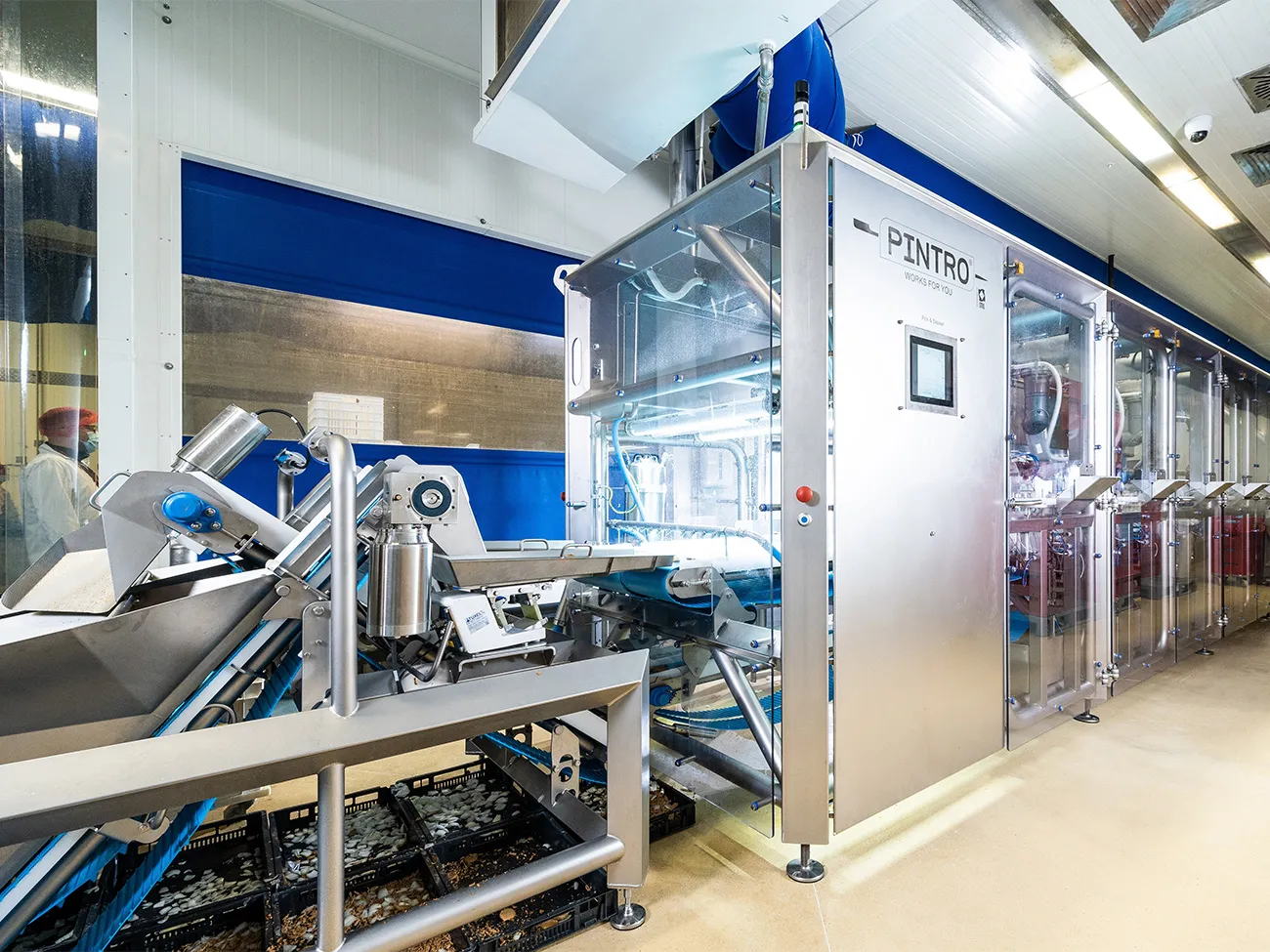
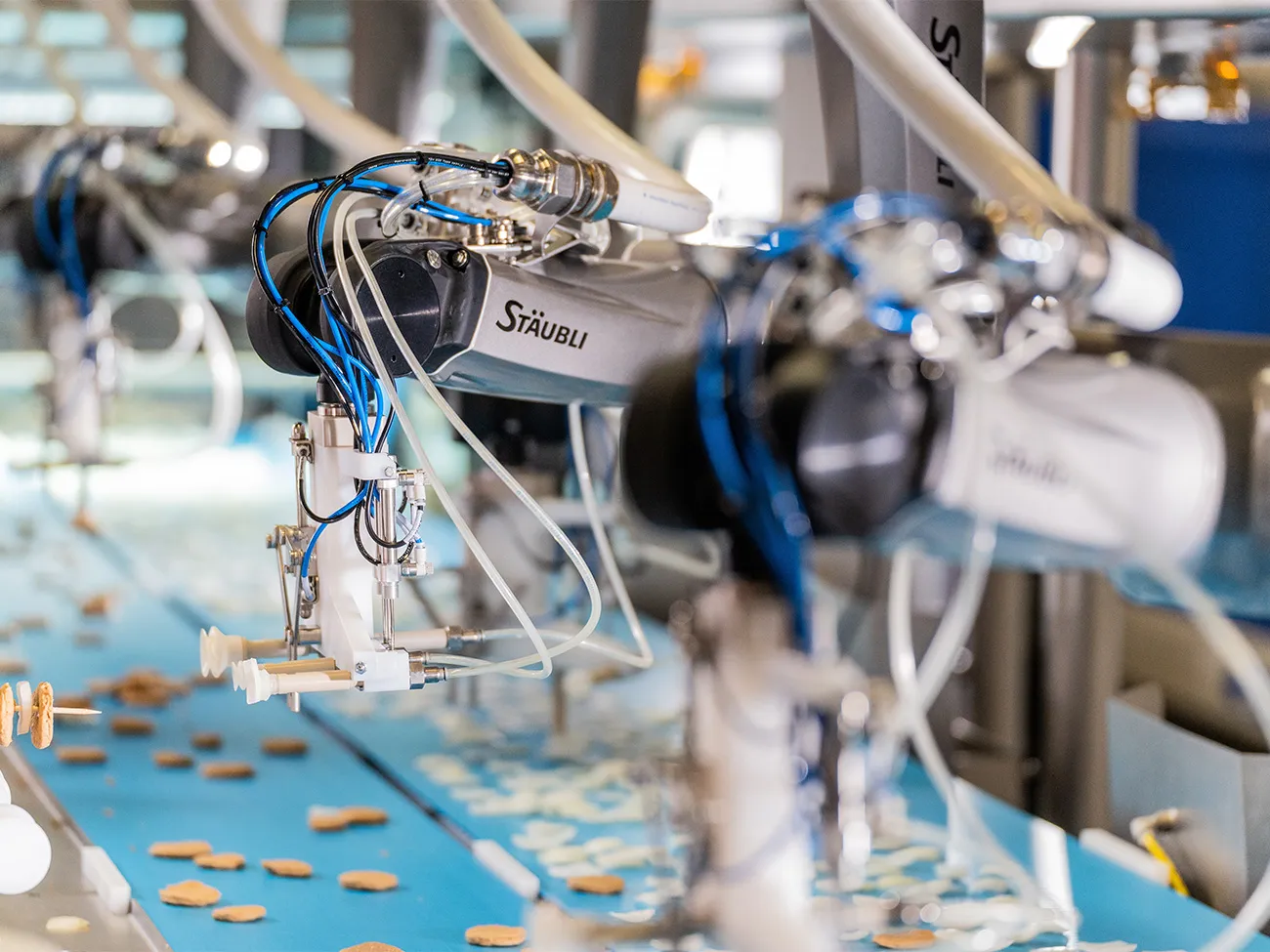
Anyone wanting to follow the fully automatic Pick & Skewer system with the naked eye needs to concentrate 100%. The production process runs at an extremely high speed. All the ingredients are conveyed on two conveyor belts to the central point of the production line: breaded, raw or marinated meat on one side, and onions, peppers, cherry tomatoes or any other ingredients specified by the recipe on the other. Alongside the system are mechanisms that separate the ingredients and hold them ready to be threaded horizontally onto the skewers. The Stäubli robots have to ‘pick’ the ingredients and ensure that the skewer pierces them exactly through the middle. The finished kebabs are then conveyed to the packaging station. The Beltaste system produces between 1 000 and 1 200 shish kebabs per hour without human intervention, each one of consistently high quality. This level of performance was precisely what prompted Beltaste’s management to invest in the world’s first Pick & Skewer system. Leon Muyshondt, Chief Technology Officer at Beltaste in Morahalom, explains: ‘We spent a long time looking for a solution that would increase productivity while improving quality. None of the solutions met our needs. When we saw Pick & Skewer, we were immediately convinced. We believed in the concept and trusted the developer and manufacturer.’
Five robots process 15 000 different ingredients per hour
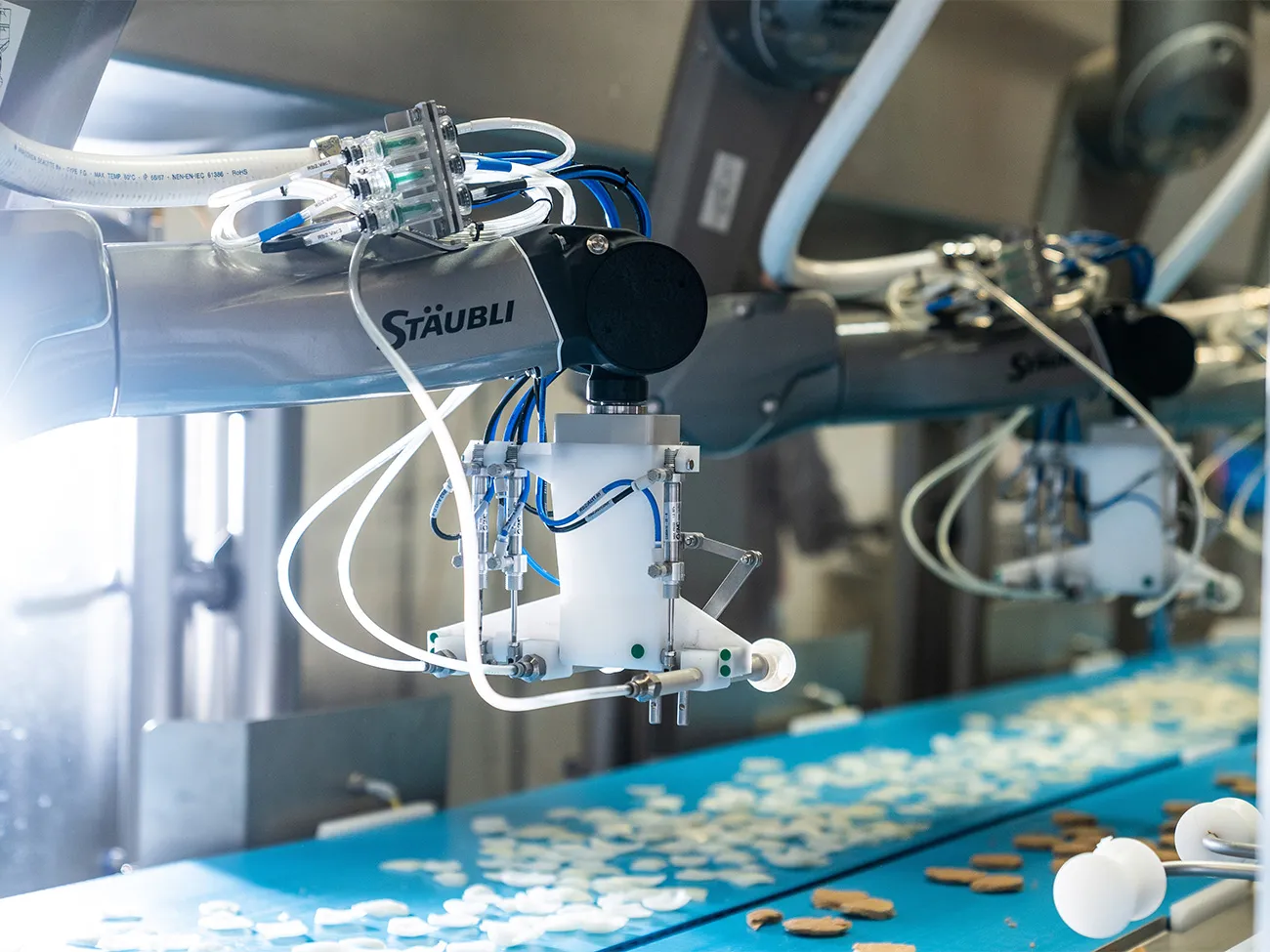
The system was developed by the Belgian company PINTRO. The name is a simplified form of the English phrase ‘pin through’. Since 2007, this subsidiary of SMO bv, which specialises in bespoke machinery, has been manufacturing machines for manual or semi-automatic kebab production. With Pick & Skewer, a major step has been taken towards fully automatic kebab preparation, on a large scale. Depending on the required output, all the ingredients are picked by between two and five robots and held ready for skewering. Beltaste opted for the version equipped with five high-performance Stäubli TX2-60L HE robots. As a six-axis robot can pick and skewer up to 3 000 individual ingredients per hour, the system can achieve a maximum throughput of 15 000 ingredients. At 10 pieces per kebab, that equates to 1 500 kebabs per hour.
Flexible ingredient changes
The robots are guided by vision systems and operate according to recipes stored in the control system. They are not only fast, but also versatile. ‘We generally change recipes every 16 to 20 hours. If a gripper needs to be changed, it takes just five minutes thanks to the quick-change systems,’ explains Muyshondt. PINTRO’s engineers invested considerable expertise in developing the grippers. The result is a combination of mechanical and vacuum grippers that picks up several ingredients at once and then pierces them with extreme precision. Without this, the high level of performance could not be achieved.
Each robot produces a kebab in just a few seconds. The exact position of each ingredient is checked by image-processing systems. Pieter Weyens, head of PINTRO, says: ‘The ceiling-mounted Stäubli robots pick up and position each ingredient with an accuracy of ±0,1 mm. Precise positioning and alignment are not the only important criteria in this installation. The kebabs also need to look as though they have been prepared by hand.
Choosing a robot: hygiene is a decisive factor
Alongside speed and precision, hygiene and ease of cleaning also played an important role in choosing the robot. Cleaning procedures are demanding, as Muyshondt explains: ‘Twice a day, we run an automatic cleaning and disinfection cycle for the tool, which takes a minute and a half each time. After every shift, the equipment is thoroughly cleaned and disinfected: first, foam is applied, then it is washed with hot water using a cleaning lance operating at a pressure of 40 bar. The robots are cleaned in the same way each time.’ The HE version of the six-axis Stäubli TX2 robot, a variant specifically designed for wet environments, is watertight and therefore ideally suited to this application. It is fully encapsulated and withstands the complete cleaning cycle without any functional limitations. Even frequent, intensive cleaning processes, such as those in the pharmaceutical and food industries, do not reduce its service life. In addition, HE robots are designed to operate in sensitive environments. Their washable, hygienic design is considered unique. The robots used in the Pick & Skewer system are lubricated with food-grade NSF H1 oil. ‘The robots are heavily loaded, as they perform many rapid, delicate movements. The lubricant must therefore be effective while also meeting the requirements of the food industry,’ Muyshondt points out. The H1 oil, developed by Stäubli in collaboration with an established lubricant manufacturer, meets these criteria perfectly.
Simple programming, even easier operation
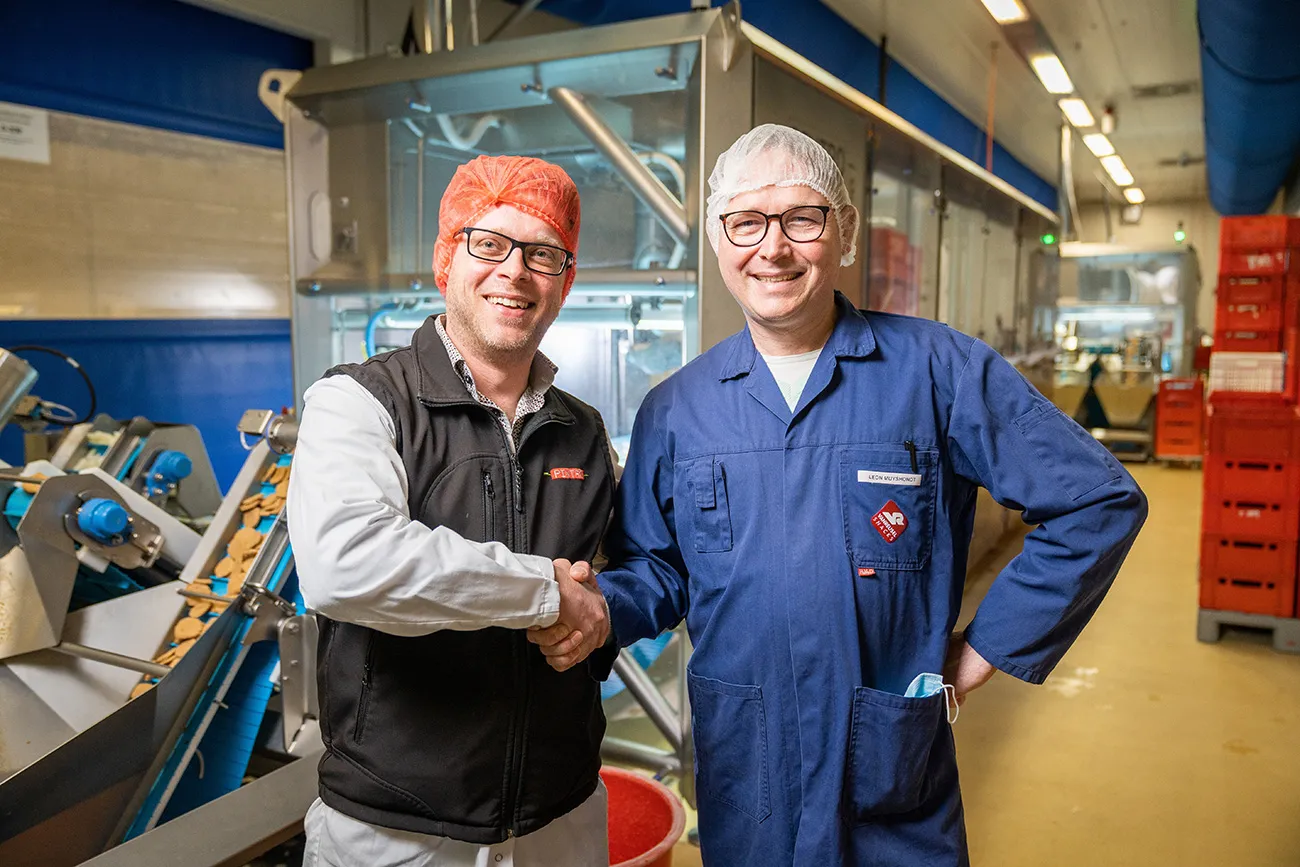
Coordinating image processing with robot movements at this speed and with such precision also places demands on the robot controller. Here, too, the machines score highly: Stäubli CS9 controllers are renowned for their robust performance and excellent connectivity. Another advantage is how easy they are to programme. According to Muyshondt, Pick & Skewer makes things even easier for operators: ‘The employee simply selects a recipe, loads the ingredients and presses the start button, and that’s it!’ Ingredients can be added while the kebab is being prepared. The image-processing systems also oversee quality checks on each individual kebab.
A concept with many advantages
With Pick & Skewer, PINTRO has developed a world first for the food industry, overcoming numerous challenges, such as designing grippers that pick up pieces of onion and cherry tomatoes and thread them onto skewers at a speed that is almost impossible for the human eye to follow. As the system processes raw meat, the entire process must be carried out under the strictest hygienic conditions. Fortunately, this is no problem for Stäubli’s HE robots. The concept offers clear advantages. Muyshondt is enthusiastic: ‘The quality of the kebabs is consistently high. The ingredients are skewered precisely, and we have complete freedom to choose the ingredients. Cleaning and disinfection times are extremely short, and the robots can be cleaned at the same time. This is the future of kebab preparation.’ Following the great success of this first Pick & Skewer line, Beltaste recently commissioned a second system at its plant in Hungary.
Question about this story? Ask your question
Keep following this
Get an email when a new story is published. No account needed.
- ThemeAutomating and connecting production
- SubjectSolutions