Laser marking and coding: a smart choice for a sustainable future
Modern manufacturing businesses face a multitude of challenges, including improving productivity, rising raw material costs, soaring energy prices and supply chain disruption. They must also contend with growing demand for more sustainable packaging from both consumers and regulators. While some aspects of supporting sustainability goals may seem beyond our control, technology is evolving in step with needs… if you know where to look.
Changing substrates
The focus on reducing packaging’s carbon footprint is driving a shift towards more recyclable substrates, including mono-material films and compostable packaging. Coca-Cola, for example, aims to make 100% of its packaging recyclable worldwide by 2025 and to use at least 50% recycled material in its packaging by 2030.
To meet industry and regulatory targets, food packaging such as wraps and pouches now uses PET and PLA films instead of polystyrene, and mono-material films (PE and PP) instead of multilayer, multi-material solutions. Food and FMCG brands are also moving away from multi-material composites towards mono-material PP or PE films. Rigid and semi-rigid containers, bottles and jars are increasingly made from mono-material or recyclable materials, as well as clear PET.
The coding solution
The wider shift towards sustainable, recyclable packaging materials creates new challenges: maintaining print quality in marking and coding, while ensuring that the processes involved help meet CO2 emissions reduction targets. The solution? Laser coding!
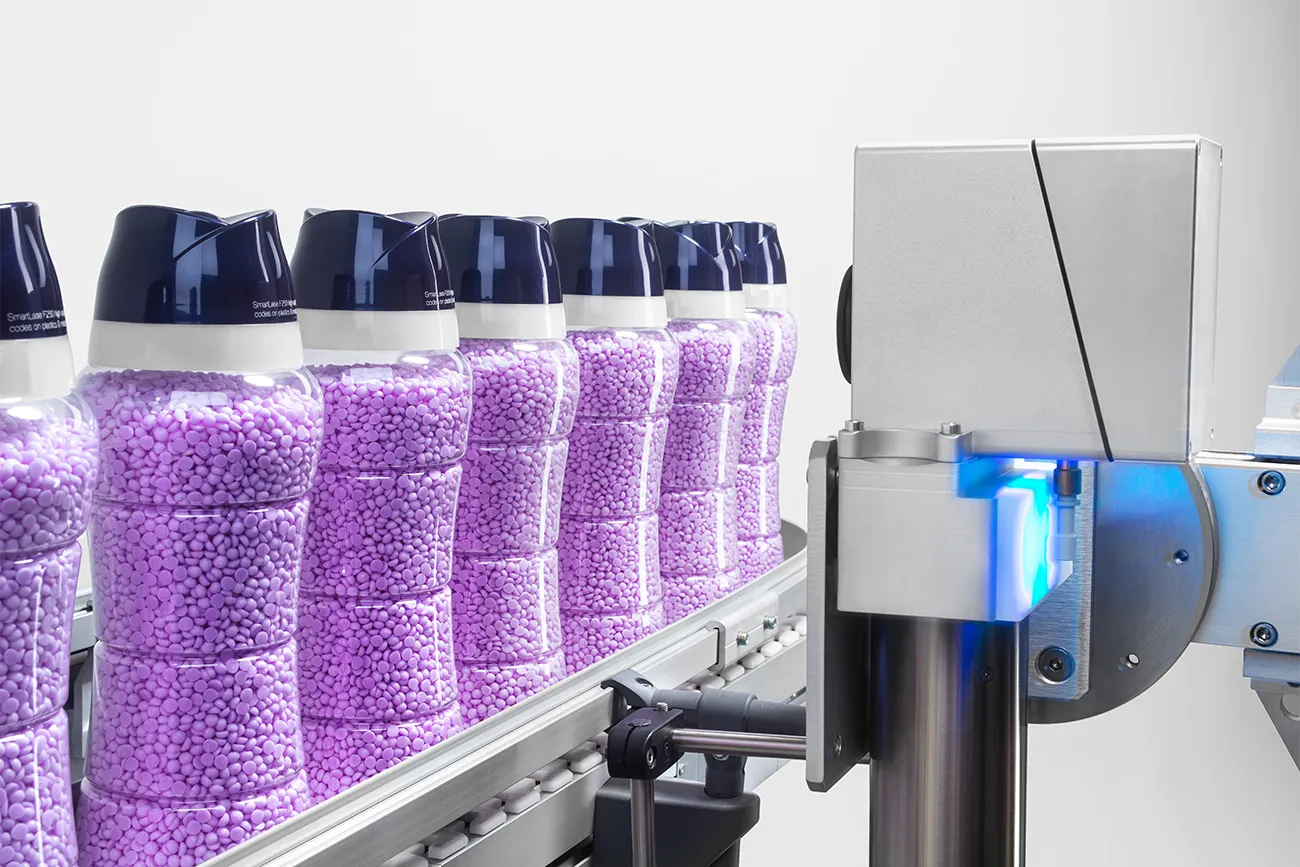
This technology can inherently support sustainability goals on the production line thanks to its many advantages: no chemicals, permanent codes and, with the latest innovations, lower energy requirements for some laser coding applications. All while producing compliant, high-quality permanent codes, even on the latest sustainable and recyclable substrates.
Supporting recyclability
Many manufacturers have long favoured chemical-free coding solutions, particularly in the food and beverage sector, where regulations require them. In a greener future where most packaging will be recycled, adding ink makes the process much more difficult, if not impossible. Laser marking and coding pave the way for a simpler recycling process.
It may seem obvious, but lasers produce permanent codes, which have always been a major advantage for traceability, compliance and brand protection. As we make progress towards sustainability, this is also becoming increasingly important from a circular economy perspective. Permanent codes make it possible to track packaging throughout its lifecycle. When a PET bottle is returned to the manufacturer, for example, the code can be scanned, the number of returns checked, and the bottle washed and refilled for sale. In this scenario, permanent laser codes make it easier to track packaging, ensure it is reused as many times as possible and verify that it is not overused.
An innovation with multiple benefits
The most innovative models, which reduce energy consumption, add to the benefits of laser coding. One example is Markem-Imaje’s new SmartLase C600, which features an integrated cooling system, a market first. The C600 saves 50% of the energy used for cooling compared with traditional water cooling, and 33% compared with air cooling.
As the industry prepares to tackle the unprecedented environmental challenges it faces, some proven technologies could make a difference today. Laser coding is already ready.
A business enquiry for Markem-Imaje NV? Get in touch
Companies in this story
Keep following this
Get an email when a new story is published. No account needed.
- ThemePackaging and tracing products
- SubjectSustainability
- CompanyMarkem-Imaje NV