Our country now has 75 Factories of the Future
Texte Bavo Boutsen et Björn Crul | Photos Agoria
"Despite digitalisation and technology, the human factor is decisive"
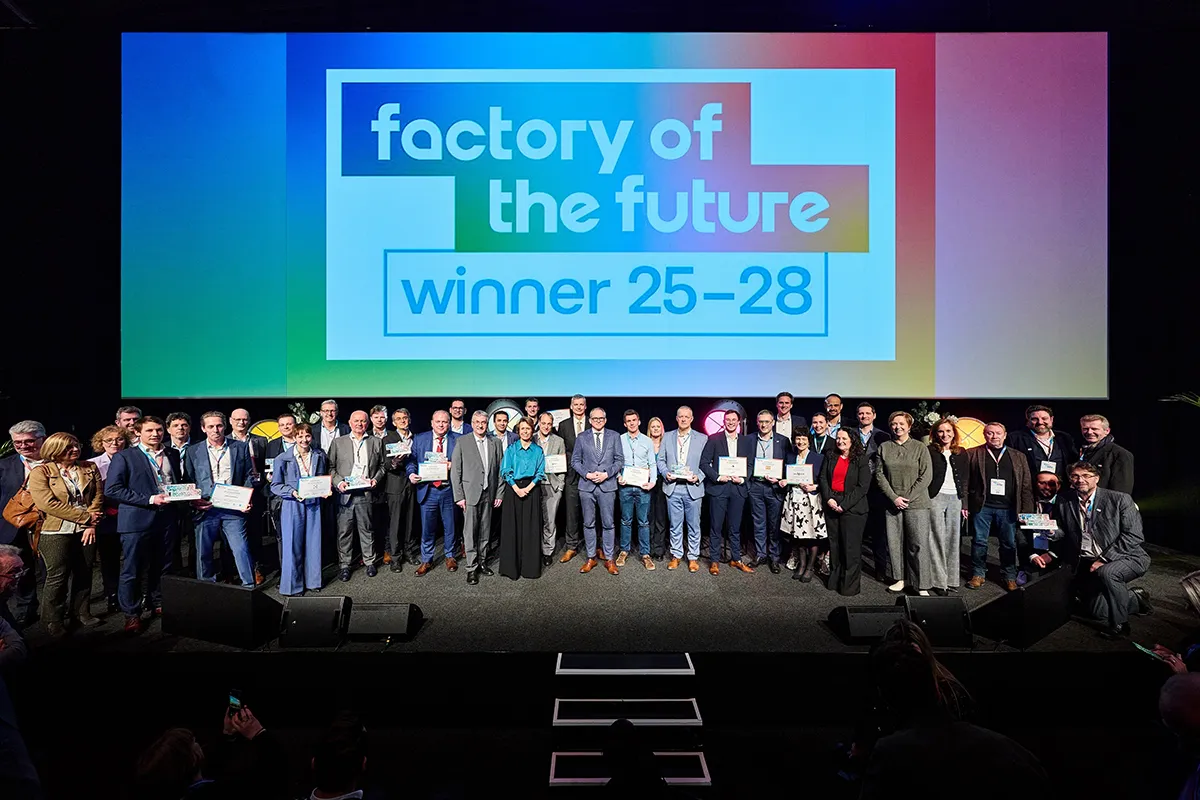
In early February, the Factory of the Future awards were presented for the eleventh time. This quality label is awarded to manufacturing companies that are fully committed to digitalisation, talent development, smart processes, world-class production and a sustainable strategy. Over ten years, the award has become a benchmark for the manufacturing industry. In total, 75 companies have successfully completed the journey through the seven transformations.
For years, innovation in manufacturing companies was almost synonymous with automation and robotisation. But Industry 4.0 involves far more than cutting-edge machinery. Companies that wish to obtain the "Factory of the Future" label must receive a score of at least 8 out of 10 from the expert jury in seven different areas. These include considered management of energy and materials, and fostering the involvement, creativity and autonomy of their employees.
Circularity comes first
Today, innovation efforts focus more than ever on ecodesign and circularity. For example, the potato snack producer Pringles has succeeded in replacing the traditional metal base of its famous tubular packaging with a cardboard one. "This makes our packaging fully recyclable in the paper stream," explains Johan van Batenburg, plant manager.
The same goes for Vinventions, the Walloon company that produces 1.2 billion wine stoppers a year and is a global player in this niche. "In recent years, we have worked a great deal on our basic raw materials. Our products are now made mainly from plant-based polymers, but also from recycled materials," explains Axel Pirard, site manager.
The entire value chain must follow
Such a circular shift is not straightforward. A company depends on the value chain in which it operates. Insulation producer Knauf Insulation has invested 15 million euros in a new facility in Visé to recycle used panels. "Successfully so, since our new furnace allows 100% of the material to be used as raw material for manufacturing new insulation panels," explains Olivier Douxchamps, plant manager. "But the new unit cannot yet run at full capacity, because we are not receiving enough used insulation panels. In Belgium, contractors are not sufficiently encouraged to separate them from their construction waste."
Using less water
In short, there is no doubt that reducing climate impact is the main driver for almost all the winners. For example, Pringles, the Chaudfontaine bottling plant and Puratos, which supplies raw materials to bakers and pastry chefs, are proud to have significantly reduced their water consumption. Olivier Carlens, site manager at Puratos Lummen, explains: "In collaboration with Azulatis, we built our own wastewater treatment plant in order to reuse as much process water as possible. As we will combine this with our own wind turbine and an electric water heater, we will become a CO2-neutral company later this year."
Artificial intelligence is everywhere
Of course, continued investment in high technology and digitalisation is necessary. Artificial intelligence is also omnipresent. Because in recent years the Factories of the Future have focused on digitalised processes, system integration and data collection, they have created the ideal context for extracting added value from the use of artificial intelligence.
At Safran Blades, an aircraft parts manufacturer that opened a new plant in the province of Liège at the end of 2024, AI is central. "We collect 100,000 data points per second in production. By using AI algorithms, we can continuously optimise our processes. That is how we remain competitive. Indeed, the new plant came into being because the parent company wanted to bring production back to Europe for strategic reasons. Competitiveness of production remains an objective," says Geoffroy Jennes, 4.0 digitalisation engineer at Safran Blades.
People are at the centre
Finally, and perhaps this is the most important observation to emerge from this tour, all the winners unanimously stress that this award singles them out as people-centred organisations. "Of course, we need state-of-the-art machines to ensure consistent quality," says Christophe Laureys of the industrial bakery Lantmännen Unibake Londerzeel. "But we rely just as much on the know-how of all our employees. That is why we invest heavily in skills, well-being, ergonomics and work-life balance. In this way, all our employees will help us remain a Factory of the Future."
The Factories of the Future 2025-2028
Companies that have successfully passed the audit may call themselves a Factory of the Future for a period of three years. This year, eleven new companies received the Factory of the Future label: Coca-Cola Europacific Partners (Chaudfontaine), Decospan (Menen), Duracell Solutions (Heist-op-den-Berg), Knauf Insulation (Visé), Lantmännen Unibake (Londerzeel), Newell Brands (Sint-Niklaas), Pfizer (Puurs), Pringles (Mechelen), Puratos (Lummen), Safran Blades (Marchin) and UCB BEBOC (Braine-l'Alleud).
At the end of these three years, they can apply for re-certification, but must again be able to demonstrate progress in the seven transformations. The jury then determines, through a new audit, whether their title can be renewed. This year, that was the case for Vinventions (Thimister-Clermont), P&V Panels (Heusden-Zolder) and STAS Waregem. For Van Hoecke (Sint-Niklaas) and TE Connectivity (Oostkamp), it was even the fourth consecutive award: they have therefore been a Factory of the Future without interruption since 2016! A company must receive an 8 out of 10 from the expert jury in seven areas to obtain the "Factory of the Future" label.
Question about this story? Ask your question
Keep following this
Get an email when a new story is published. No account needed.
- ThemeAutomating and connecting production
- SubjectNews