Sausage production automated by a six-axis robot
Texte & photos Stäubli
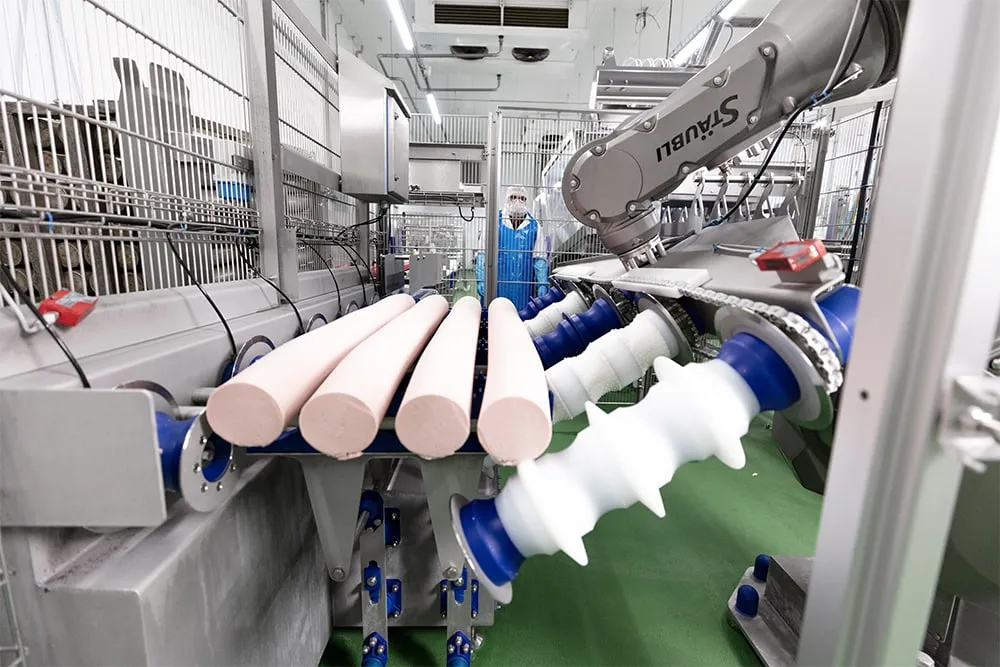
Kaufland is breaking new ground in the processing of its 12 kg sausages. The six-axis Stäubli TX200 HE robot now loads the machine that automatically slices the 1.5 m long sausages into tasty slices ready for packaging. This robotic solution relieves workers of a heavy, repetitive load and brings considerable additional benefits.
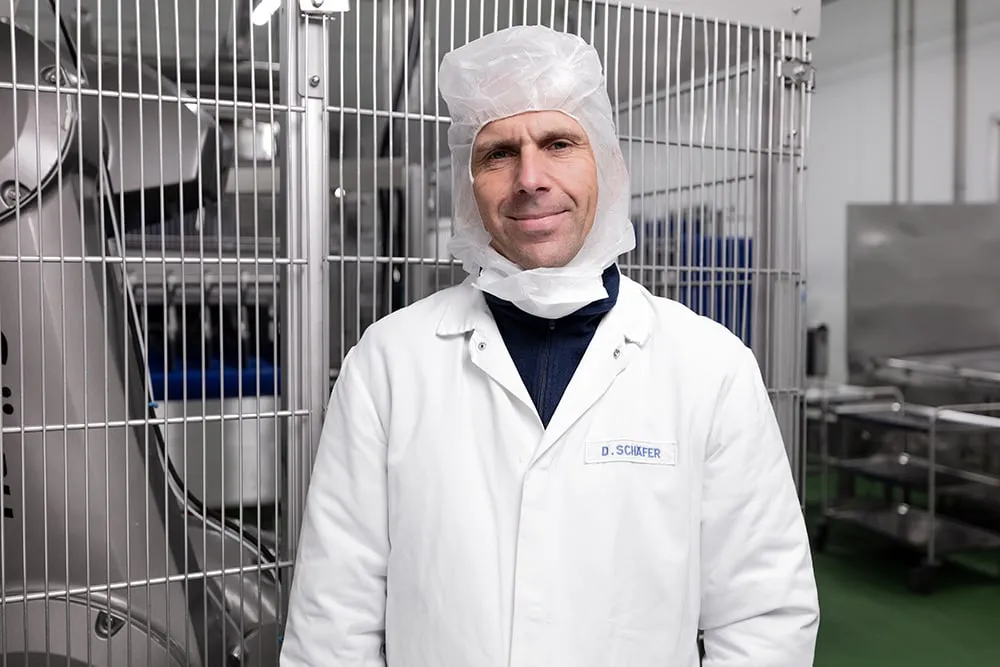
Robots that come into direct contact with food must meet the strictest hygiene standards. They must withstand the various cleaning procedures and disinfection processes specific to the food industry. More and more processing companies are considering robotisation. "Loading 1,500 mm, 12 kg sausages into the slicer over three shifts was one of our employees' least favourite tasks," explains Dieter Schäfer, packaging team leader at Kaufland Fleischwaren. "With the introduction of more efficient processes in other production areas, it became increasingly difficult to keep performing these manual tasks. Integrating a robot seemed the right solution, but we were sceptical: would a six-axis robot be able to withstand our cleaning cycles over the long term?"
Reliability in extreme conditions
Martina Düngfelder, Life Sciences & Food manager at Stäubli Robotics Germany, dispelled these doubts: "I knew Kaufland's reservations from many other projects. But in the meantime, our HE (Humid Environment) robots have proven themselves as the benchmark for applications in hygiene-sensitive environments." Stäubli invited Kaufland's management to see for themselves on a guided tour of similar projects. They were convinced immediately. The integrator BSB Robot Systems GmbH gladly took on the project. What seemed simple at first, picking up four giant sausages at a precise location and moving them to the slicer, proved more complex than expected. Rainer Bonfig, managing director, explains: "The two challenges were adapting the robot to the restricted space and making the gripping technology work precisely enough to handle the sausages without damaging them."
A tailor-made design
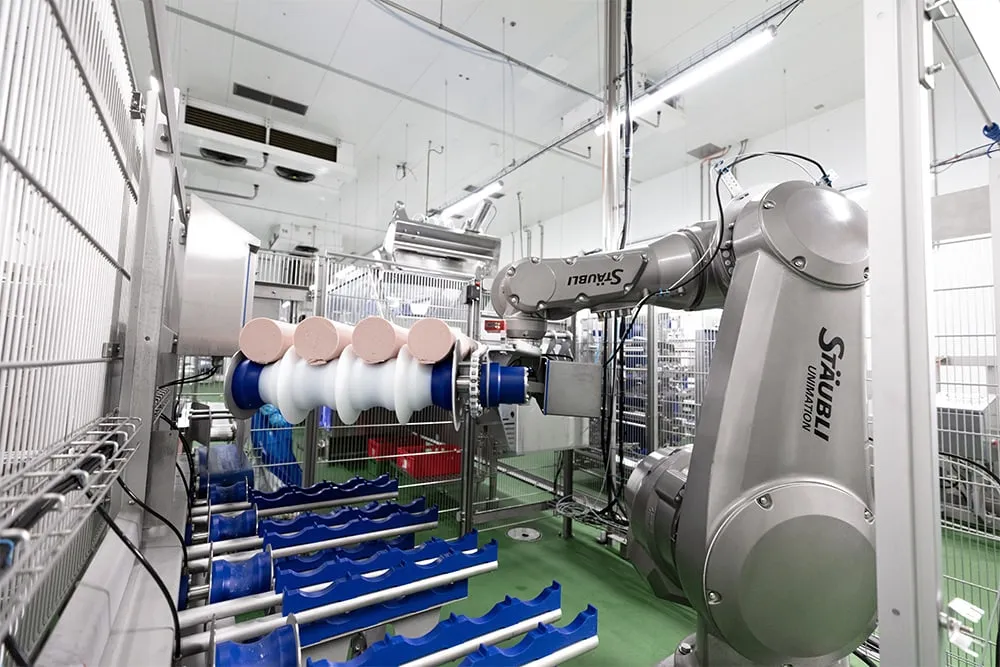
The Knaufland slicer is probably the first in the world to be equipped with a six-axis robotic loader. Choosing the robot was child's play: given the intensive disinfection and cleaning processes, only the fully encapsulated, watertight Stäubli HE robot was considered. The required payload and reach pointed to the large TX200 HE. In designing and building the gripper, the BSB team drew on decades of expertise. To achieve the specified cycle times, it had to pick up four sausages at once. Bonfig explains: "The six-axis TX200 positions the gripper under the four sausages at the transfer position and lifts them gently. The gripper weighs just under 80 kg and is 1,800 mm wide. For each of the four sausages, it has four rollers driven by a central motor. The four evenly distributed supports ensure a secure lift and prevent the soft sausages from sagging and splitting." The TX200 approaches the transfer position with great precision before loading begins. Once the final position is reached, the central motor drives the gripper's rollers. To prevent the sausages from slipping on the gripper, the surface of the 3D-printed rollers has a fine, spiky texture that provides the necessary traction.
6,000 kg of sliced sausage per shift
Thanks to the installation of this automation system, unique in the world, Kaufland in Heilbronn can now produce 12,000 kg of sliced sausage per day in two shifts. The system handles up to 21 different types of sausage. These are combined into four different sausage packs. Schäfer: "The six-axis Stäubli TX200 HE robot completely dispelled my concerns about meeting our strict hygiene standards. The robotic solution also meets our other objectives 100%. Reducing our employees' workload, reliable machine performance in such a small space, increased productivity, high availability, resistance to intensive cleaning processes and the exciting new possibilities it offers make this project a complete success in every respect."
The TX2-200 is now also available in an HE version
The new generation TX2-200 is now also available in an HE version. The TX2-200 HE is the largest robot in the series, with a lifting capacity of 170 kg and a reach of 2,209 mm, ideal for heavier handling applications. At the same time, it is a precise robot with impressive dynamics for short cycle times. In terms of food safety, the robot has the closed structure and smooth contours of its standard-version counterpart. But as an HE robot, it is compatible with ISO class 4 environments and can operate in wet environments (IP67 classification). The enhanced safety technology integrates all the latest safety functions. These comply with the SIL3/PLe standard and thus guarantee maximum safety. The TX2-200 can therefore be used in human-robot collaboration without the need to separate work areas with barriers. The TX2-200 offers a new level of safety, flexibility and user-friendliness, making integration even faster and easier.
Question about this story? Ask your question
Keep following this
Get an email when a new story is published. No account needed.
- ThemeAutomating and connecting production
- SubjectSolutions