












Cleaning and disinfection in the poultry processing sector
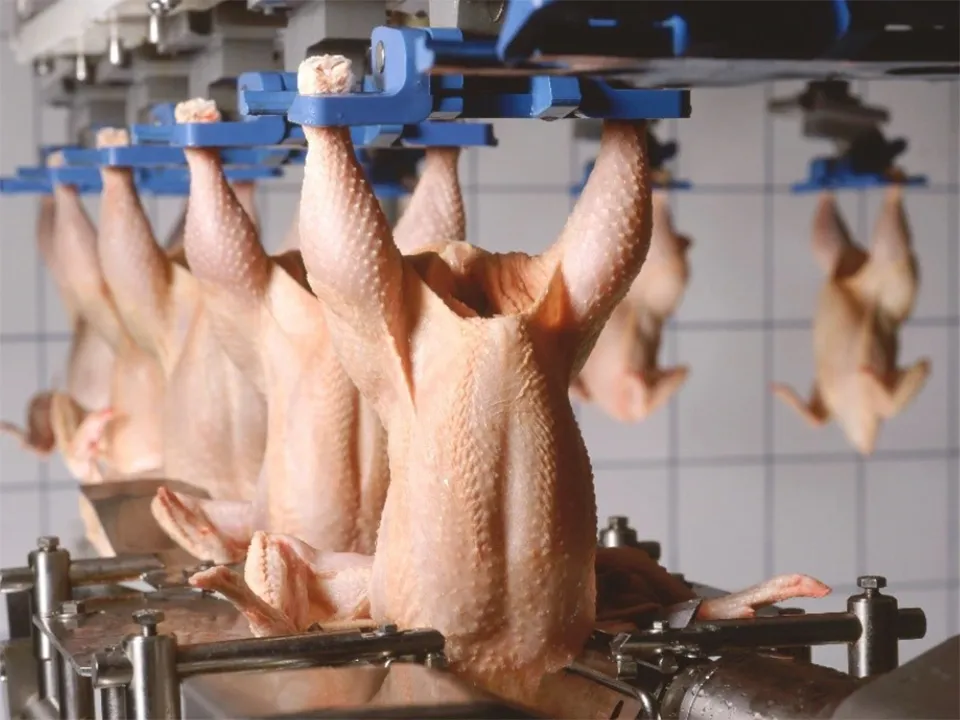
The poultry sector plays an important role in Europe, not only as a supplier of meat but also culturally and economically. Many European dishes contain chicken or turkey. In 2022, poultry meat consumption in the European Union amounted to 11.817 million tonnes.
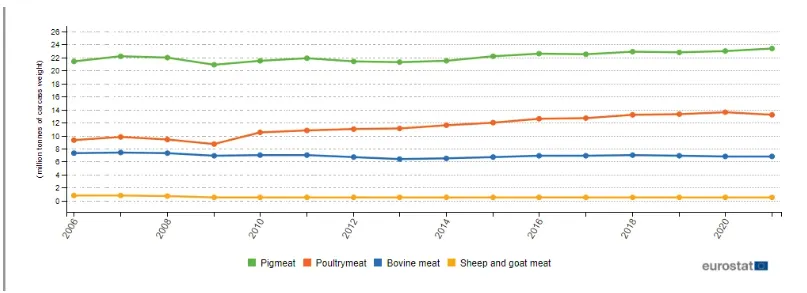
In 2021, the EU produced an estimated 13.2 million tonnes of poultry meat, a decrease of about 2.9% compared with 2020. This decline should, however, be seen against a strong upward trend in production. Between 2006 and 2021, EU poultry meat production increased by 3.9 million tonnes, a cumulative rise of about 41%. This article examines the sector’s main characteristics and challenges from a hygiene perspective. It also presents the best possible solutions.
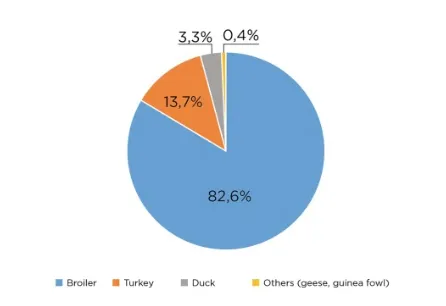
Poultry meat is the second most produced and consumed meat in the EU after pork (Figure 1). Broiler production is by far the largest subsector of the poultry meat supply chain, followed by beef and sheep and goat meat.
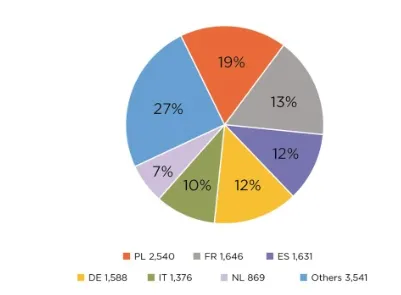
According to Eurostat, six Member States account for almost three quarters of total EU production. Poland remains the largest producer, accounting for 19% of production in 2021. France comes next (13%), followed by Spain (12%), Germany (12%) and Italy (10%), before a drop to the Netherlands (7%).
Pathogens and spoilage microorganisms
Quality and safety are crucial in the poultry industry, particularly in poultry slaughterhouses and cutting plants. Here, measures to control pathogens are essential to produce safe food for consumers. They are also needed to limit the presence of spoilage microorganisms, which can shorten the shelf life of products.
Poultry is highly perishable because it provides an excellent medium for microbial growth. Spoilage microorganisms affect a product’s shelf life when the number of microorganisms per gram in a piece of meat exceeds 1.0 x 10⁵ cfu/cm2 (Poultry Meat Processing and Quality). At this point, changes begin to occur, including unpleasant odours, colour changes and surface slime. The product becomes unfit for human consumption. To prevent the transfer of microorganisms, all surfaces that the product passes over must be kept as hygienic as possible.
To prevent microorganisms from multiplying, a number of strategies should be considered, including:
- freezing and frozen storage
- cleaning and disinfection
- personal hygiene
- physical separation of areas
- sanitation during the working day,
- etc.
Pseudomonas is the most common spoilage microorganism capable of affecting the product’s organoleptic quality.
Failure to invest adequately in prevention strategies can have a significant impact on public health due to the presence of pathogens. The bacterium responsible for the largest number of zoonotic outbreaks is Campylobacter, followed by Salmonella. Another common bacterium found on poultry is Listeria, which is associated with a high mortality rate. Other pathogens that can be found in poultry processing plants include E. Coli and Staphylococcus spp.
Biofilm
Biofilm formation is also a threat to meat safety. Many foodborne pathogens can form biofilms in places that cannot be cleaned and disinfected properly. Biofilm formation depends mainly on the interaction between three components: bacterial cells, the attachment surface and the surrounding environment. Christeyns uses modern technology to detect biofilms quickly and easily. TBF® 300 is a ready-to-use product for detecting all types of biofilm in the food industry. Christeyns also offers a complete range of chemicals for removing biofilms.

Critical points in the processing chain
Spoilage microorganisms and pathogens are present continuously throughout the production process. There are also several critical points that can lead to cross-contamination, from the arrival of live birds in their crates to the slaughter area, scalding tanks, plucking lines and evisceration. An analytical, systematic approach should be considered to reduce the microbial load. Preventive measures and monitoring strategies should also be taken into account. These include cleaning and disinfection procedures, and chemicals suitable for removing soil in all areas, among other measures.
The type of organic soil differs across each area of the slaughterhouse. The so-called “dirty stages” of the process (unloading and hanging the birds, stunning, scalding and plucking) mainly involve feathers and faeces. In the area where the birds are killed and bled, blood is the main contaminant and requires specific removal measures. In the evisceration area, fat, proteins and organic residues from the intestinal tract are released, along with microorganisms found in the intestines. Fat residues are particularly difficult to remove from broiler chickens. The hooks in the chilling tunnel are exceptionally difficult to clean, not only because there are so many of them, but also because they are hard to access.
Cleaning and disinfection procedures
To eliminate the risks mentioned above, a cleaning and disinfection procedure should include at least the following basic steps:
- Remove coarse soil using efficient water pressure and mopping. After this step, walls, equipment and floors should be visibly clean.
- Apply cleaning agents or disinfectants specifically designed for the food industry. These help loosen and keep in suspension, or emulsify, any remaining soil, such as fat particles. Cleaning agents are dissolved in water and should be used at the correct recommended concentration and temperature. They can be applied in several ways: spraying, immersion or foaming. Some surfaces with thick layers of adhered soil may need to be scrubbed manually using scouring pads or non-abrasive brushes.
- The next step is rinsing to remove all remaining dissolved soil and cleaning agent.
- Disinfect by spraying all surfaces at the recommended concentration and contact time.
- Finally, thoroughly rinse surfaces that come into contact with food.
Christeyns offers a wide range of products, including disinfectants with different active ingredients, alkaline cleaners and acidic cleaners. It has also developed products to tackle specific problems, such as detecting and removing biofilms.
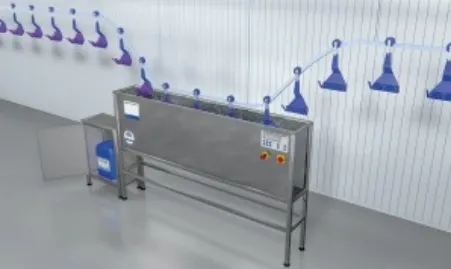
Christeyns has also developed hygiene equipment for cleaning and disinfecting hard-to-reach points, such as an ultrasonic hygiene system for hooks and an automatic conveyor belt cleaning and disinfection system. Another essential aspect for the poultry industry is ensuring that staff entering production areas meet the highest hygiene standards. To achieve this, a suitable combination of personal hygiene equipment needs to be installed.
Monitoring
The importance of monitoring routine cleaning and disinfection should not be overlooked. This makes it possible to check that procedures have been carried out correctly and that facilities have been cleaned properly, both physically and microbiologically, to prevent possible cross-contamination. Monitoring can identify errors in these procedures and potential sources of microbiological contamination. The results can also be used to improve hygiene progressively and optimise operating costs.
Chicken is a staple in our diet, making the poultry industry critically important to food safety. Achieving the highest standards of hygiene in the industry is therefore essential to guarantee the quality and safety of poultry, while also promoting the sustainable management of resources such as chemicals, water and energy.
Bibliography
- Eurostat (https://ec.europa.eu/eurostat/statistics-explained/index.php?oldid=427096#Poultrymeat) Accessed on 13 January 2023
- Poultry market overview. European Commission (https://agriculture.ec.europa.eu/system/files/2023-01/poultry-meat-dashboard_en_0.pdf). Accessed on 13 January 2023
- Poultry Meat Processing and Quality, G Mead, Elsevier, 1 June 2004.
- Canet, JJ (2020). Salmonella in the poultry industry. Critical contamination points and prevention strategies. Blog Betelgeux-Christeyns, 13 November 2020. Accessed on 18 November 2020.
- Lorenzo, F. (2019). Rapid tools for microbiological monitoring of surfaces. Blog Betelgeux-Christeyns, 30 April 2019. Accessed on 13 January 2023
- Orihuel, E., Bertó, R. Canet, J.J., Lorenzo, F., Milvaques, A. (2019). Listeria monocytogenes in the meat industry. Ed. Betelgeux (Gandia).
Een zakelijke vraag aan Christeyns NV? Get in touch
Companies in this story

Keep following this
Get an email when a new story is published. No account needed.
- ThemeFood safety from design to audit
- SubjectFood safety
- CompanyChristeyns NV







