












Drawing up a HACCP plan
Text Valérie CouplezImage iStock
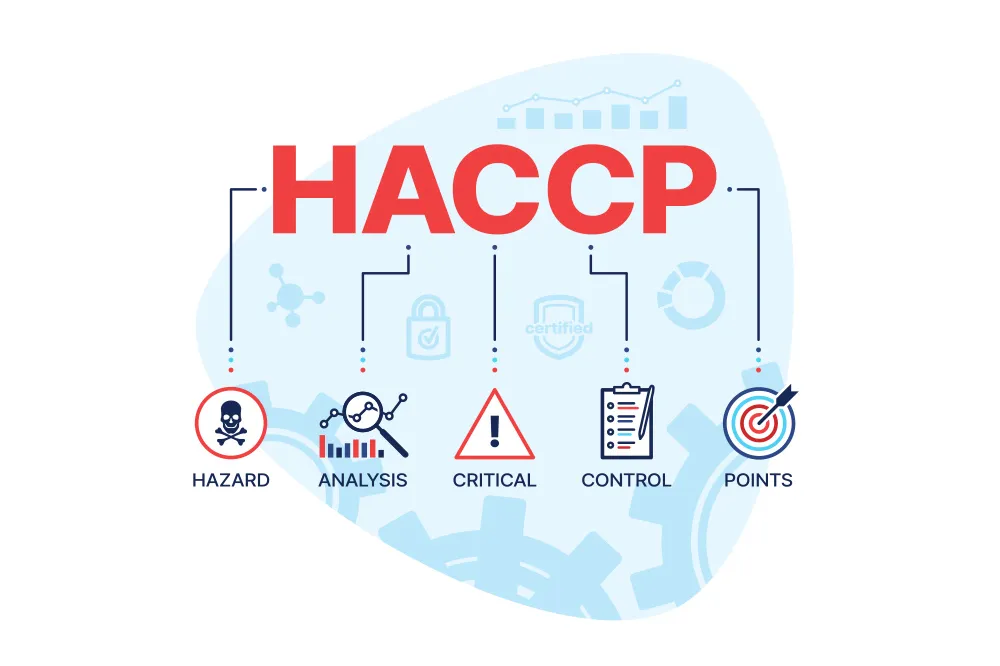
A HACCP system consists of seven principles. Together, they should ensure that food businesses understand hazards, can identify them on the shop floor and take steps to control them. A 12-step plan is often prescribed to achieve this. This article takes a closer look at how to carry out a sound risk analysis and determine critical control points.
Risk analysis is at the top of the list of HACCP principles. After all, only once the hazards have been identified can a plan be drawn up to control them. The Codex defines a hazard as ‘a biological, chemical or physical agent in, or condition of, food with the potential to cause an adverse health effect’. Eliminating these hazards or reducing them to acceptable levels is essential to the production of safe food. In addition to biological (bacteria, viruses, moulds, parasites …), chemical (toxins present in food, pesticides, antibiotics, growth hormones …) and physical hazards (foreign objects such as glass, wood, metal, bone …), allergens and possible radiation must also be taken into account.
How to carry out a risk analysis
After listing all the hazards (biological, chemical or physical) that can reasonably be expected at each stage of primary production, processing, production and distribution up to the point of consumption, the HACCP team must assess the potential significance or risk of each hazard, taking into account the likelihood of its occurrence and its severity. Risk assessment is based on a combination of experience, epidemiological data and information in the technical literature. The severity of a risk relates to the consequences if the hazard is not controlled. If the likelihood is low and the severity is low, the risks do not need to be addressed in the HACCP system, but through GMPs. Five areas of assessment can help identify and understand all possible hazards.
- Check incoming materials and raw materials;
- Assess processing steps for potential risks;
- Observe how things are done in practice;
- Take the necessary measures;
- Analyse the measures taken and make adjustments where necessary.
Control measures
Once the hazard analysis is complete, the team must consider what control measures are available to manage each hazard. These include all actions and activities that can prevent or eliminate food safety hazards, or reduce them to an acceptable level. More than one measure may be needed to control a specific hazard, and there may be more than one hazard. Biological hazards, for example, can be controlled by limiting, eliminating or altering the growth kinetics of micro-organisms. Examples include heat treatment (heating or cooking), freezing or drying. Appropriate cleaning procedures are also important.
Determining critical control points
The next step, and the second HACCP principle, is to determine the critical control points. The Codex defines a critical control point (CCP) as ‘a step at which control can be applied and is essential to prevent or eliminate a food safety hazard, or reduce it to an acceptable level’. Determining a CCP in the HACCP system can be made easier by using a decision tree, such as the one included in the Codex HACCP system and its guidelines for application, which provides a logical approach to reasoning. Its application should be flexible, depending on the type of operation (production, slaughter, processing, storage, distribution or other). It will not be suitable for every situation either. A series of questions is asked to determine whether or not a step is a critical control point. Once the critical control points have been determined, the parameters to be monitored and controlled can be documented.
- Are control measures in place?
- Is this step specifically designed to reduce the likely occurrence of the identified hazard to an acceptable level?
- Could contamination with the identified hazard occur above acceptable levels, or increase to unacceptable levels?
- Will a subsequent step eliminate the identified hazard or reduce the likelihood of its occurrence to an acceptable level?
Question about this story? Ask your question
Keep following this
Get an email when a new story is published. No account needed.
- ThemeFood safety from design to audit
- SubjectFood safety







