












Effective allergen management: control risks, prevent cross-contamination and ensure accurate labelling

A robust allergen management system is essential for controlling allergen risks. The aim of such a system is to provide consumers with accurate product information. Consumers with allergies can then use this information to make a safe, informed choice. Allergen management is therefore primarily about product and label information, not just preventing cross-contamination with allergens, as is often assumed. In practice, however, we see too little attention being paid to data management and mix-ups. This leads to allergen recalls.
It is therefore important to safeguard all the pillars of allergen management.
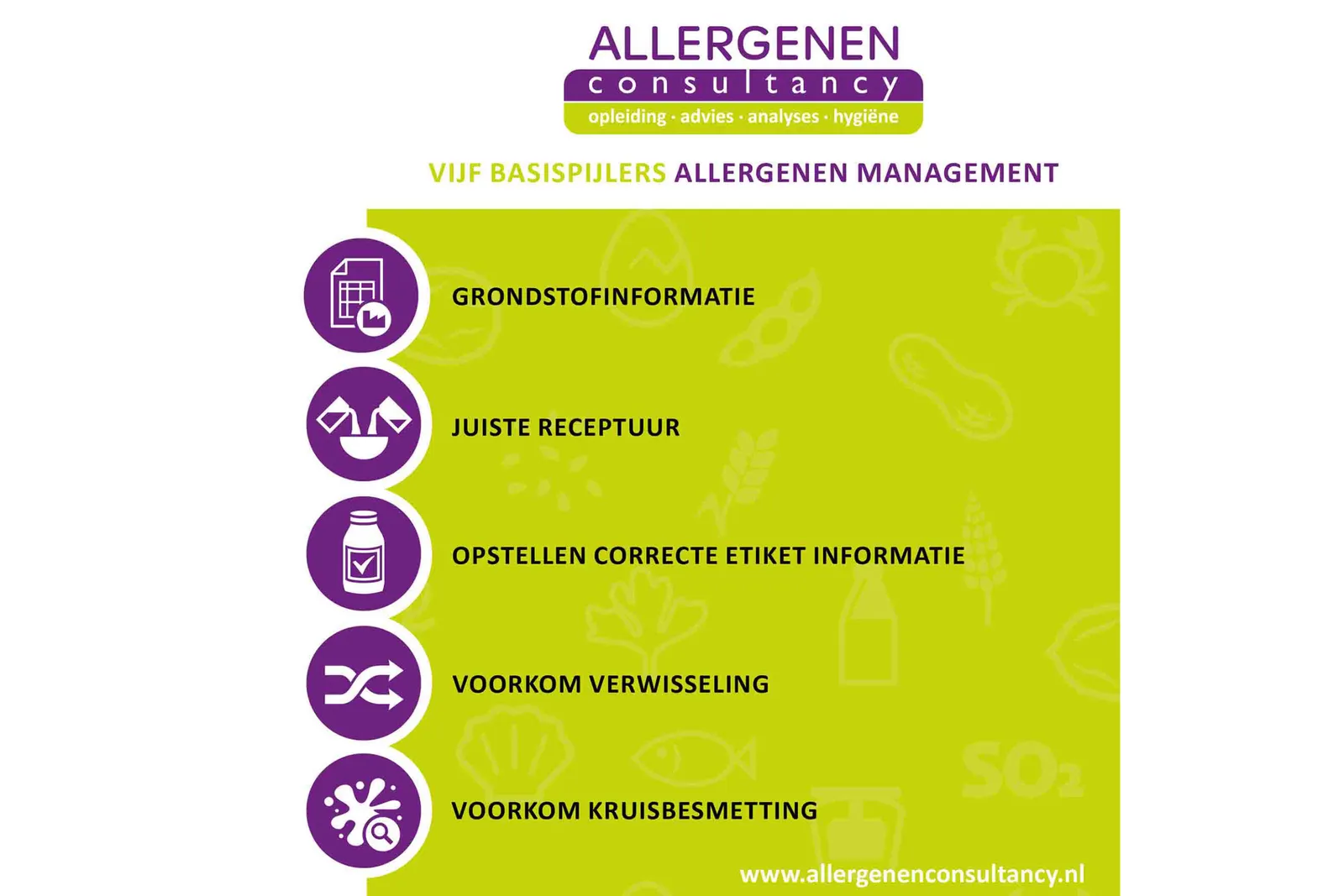
Core pillars of allergen management
A good allergen management plan consists of the following elements:
- Raw material information
- Recipe management
- Label information (based on pillars 1 and 2)
- Preventing mix-ups of raw materials, semi-finished products or labels.
- Preventing cross-contamination (in-house production or in raw materials)
Other food safety schemes, such as FSSC 22000, BRCGS and IFS, differ considerably in their requirements for allergen management. The BRCGS Standard for Food Safety contains the most comprehensive requirements for allergen management. Nevertheless, none of the schemes covers all the core pillars of allergen management. Requirements are often limited to preventing cross-contamination and preparing the label (pillars 5 and 3).
Given the high number of allergen recalls in the Netherlands and other countries, where many businesses are certified to these quality standards, this is not enough to reduce the number of recalls. The other pillars also need attention.
Legislation
The Codex Alimentarius has also recognised that the number of allergen recalls is too high and that allergen management at businesses needs to improve. To address this, in 2020 it published the “Code of Practice on Food Allergen Management for Food Business Operators” (COP). Unfortunately, this does not cover the recipe management pillar, and the issue of mix-ups is also underrepresented in the Codex COP. Nevertheless, this Code of Practice (COP) will help raise the standard of allergen management worldwide.
It is not only a guide for businesses, but also provides a basis for governments to develop legislation. The publication of the Codex COP prompted the European Union to amend the Hygiene Regulation.
Regulation (EC) No 852/2004, also known as the Hygiene Regulation, sets general hygiene requirements for all food businesses. Businesses are divided into the primary sector and other businesses. The primary sector includes agricultural businesses (plant and animal production), fisheries and hunting, as well as transport and storage businesses handling these products. Amendments or proposals have been made both to the text of the Regulation itself and to accompanying guidance documents, making the prevention of cross-contamination with allergens mandatory. Unfortunately, the amendment is very limited. However, it is certainly a step towards improvement and greater awareness, as European legislation had not previously set any explicit requirements for allergen management.
AllergenenScan
Looking to deepen your knowledge of allergen management or gain an immediate overview of areas for improvement in your business? Take the Allergen Management in Practice training course or ask us to carry out an AllergenenScan. The AllergenenScan quickly provides an overview of the status of your allergen management system.
The AllergenenScan can be applied throughout the supply chain, from raw material supplier to finished product.
Thanks to our years of experience and familiarity with common pitfalls in allergen management systems, the AllergenenScan is a quick and efficient way to set up a well-functioning allergen management system. The Scan is also suitable as a supplier audit or for a thorough root cause analysis following allergen recalls.
E-learning for the food industry on allergens (Dutch, English and Polish)
Train production employees to handle allergens correctly. Practical examples explain what this means for their day-to-day work and how to prevent allergens from unintentionally entering products. The e-learning course concludes with a test and certificate.
The e-learning course is suitable for production employees and operators working in the food industry. It is also available in English and Polish.
The course material and test are completed online, via the internet. The e-learning course and test take approximately 30 minutes to complete.
Register for the Allergen Management in Practice training course
Een zakelijke vraag aan Allergenen Consultancy? Get in touch
Companies in this story
Keep following this
Get an email when a new story is published. No account needed.
- ThemeFood safety from design to audit
- SubjectFood safety
- CompanyAllergenen Consultancy







