












Frequently asked questions about cleaning and disinfection in the poultry industry
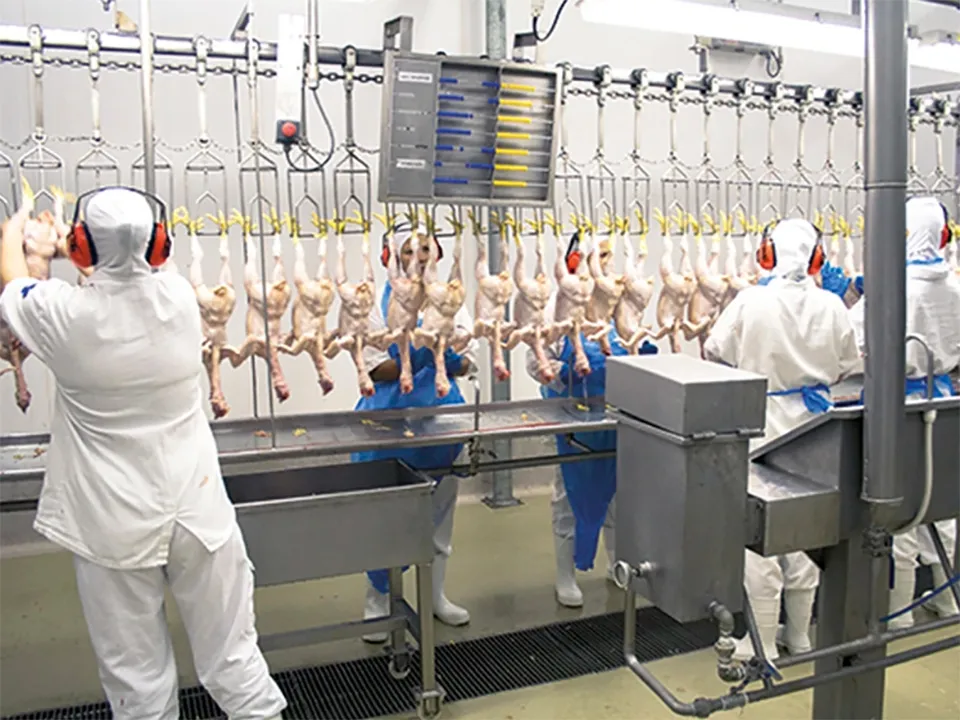
Perfect hygiene is essential in the poultry industry. In particular, poultry slaughterhouses and cutting plants need to implement strategies to combat pathogenic micro-organisms, ensuring that safe chicken meat is produced for consumers. It is also important to minimise the presence of spoilage micro-organisms, which can shorten the shelf life of products.
In this article, we answer the key questions about cleaning and disinfection processes in the poultry industry.
When cleaning and disinfecting areas in a poultry slaughterhouse, is it better to use one disinfectant, or to vary the product depending on the area or CCP?
It is more difficult to develop resistance to disinfectants than to antibiotics. However, it may be advisable to rotate biocidal active substances to prevent certain types of resistance or micro-organisms adapting to residual doses of particular biocides. In areas of the slaughterhouse where there is more contamination, it may be preferable to use biocides with greater residual activity or which are less inhibited by the presence of dirt. In other areas, it is preferable to use disinfectants with low residual activity that are easy to rinse off.
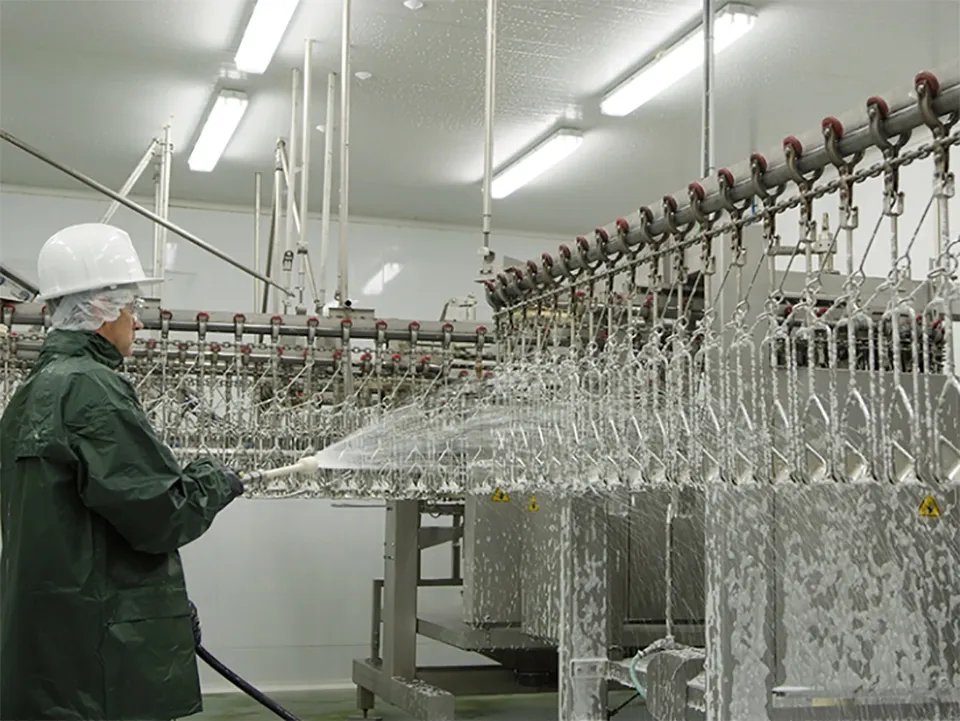
How much drying time should be allowed between cleaning and disinfection?
Drying time depends on the concentration of the disinfectant and the surface. Ideally, no water should remain when the disinfectant is applied, as this would dilute it. On a conveyor belt, for example, almost all the water will have drained away after one complete revolution, so the disinfectant can then be applied.
Is a final rinse recommended after disinfection?
In many areas, a rinse is not necessary, depending on the type of industry and the circumstances. Legislation requires surfaces that come into direct contact with food to be rinsed. Avoid using water on upper sections if lower sections have already been disinfected and rinsed. Water could drip down from above and recontaminate the lower sections. Particular attention should then be paid to drying. Removing moisture prevents the spread of pathogens that have survived the cleaning process.
Do high temperatures enhance or inhibit the effect of disinfectant in the scalding tank?
There are biocidal active substances, such as amines, that do not produce foam and can be used in these conditions. Temperature is a useful way to further optimise the product. A CIP treatment at 80°C with an amine is recommended. For other types of product, such as peracetic acid-based disinfectants, it is not advisable to work at temperatures above 40 or 45°C. The first consideration should be the type of active substance used in the scalding tank. Not all substances are suitable. The type of scalding tank must also be taken into account. Particular attention should be paid to scalding tanks with diffusers underneath, as organic matter often accumulates there. If steam is injected from below, all these particles are released back into the environment. These pipes must be cleaned and disinfected very thoroughly. Note that the plates providing heat usually do not have much build-up. In summary, the most suitable process needs to be determined for each installation.
How can pipes be checked as a source of contamination in businesses such as those in the poultry industry?
They need to be cleaned and disinfected thoroughly, almost as in a CIP process. This involves an alkaline phase, an acid phase and a third disinfection phase. Cameras can also be used to inspect the inside and check for dirt, and the final rinse water can be analysed. Another recommendation is to implement a biofilm management plan.
Cleaning the cutting machine is very difficult because of its design. Doing it mechanically is complex. What alternative mechanical methods are available? Is it possible to use high pressure?
High-pressure water must not be used, to avoid spreading contamination. Thorough scrubbing of equipment and tools that come into contact with the carcass is recommended. It is also advisable to use a degreasing product and warm water. Manual cleaning is recommended very frequently, even if not every day.
Should Listeria spp. be tested for frequently in slaughterhouses and cutting plants?
Yes, regular testing is needed because it provides information about the microbial load of poultry when it arrives at the plant. Analysis results show how well internal hygiene and production protocols are working, and enable any persistence to be detected and prevent Listeria spp. from reaching the next link in the chain.
What are the most common pathogenic micro-organisms in drains?
The most common pathogen found in drains is Listeria spp. Drains are a reservoir for Listeria spp. The first rinse carried out in the area flows into the drain. If the drain is not cleaned properly, using pressurised water for cleaning and disinfection can generate splashes and aerosols, spreading pathogens again.
What is the main factor behind the sustained high prevalence and spread of Campylobacter spp. in poultry?
Regulation 1495/2017 appears to make it clear that vertical transmission is minimal. It is very difficult to detect Campylobacter spp. during the first two weeks of a broiler's life. The problem arises in the third week, because maternal immunity protects the birds at an earlier stage. This immunity disappears in the third week, after which cases of Campylobacter spp. start to emerge. The source may be surfaces that have not been cleaned and disinfected properly, or the environment and vectors. Once Campylobacter spp. enters a farm, it infects the whole flock within four to five days. It spreads through a flock much faster than Salmonella spp., because it is a pathogen that is highly adapted to poultry.
How can Pseudomonas spp. be removed from surfaces and environments?
By following a proper cleaning and disinfection protocol using the right products at the usual concentrations. If it is embedded in a biofilm, an enzyme-based product should be used, followed by a disinfection phase.
Are there any other strategies that should be used to control Salmonella in poultry slaughterhouses?
The presence of Salmonella in poultry carcasses, cut-up products and processed products is a problem affecting the entire production chain. If a positive result is found at the slaughterhouse, the measures that can be taken are limited. Specific cleaning and disinfection strategies can be used, such as biofilm removal products and strict hygiene at every stage (hooks, scalding tanks, pluckers, etc.). This reduces and limits transmission as much as possible, but does not guarantee complete absence. Therefore, the spread of salmonella in live birds and in crates must be prevented as much as possible through biosecurity measures on farms and at hatcheries, as well as in feed production. These include cleaning and disinfection, access control, pest control, preventing vertical transmission, using feed additives, water treatment, and disinfecting crates containing live birds.
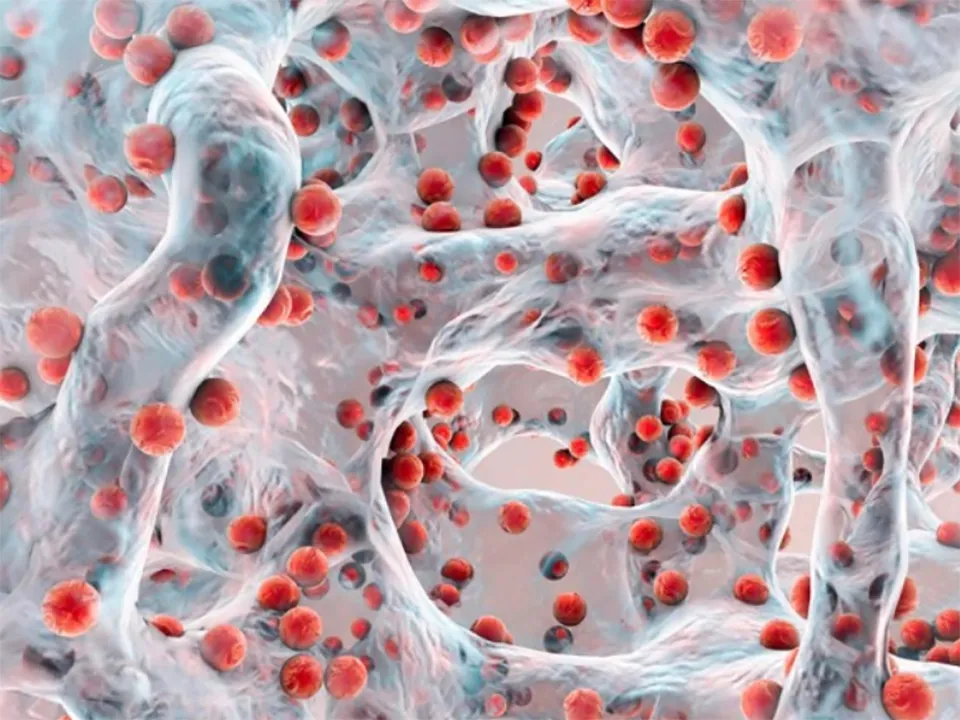
Biofilm removal is part of the disinfection strategy. Which disinfectants are most suitable, taking the surface material into account? Can glutaraldehyde be used?
Biofilms can be removed using various products, including enzymatic or chemical products. In any case, this process is completed with a second disinfection phase, using products based on peracetic acid, quaternary ammonium compounds or glutaraldehyde. These products are all recommended for surface disinfection under the BPR. A three-step process is recommended for safe biofilm removal, including thorough alkaline pre-cleaning and a specific biofilm treatment.
For areas that are difficult to clean, a biofilm detection test using the product TBF 300 is recommended. Chlorine is used on plastics as a bleach. It is not recommended for any other surfaces because of its oxidising effect.
Can natural compounds and terpenoids be an effective alternative or addition to synthetic disinfectants for reducing and removing biofilms?
Research shows that natural compounds exist that inhibit biofilm formation, such as terpenoids, polyphenols, organic acids and essential oils. However, once a biofilm is mature, mechanical energy is needed to break up the matrix, along with suitable products to remove the biofilm.
Can communication between bacteria in a biofilm be blocked?
Yes, some publications acknowledge that certain molecules, which are antagonistic to the autoinducers bacteria use in quorum sensing, can neutralise this form of communication. If we inhibit quorum sensing, we disrupt communication between bacteria and also inhibit biofilm formation. The difficulty is that quorum sensing differs depending on the bacteria inhabiting the biofilm. This requires knowledge of the type of biofilm, the type of autoinducers and the type of molecules that can act as antagonists to disrupt this communication.
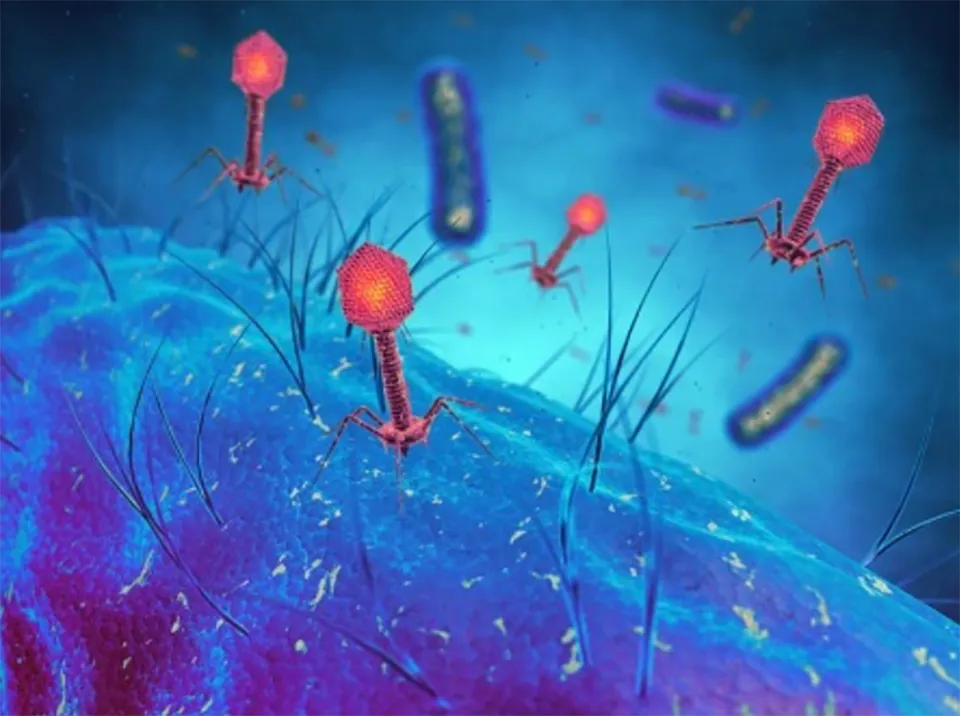
What is the role of bacteriophages and probiotics in disinfecting livestock farms?
Bacteriophages are highly specific. A mixture of these phages would need to be used to achieve the desired effect, and a phage sensitivity test should first be carried out to establish whether the bacterium is susceptible to the phage. However, bacteriophages cannot be used repeatedly, to prevent bacteria from becoming resistant to that specific phage. It is true that using phages can lead to resistance or to the emergence of traits that the bacterium did not previously have. Their use should be considered a last line of defence, after other methods. We should try to tackle these problems using other means, such as biosecurity, cleaning, disinfection and applying additives to animals so that they do not carry diseases.
As for the use of lactic acid bacteria, there are indeed some products based on this type of micro-organism that are used for disinfection. Probiotics are applied to surfaces to colonise them and bring about competitive exclusion. They colonise the entire environment and displace pathogens present there. Disinfection must be carried out first, followed by colonisation with the desired micro-organisms.
What relevant information can we obtain from metagenomic analysis in the poultry industry?
Metagenomics is a tool that will replace traditional microbiology in the near future: it is the microbiology of the future. The information it provides is very broad, but it is important to understand how to interpret it properly. The main advantage of metagenomics is that it can detect all the bacterial species present in an environmental sample.
Disinfecting chicken carcasses with disinfectants is not permitted in the EU, but can chlorine dioxide be used during chilling and pre-chilling?
In the EU, ClO2 can be used at the dosage required to make water potable. It is prohibited at concentrations above the legally permitted level.
How important is the training of R&D staff and food handlers?
Training R&D staff is of fundamental importance. They need to know how important their work is to the quality of the final product, and they must be familiar with the products and protocols. It is also important to inform them about critical points in the plant where biofilms can form and provide a breeding ground for Listeria. These areas need to be scrubbed by hand every day, in addition to following specific protocols.
Food handlers, for their part, must be aware of their influence on the prevention of cross-contamination and of the importance of personal hygiene. A number of foodborne toxins are often attributable to people, such as infections caused by Staphylococcus Aureus.
How important is environmental disinfection?
Rather than environmental disinfection, we should talk about surface and air disinfection. The number of microorganisms in the air in a room will decrease through sedimentation if the room remains closed for some time. An important aspect of this type of disinfection is reaching parts of the plant that are not usually disinfected by traditional spraying systems: hidden areas and elevated equipment (e.g. evaporators). These areas can harbour niches for pathogenic microorganisms and biofilms, which can then reach equipment in direct contact with food or the products themselves via condensation, air currents, etc.
For this type of disinfection, foggers can be used with biocides formulated with quaternary ammonium compounds, tertiary amines, hydrogen peroxide, glutaraldehyde, etc. Where an increase in humidity is undesirable, for example in feed silos and packaging rooms, products containing active substances such as glycolic acid can be used. These are metered cans designed for specific volumes.
Een zakelijke vraag aan Christeyns NV? Get in touch
Companies in this story
Keep following this
Get an email when a new story is published. No account needed.
- ThemeFood safety from design to audit
- SubjectFood safety
- CompanyChristeyns NV







