












Heat treatments eliminate stored-product insects non-toxically
Text Valérie CouplezImage Rentokil
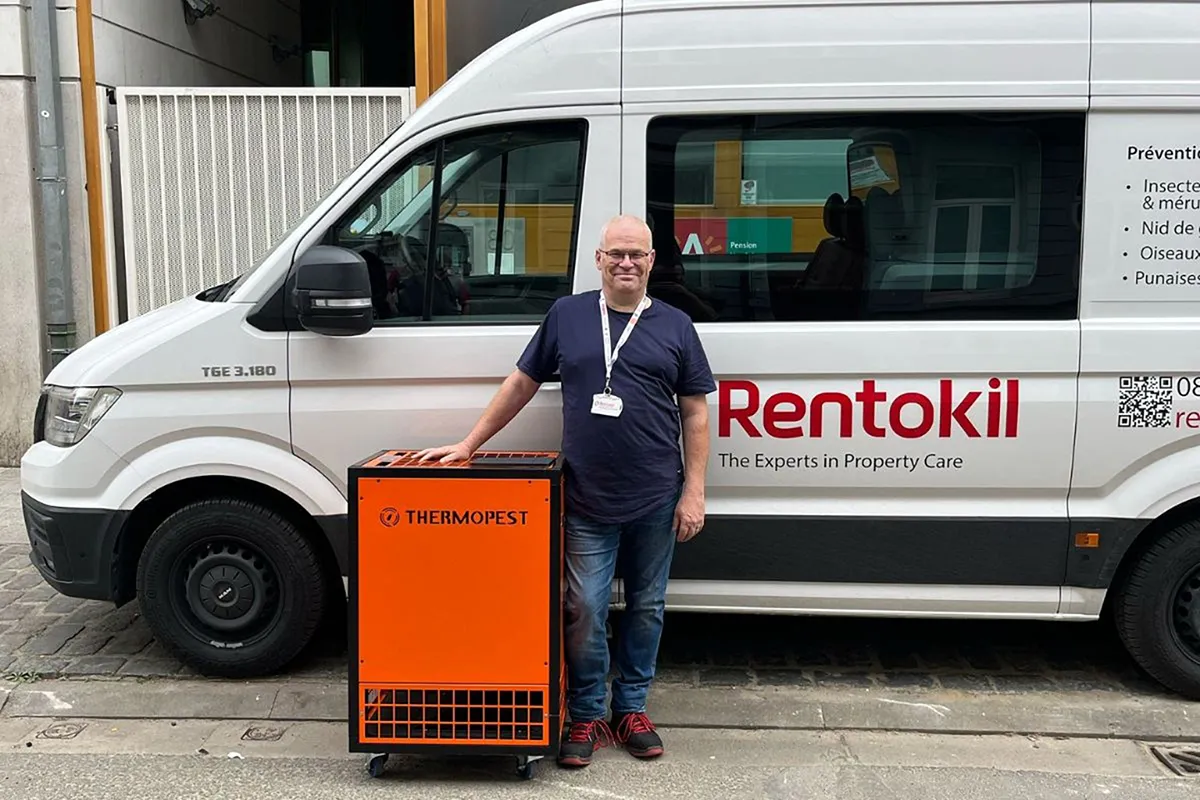
Rentokil is celebrating its 100th anniversary this year. That means customers benefit from a century of pest control experience, which the company also draws on to keep innovating. A fine example is the Heat heat treatment, which it has recently started using in the food industry to tackle stored-product insects.
When people think of pests, they may immediately think of rats and mice. But insects are the biggest pest problem for food companies. “We often see them appearing where raw materials or finished food products are stored. For food safety reasons, anything they touch has to be discarded. In a sector such as the food industry, where margins are already tight, these losses quickly add up,” says marketing coordinator Jules Bossier.
Pest control starts with prevention
At Rentokil, pest control starts with prevention. Bossier says: “What doesn’t get in doesn’t need treating. So our first step is to advise customers on how they can prevent this. Thorough checks of incoming raw materials, for example, are already an important weapon in this fight. If pests do get in, we of course help our customers both with the pest control itself and with cleaning up the residues. However, this is no easy task in hard-to-reach places, for example behind machinery.”
Minimising risks, maximising efficiency
Drawing on its extensive experience across a range of sectors, Rentokil is introducing a new approach for food companies that addresses this very challenge. “The Heat treatment heats the entire space to 56 °C for a specified period. At this temperature, not only adult insects but also the other life stages are killed,” explains Michel Leers, heat treatment expert at Rentokil Initial. “It is also a non-toxic treatment, which we believe is the future of pest control, particularly in the food industry. One food-industry customer put it this way: with Heat, we minimise risks and maximise efficiency.”
Thorough preparation for a plug-and-play solution
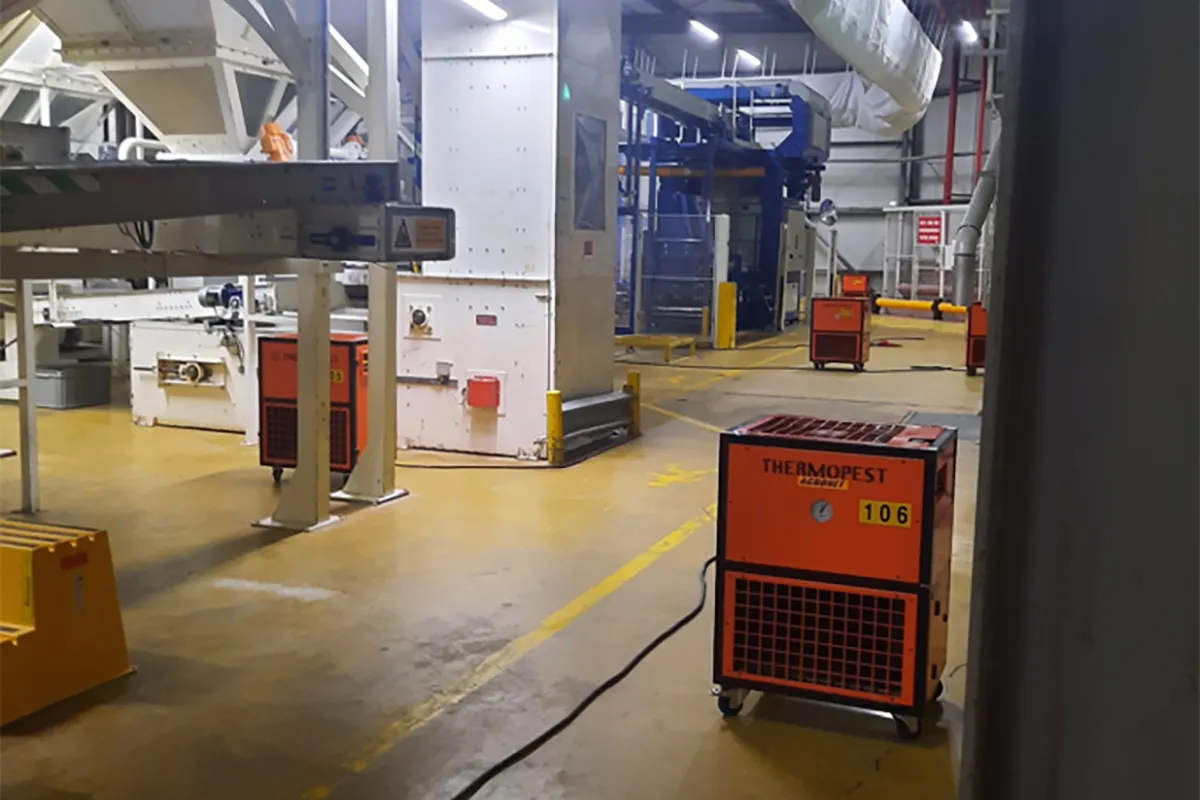
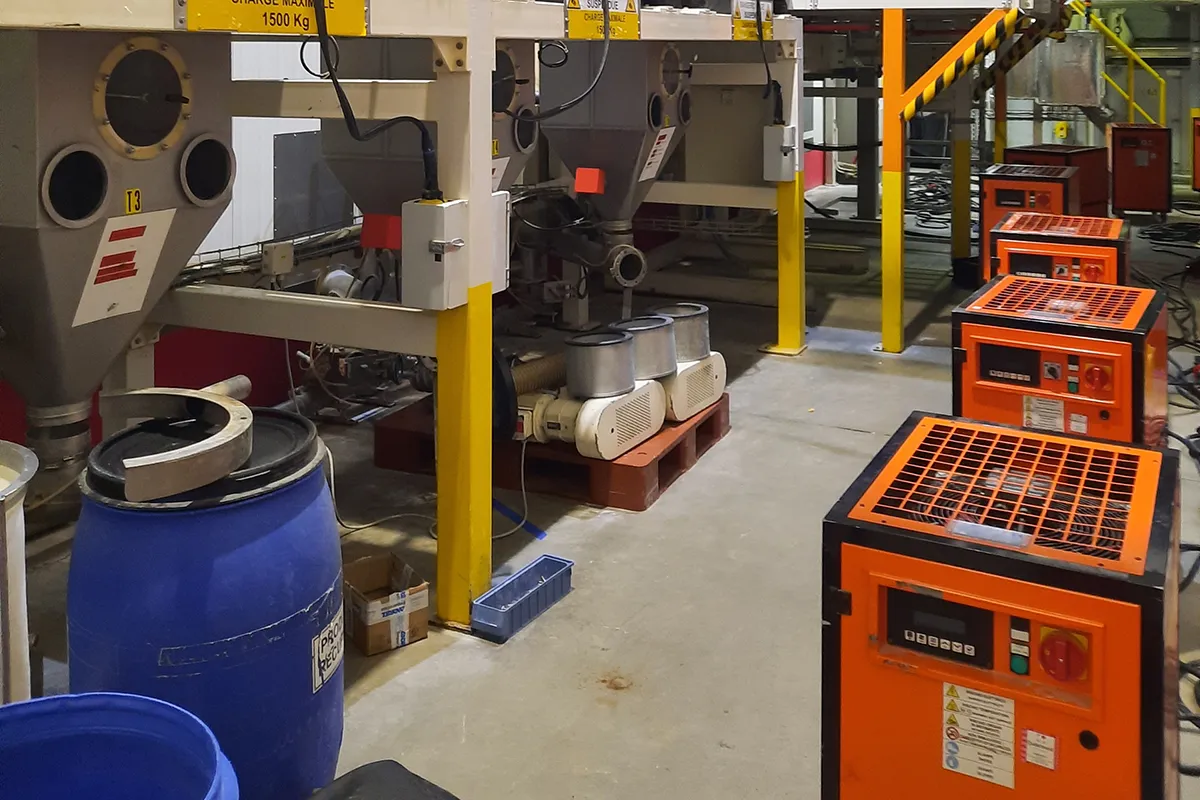
To carry out this treatment, Rentokil invested in specialist heat cannons. “We calculate exactly how many are needed, depending on the space. Stainless steel is a popular material in the food industry, which also works in favour of our Heat solution. It conducts heat well,” Leers explains. As with anything, the secret lies in good preparation. “That’s where our experts’ experience comes in. You need to ensure the heat is high enough in the places where the risk of infestation is greatest. We map all of this out in advance. We can then direct the heat even more effectively by adding fans. We monitor the process using temperature sensors, so we can keep the temperature very constant.”
Bringing insect numbers down to zero
They also check in advance that there is sufficient power for all the equipment. Leers says: “We need a 400 V connection for each heater. If one is not available, we can bring control cabinets connected to mobile generators to supply the power. Above all, we want to take the burden off our customers. All they need to do is shut down production and empty the silos. Then we take over.” How long the equipment needs to run depends on the infestation. It can be up to 24 hours. But the results speak for themselves. After the Heat treatment, insect numbers will have been reduced to zero. “With conventional insecticides, you have to expect 80 to 90% of the total population to survive treatment, because eggs, larvae and pupae are so difficult to kill.”
Fewer treatments needed
This efficiency is what makes the technique appealing to companies of every size. “The investment is higher than for established methods, but because we remove all, or at least almost all, of the insect life stages, the interval between treatments can be extended considerably. So you need to look at the whole picture, both in terms of results and savings.” Leers gives the example of a food company that now only needs a visit once a year. “The fewer treatments there are, the less production downtime,” he adds. Another customer switched entirely to Heat because it delivers results and they do not want insecticides in their production. “Our heat treatment tackles the root cause of stored-product insect problems,” he concludes confidently.
100 years of Rentokil
Rentokil’s roots lie in Great Britain. Rent to kill? Not at all. When the name was chosen, it had everything to do with insects and the Greek word ‘entomon’ (insect), to which it refers. It was the name that founder Professor Maxwell-Lefroy had given to his treatment for killing wood-boring beetles. Knowledge has remained a constant thread throughout the company’s 100-year history. In ’92, it launched its first wireless mouse-trapping solution. It also proved itself a pioneer with its Lumnia insect traps based on LED lighting. It continues to maintain that innovative spirit today. Rentokil is increasingly opting for non-toxic treatments.
Een zakelijke vraag aan Rentokil? Get in touch
Companies in this story

Keep following this
Get an email when a new story is published. No account needed.
- ThemeFood safety from design to audit
- SubjectFood safety
- CompanyRentokil







