












Pest control: digital and sustainable
Text Valérie CouplezImage Rentokil
Becoming and remaining the world’s largest pest control company takes more than luck. Rentokil draws on its knowledge and experience in every region to keep developing new products and services. With just one goal in mind: protecting people and the environment in a sustainable way. A conversation with Rentokil Pest Control België Managing Director Giuseppe Bica and Commercial Manager Peggy De Clercq about the main trends in pest control.
Let’s start with the figures. In Belgium, Rentokil Pest Control has three offices and 300 employees. Each year, they carry out more than 150,000 interventions for around 18,000 customers. It is no surprise that the key themes in pest control today, digitalisation and sustainability, are the same ones facing food businesses. “That’s because we work closely with our customers,” says Bica. “To devise the right solutions, you need to understand the entire value chain and your customers’ needs. You need to know the hazards and risks to help them. Pest control still depends on expertise, but we use technology to support us as effectively as possible. And, to prepare for future regulations, we favour an approach that is as sustainable as possible for people and animals. For example, we no longer use fumigation in Belgium. We offer customers alternative solutions, including heat treatments.”

A global presence is a source of knowledge
The value chain is, after all, a global concern. “On the one hand, we have customers operating on several continents. They need a consistent approach across all their sites, while complying with local legislation and meeting the highest quality standards. On the other hand, we can learn a great deal from other countries. That makes our global presence a real asset. Until recently, for example, mosquitoes posed little threat to food safety here in Belgium. Climate change has made them a threat now. But we have already learned how other regions deal with them, enabling us to provide our customers with effective solutions straight away. Sharing knowledge and experience in this way is what really sets us apart.”
A 360° approach to continuous improvement
Rentokil’s consistent approach follows a four-step methodology: exclude, restrict, destruct, monitoring. “It all starts with mapping the risks at a production site,” explains De Clercq. “Based on that analysis, we make recommendations to the customer, for example on hygiene, cleaning, or making the environment unsuitable for pests to develop.
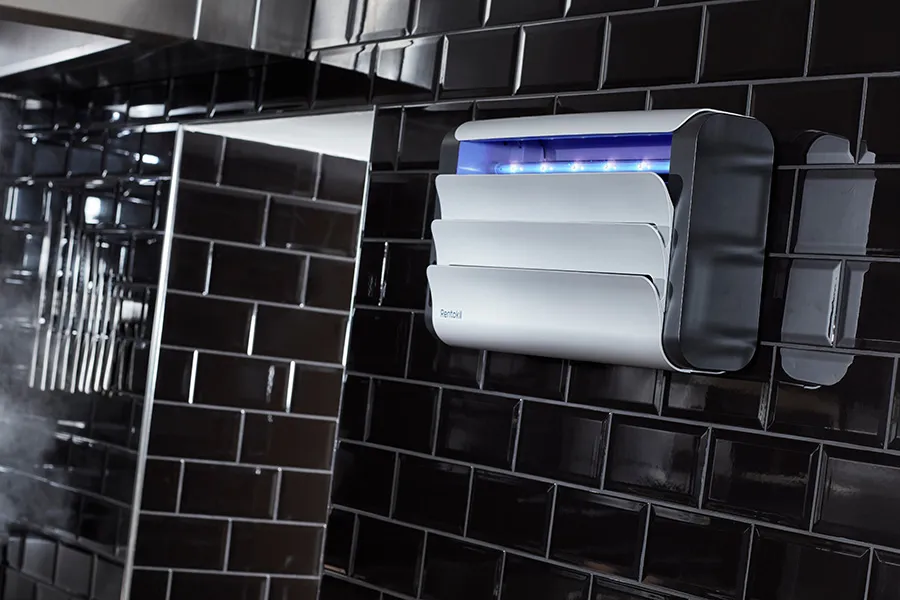
We also discuss ways to limit pest movement and reproduction. We then take the appropriate measures to prevent pests from entering the production area, using our own range of exclusion solutions. That doesn’t just mean filling in holes. We use ‘pest-proof’ products developed using our own expertise.” The final stages of pest control are to restrict pest movement as much as possible, for example by using lamps (with energy-efficient LED technology) and traps (made from 100% recycled material), and then to remove the pests. De Clercq calls this a 360° approach, an integrated pest management approach, because we work with the customer from the very start of the process. “These steps are repeated time and again to keep improving quality and food safety. Monitoring is tailored to the customer’s needs, from annually to 24/7.”
Connected devices for greater efficiency
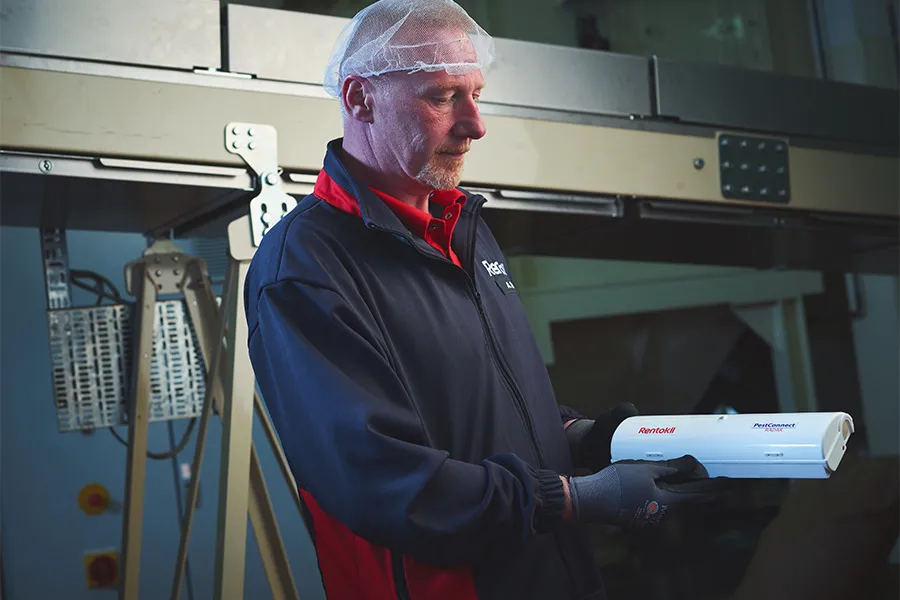
Rentokil technicians do not have to fight pests alone. They are equipped with a range of digital tools. “Our connected devices send an alert when a technician needs to take action. If a mouse is caught in a trap, he receives an alert to go to the site. This is already available for rodents, and next year we will extend it to flying insects. It’s a way to significantly boost efficiency,” says De Clercq. The technician can then use the visit to assess the situation: where did the mouse come from? How can we reduce the risks? … “This means our customers can respond quickly too. Is there a problem with incoming raw materials, for example? Or has an employee left a door open? Our connected devices give customers 24/7 non-toxic monitoring, meaning weekly or monthly checks will no longer be needed in the future. We really engage with our customers to develop an effective approach. That’s the 360° approach,” promises Bica.
Everything together in MyRentokil
Digitalisation brings all this information together for customers on the MyRentokil portal. De Clercq says: “Reporting is important in the food industry. Customers can easily track all interventions and recommendations there in real time. The data can also be used to identify lessons. We carry out trend analyses so customers can see the value of our partnership. They also have everything to hand for an audit, including technical data sheets, certificates and recommendations. The customer portal also provides a direct link to audit reports.”
Your pest control partner is an essential part of your HACCP compliance and can play an active role in inspecting, auditing, identifying and preventing potential situations that could cause damage, contamination or illness. By choosing an integrated digital approach centred on inspection, recommendations, pest exclusion and continuous monitoring, food processing businesses will also be able to work more flexibly. ■
Een zakelijke vraag aan Rentokil? Get in touch
Companies in this story
Keep following this
Get an email when a new story is published. No account needed.
- ThemeFood safety from design to audit
- SubjectFood safety
- CompanyRentokil







