












Supplementary module for self-checking guides
Text Valérie Couplez
Control of environmental pathogens in the food industry
The FAVV has drawn up a supplementary module for the control of environmental pathogens in collaboration with Fevia and Ugent. From March, it will be included in audits for the self-checking guide. The module is based on two pillars: preventive measures through good hygiene and production practices, and effective environmental monitoring to verify that these practices are being followed. This article summarises the key points of environmental monitoring.
The new module focuses on pathogenic micro-organisms, with salmonella and listeria the most common across the various sectors and food production activities. However, other pathogens may of course be relevant to specific sectors and processes. Examples include E.coli in beef or raw-milk cheese, and campylobacter in the poultry sector. They occur as ‘transient’ or ‘resident’ strains. The module describes
transient strains as pathogens found only once in the production environment. Standard cleaning and disinfection procedures are sufficient to remove them. Persistent or ‘resident’ strains are strains of environmental pathogens that establish themselves in niches in the production environment and are found there over a long period (across multiple sampling occasions). This is because standard cleaning and disinfection procedures do not fully inactivate them. They survive on surfaces and materials for several months or years, potentially leading to cross-contamination of food and, consequently, repeated foodborne outbreaks involving the same molecular type.
- Risk assessment of the sector and activities
With environmental monitoring now mandatory, food businesses must be able to detect environmental contamination by pathogens. The FAVV identifies ten steps in drawing up and following up an environmental monitoring plan. It all starts with a risk assessment (first at sector level, then at business level) to estimate the likelihood of environmental contamination across all activities carried out by the business.
- Zoning the business
This results in a clear floor plan assigning all areas to a risk zone: basic, low-risk, high-risk or product-free. It goes without saying that areas in high-hygiene zones present a higher-risk situation.
- Target environmental pathogens
The food business makes a well-considered and demonstrable decision about which environmental pathogens are relevant for inclusion in its environmental monitoring, based on the type of activities and products.
- Defining and classifying sampling locations
On this basis, the food business defines sampling locations for each zone. These are classified by surface type. Type 1 covers food contact surfaces that come into direct contact with (unpackaged) food. Type 2 consists of indirect contact surfaces close to (unpackaged) food. The third surface type comprises surfaces further away from products but still within production areas. Type 4, finally, is found only in the lowest-risk areas: just outside the production environment and primarily in product-free zones. These types are further categorised as persistent growth niches (hard-to-reach places) and/or transfer points (wheeled equipment, door handles or gloves).
- Setting the frequency
The business has made a well-considered and demonstrable decision on the frequency of environmental sampling, the distribution of the number of samples (by type and zone) within each sampling round, and the rotation of sampling locations. Businesses already carrying out environmental sampling can take historical data into account to reduce the number of certain zones, types of sampling locations and/or sampling frequencies. For very small businesses (up to a maximum of ten employees), the recommendation is to maintain a monthly frequency but reduce the number of sampling locations to 25%. The guide also provides examples of how food businesses can implement this.
- Sampling time
Pathogens can be difficult to detect immediately after or shortly after cleaning and disinfection. The module therefore recommends combining sampling times: just before production starts and after at least two to three hours of production, or at the end of production.
- Surface sampling
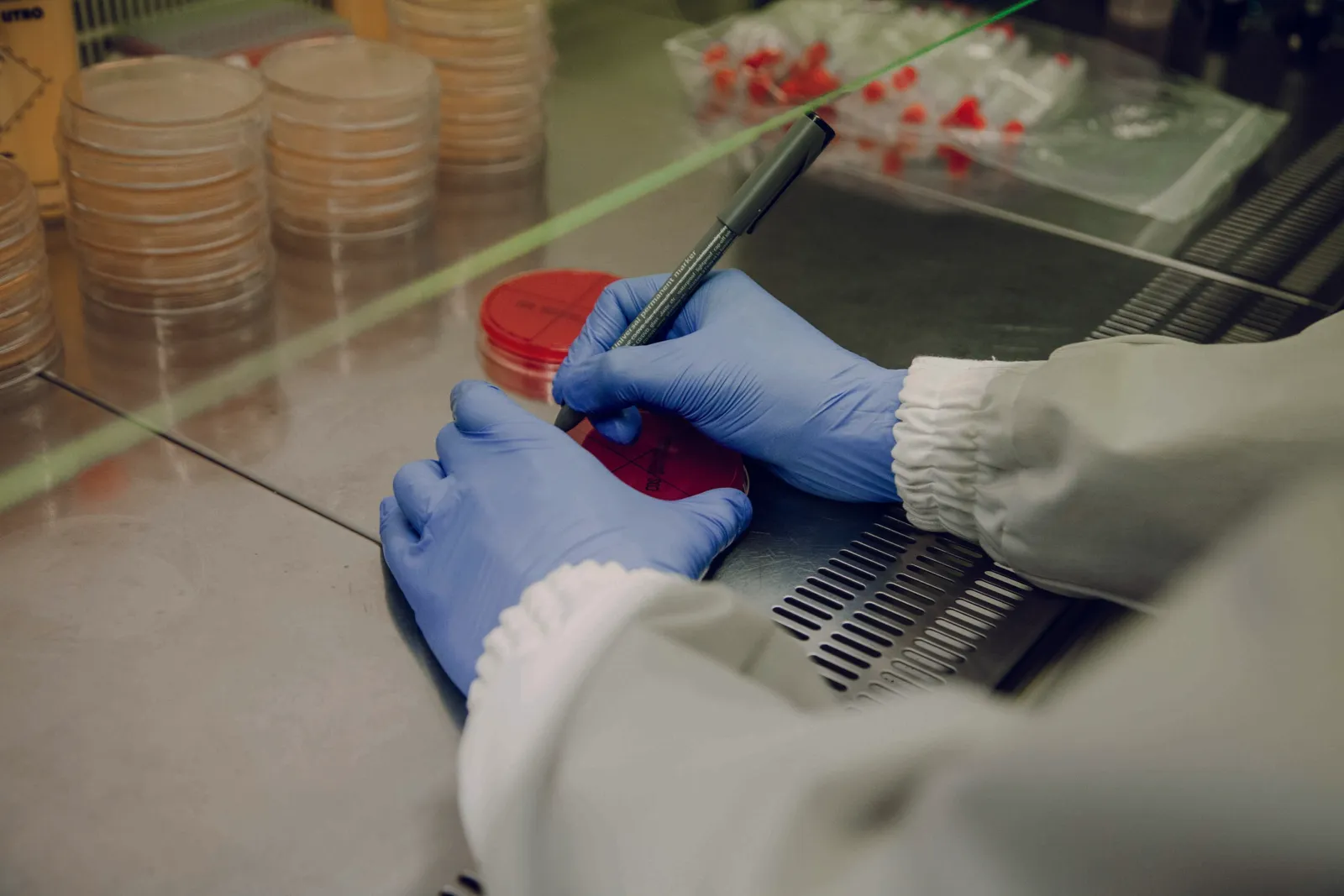
Surface sampling is carried out in accordance with standard protocols. Instructions are provided on how to do this and which materials to use.
- Sample analysis
Analysis can be carried out in the company’s own laboratory or outsourced. The analysis protocol used will depend on the target pathogen. Although it is not mandatory, the FAVV recommends that analyses be carried out by an accredited laboratory.
- Trend analysis
The results of the analyses can be used to build a database and develop historical knowledge. Monitoring trends can help the business learn when its production environment may be more susceptible to contamination by pathogens.
- Corrective actions
The business has developed an action plan for cases where an environmental sample is found to be non-compliant due to the presence of a pathogen. These actions are carried out systematically and documented in a demonstrable way. The module also notes that when environmental samples are found to be positive for pathogens such as salmonella and listeria more frequently, it may be useful to genetically characterise these strains.
Question about this story? Ask your question
Keep following this
Get an email when a new story is published. No account needed.
- ThemeFood safety from design to audit
- SubjectFood safety







