AM for Precision showcase highlights 3D metal printing as part of precision engineering
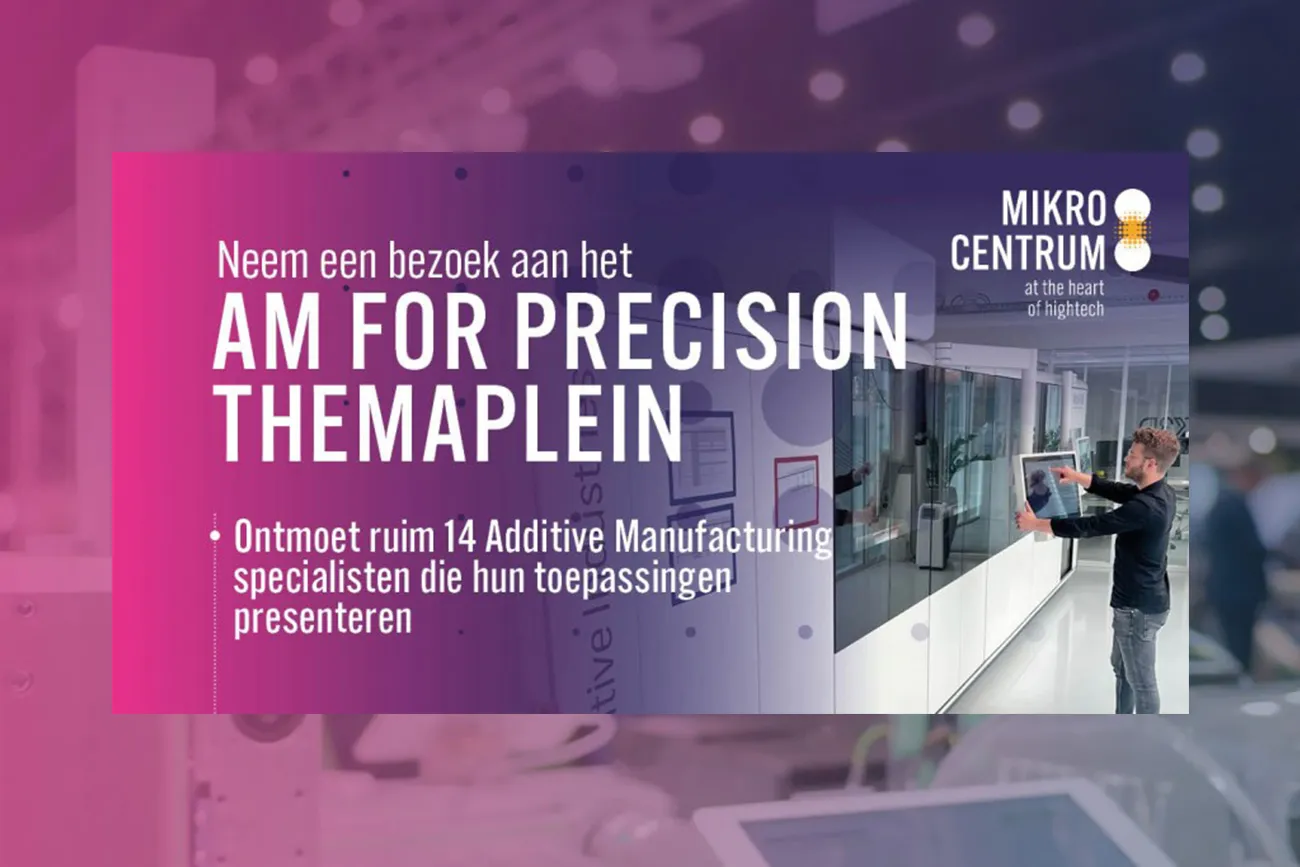
For several years, Tier 1 suppliers to the semiconductor industry have been building up production capacity for additive manufacturing. Has additive manufacturing finally taken hold in high-tech manufacturing? The AM for Precision showcase at the 22nd edition of the Precisiebeurs shows where suppliers stand and what is technically possible.
John Hagelaars of De Valk Additive (the name adopted by Machinefabriek De Valk after its acquisition by Anvil Group) is one of the pioneers of the Dutch AM industry. He entered the field ten years ago with high expectations. Now he is working on the first concrete orders for serial production of metal components using 3D printing. “It’s starting to filter through to high-tech companies,” he says. “But their rationale for additive manufacturing has changed.”
Capacity shortages
In recent years, precision machining companies working with 3D metal printing have mainly tried to make the business case by highlighting the typical advantages of additive manufacturing. For example, better positioning of cooling channels, or weight reduction through topology optimisation. Components with often organically shaped, complex geometries could be seen at the Precisiebeurs (15 and 16 November, Den Bosch) every year. In 2023, the main driver appears to be a lack of capacity in the supply chain. “Ten years ago, the term was freedom of design when it came to 3D metal printing. The more difficult the part, the easier it was to print,” says Henk Jansen, director of FMI Additive.
Ten years ago, the term was freedom of design when it came to 3D metal printing. The more difficult the part, the easier it was to print, says Henk Jansen, director of FMI Additive
The world has come to its senses, he observes. “The added value people now see in 3D metal printing is that assemblies can be made more easily, in fewer process steps. And as long as we’re talking about critical parts, we’re competitive on price.” FMI Additive aims to develop a second market for critical titanium components for the semiconductor industry, alongside medical implants, for which serial production is already under way.
“We have already started production for some system suppliers, often of manifold-like, thin-walled products. For ASML, we are completing qualification and validation.” These are, for example, components originally made by milling, with internal cooling channels, which are then joined by laser welding. Laser welding is a specialist process. Not every supplier has this technology in-house, so parts have to be transported, leak-tested after laser welding and then returned to the supplier for mechanical finishing. When you add up all these steps, 3D printing the part in one go and then machining it in the same company saves a great deal of lead time.
This has opened the eyes of high-tech OEMs to additive manufacturing. John Hagelaars says: “Direct costs are no longer the top priority. It’s about making the process more cost-effective. That’s not just about making swarf, but also about logistics, footprint, the circular economy and so on. We can supply parts now that there are capacity shortages in the supply chain.”
Sometimes up to 80% precision engineering is required
AM is not simply a matter of printing a part, tying a bow around it and sending it to the customer. The suppliers currently succeeding with additive manufacturing offer a complete solution, including mechanical finishing to achieve dimensional tolerances of a few microns and surface roughness values well below 1 micron Ra.
Sometimes you need up to 80% precision engineering: you need to understand conventional turning and milling, says John Hagelaars
“After printing, you run into the issues that come up with every order,” says John Hagelaars bluntly. Additive manufacturing is just one step in the overall process. Both FMI Additive and De Valk Additive are suppliers that deliver the entire process, carrying out most steps in-house or at one of their sister companies. “Printing alone is nothing. You need to talk to a milling specialist to make it work,” says John Hagelaars.
“Sometimes you need up to 80% precision engineering; you need to understand conventional turning and milling.” One example is cleaning: De Valk Additive meets ASML’s Grade 2 requirements, something OEMs thought impossible a few years ago. That is why he believes the AM for Precision showcase is a good fit for the Precisiebeurs. “Much better than a standalone AM event.”
Quality assurance throughout the process
Quality control is a crucial step in this process and a cost factor that cannot be overlooked. FMI Additive has built up considerable experience in this area over the past ten years through 3D printing titanium implants for large medical companies. Henk Jansen believes that the quality procedures used in the medical and semiconductor industries are not very different. In the medtech industry, FMI Additive has to demonstrate that both the first and the five-thousandth implant are safe, strong and clean.
You also have to demonstrate that powder handling, machine cleaning, powder sieving and so on are carried out according to a single, fixed procedure, says Henk Jansen
Process validation means you do not have to inspect every component individually. The same applies to printing tensile test bars and test coupons to prove that if product 1 is good, they all are, without having to CT-scan every product. Henk Jansen says: “There are differences in emphasis compared with the semiconductor industry, but in principle the processes for critical high-tech parts are approached in the same way. This validation goes beyond the printing itself. You also have to demonstrate that powder handling, machine cleaning, powder sieving and so on are carried out according to a single, fixed procedure.”
The supplier’s added value
As one of the AM technology suppliers on the AM for Precision showcase at the Precisiebeurs, Renishaw offers software designed to ensure that build jobs developed by an OEM’s engineers are printed exactly as intended by a supplier. It is an end-to-end solution for critical parts. Philippe Reinders Folmer, director of Renishaw Benelux, says: “All the parameters are in the file. The operator cannot change anything. The only factors that have an influence are things such as gas flow, cleaning and powder handling.”
It is about replicating parts, even far from home, while ensuring that quality is adequately assured, says Philippe Reinders Folmer, director of Renishaw Benelux
Renishaw aims to minimise the operator’s influence on the final quality and ensure consistent results. Does that make the proposition less attractive to suppliers? What value can they still add? Philippe Reinders Folmer says: “The supplier’s added value lies in finishing the parts, inspection and delivering them ultra-clean. Not in the printing process itself. There should be as few variables as possible in that.”
Rein van der Mast points out that the same thinking is prevalent in the Ministry of Defence, which is looking at the potential of additive manufacturing. “It is about replicating parts, even far from home, while ensuring that quality is adequately assured.”
Support from IAMM
Both suppliers have a long track record in additive manufacturing. “We knew there would be a valley of disillusionment, but we didn’t expect it to be so long and so deep. Now things are starting to fall into place,” says John Hagelaars. It has been a valuable learning process. The entire AM process, including everything that goes with it, is difficult, adds Henk Jansen.
Ultimately, the market needs to drive additive manufacturing, rather than a handful of inventors continuing to push it. That means looking beyond the technology to the entire value chain, says Rein van der Mast (Fontys Hogescholen), founder of IAMM
To support the Dutch metal industry in adopting additive manufacturing, several universities of applied sciences (Fontys, Windesheim and Saxion) have pooled their expertise in a long-term collaboration: Industrieel AM in Metalen (IAMM). Universities (Delft, Enschede), technology companies and other organisations are also involved. At the Precisiebeurs in Den Bosch (15 and 16 November), the project team will have a helpdesk where visitors can get answers to their questions.
Together with their partners, the universities of applied sciences aim to help industry recognise and seize the opportunities. Rein van der Mast (Fontys Hogescholen), founder of IAMM, says: “Ultimately, the market needs to drive additive manufacturing, rather than a handful of inventors continuing to push it. That means looking beyond the technology to the entire value chain.
After all, value chains are connected to the market, not to engineers.” The IAMM helpdesk offers easy access to expertise, training, test facilities and more. For metal printing, the partners have several technologies in addition to the familiar laser powder bed fusion process. These include Meltio’s DED technology and cold spray, relatively unfamiliar techniques that are nevertheless a good fit for machining companies.
What is needed?
Are these and other new technologies needed to help AM gain wider acceptance? John Hagelaars believes there needs to be a better link between additive and subtractive processes, for example through zero-point clamping systems, so that parts can be transferred directly from the metal printer to a 5-axis machining centre.
Henk Jansen expects other printing technologies to gain wider acceptance. These include Electron Beam Melting, the Arcam technology FMI Additive uses in Tilburg to print large batches of implants.
Some manufacturers are working on this. “But they are still very much two separate worlds, and there is plenty of room for improvement.” Henk Jansen expects other printing technologies to be more widely accepted as the market matures. One example is Electron Beam Melting, the Arcam technology FMI Additive uses in Tilburg to print large batches of implants. In the precision industry, Laser Powderbed Fusion dominates. “Yet electron beam has the advantage that we print in a vacuum at high temperatures, so we build up almost no stresses. And we can print without supports.”
However, unfamiliarity breeds indifference. Rein van der Mast sees potential in the digital twin for better predicting the outcome of the printing process in advance and anticipating deviations in good time. One of the students completing a graduation project investigated the reliability of Siemens NX predictions for powder bed printing. “The software’s predictions are fairly accurate. This matters because more iterations can then take place in the virtual, digital domain, saving time and money.”
Will the AM market now grow?
Will the Dutch AM market finally start to grow? John Hagelaars expects AM to remain a niche technology for another five years or so. He sees little sign of activity in other high-tech sectors beyond the semiconductor industry. The IAMM desk could help change that. A real breakthrough will come from engineers, when they start designing specifically around the possibilities offered by 3D printing. That is still in its infancy. Henk Jansen expects adoption to remain gradual, as is the case with every new technology. “When wire EDM first came onto the market, engineers had to learn that they could use it to cut shapes out of metal. That was the start of the wire EDM revolution. We are now seeing the same thing beginning to happen with AM.”
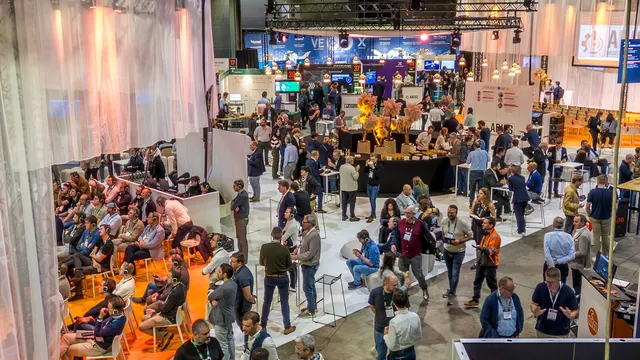
The AM for Precision showcase at Precisiebeurs features 14 exhibitors, as well as a meeting area where visitors can discuss business with these participants in a relaxed setting. Precisiebeurs takes place on 15 and 16 November at Brabanthallen in ’s Hertogenbosch. The trade fair is free to attend on both days. Register here.
Question about this story? Ask your question
Companies in this story
Keep following this
Get an email when a new story is published. No account needed.
- SubjectEvents
- CompanySiemens