












Bacharach ethylene monitoring for critical fruit and vegetable ripening
As fruit and vegetables begin to ripen, they release a naturally occurring gas that enables and promotes further ripening. That gas is ethylene.
Producers can control the ripening process by measuring when fruit is ready to ripen. When fruit and vegetables begin to ripen, naturally occurring ethylene reaches a concentration of 1000 ppb (parts per billion). Once the process has started, producers can inject additional ethylene into ripening rooms to speed up and control the process, bringing fruit and vegetables to market sooner.
Ripening rooms are typically conditioned spaces where fruit and vegetables are kept at controlled humidity (80-90%) and temperature, with a constant ethylene concentration, usually around 150-200 ppm (parts per million).
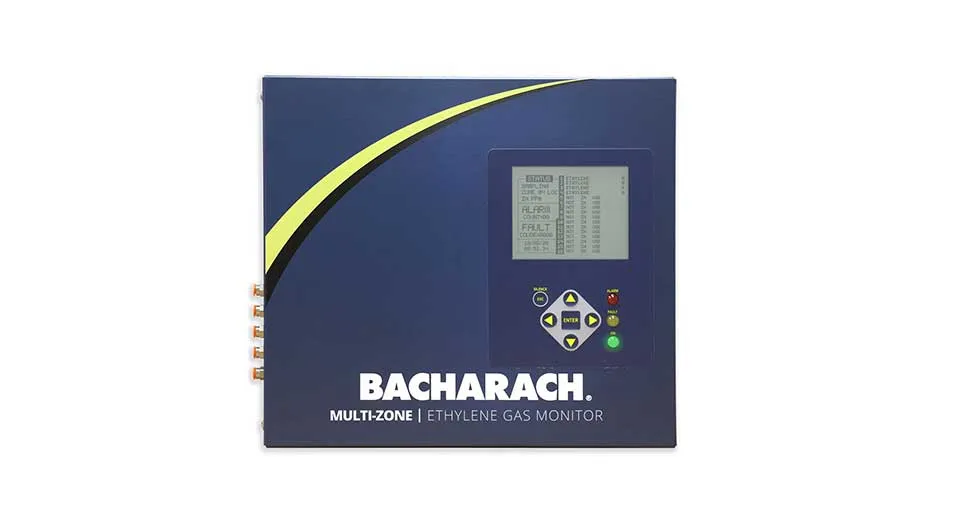
An ethylene gas monitor that can withstand changes in humidity and temperature and remain accurate at consistent gas concentrations would be ideal for this application. Diffusion gas detectors can become ‘poisoned’ and inaccurate when exposed to a constant gas concentration. Bacharach’s Multi-Zone is the right solution for controlling the ethylene ripening process.
Bacharach’s Multi-Zone provides superior process gas monitoring, with an MDL of 10 ppm for ethylene gas, a fast sampling rate and an NDIR sensor that is immune to changes in temperature and humidity. The large LCD screen and LED status indicators provide a clear overview at a glance.
The Multi-Zone ethylene gas monitor ensures that the right ethylene gas concentration is used to achieve the highest yield from the ripening process. Several communication interfaces are available, including Modbus, BACnet and LonWorks, allowing easy integration with BMS/BAS systems and remote monitoring solutions.
Question about this story? Ask your question
Keep following this
Get an email when a new story is published. No account needed.
- SubjectSolutions







