












Making hard work easy
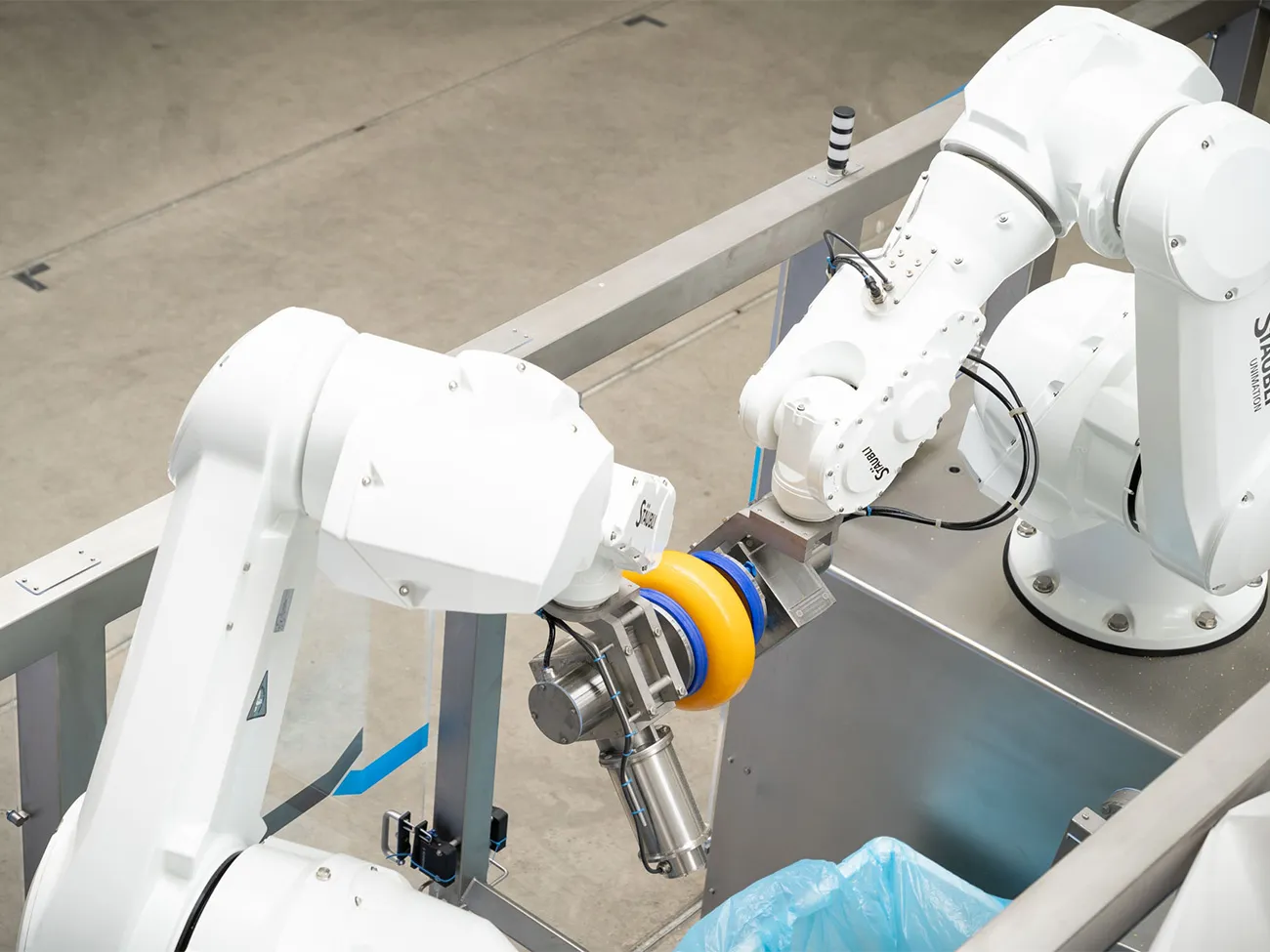
Even in the most highly automated factories processing cheese on a large scale, removing the rind from naturally matured cheese remains a difficult manual task. Yet it is a necessary step before the cheese can be sliced. DERO GROEP has now succeeded in automating the process with the ELTEN/DER* 200S/2 machine. Two six-axis Stäubli robots work ‘hand in hand’ to remove the rind in less than half a minute. A real milestone in cheese processing.
It takes around two minutes, two strong arms and an experienced worker to remove the natural rind from a round cheese. Given that modern cheese factories process thousands of round cheeses a day, it is clear why this task calls for automation. DERO GROEP, based in the Netherlands, was keen to take up the challenge. Its head office is in Nieuw-Vennep near Amsterdam, a stone’s throw from Gouda, the cheese capital of the Netherlands. Through its Dero, Elten and Bosgraaf brands, the company offers automated solutions for cheese production, processing, handling and packaging.
Why automate?
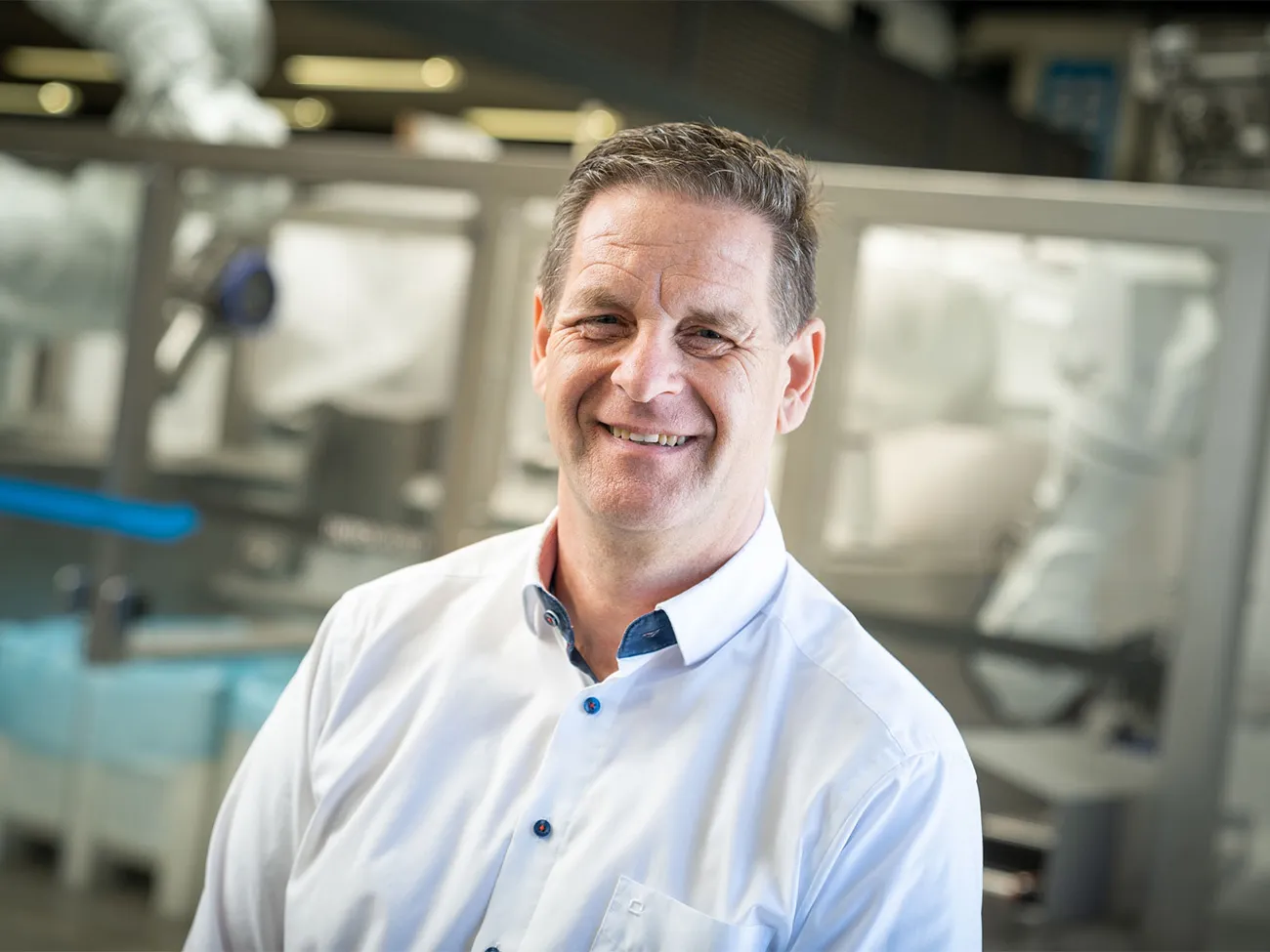
Removing rind by hand is hard work, making it increasingly difficult to find staff for the job. Another reason to automate the process is the amount of waste produced, even when the cheeses are handled by the most experienced workers. Hygiene is another concern. Sales manager Joop Bouman says: “Bacteria can cause maturation. To avoid contamination, the basic rule is therefore ‘no hands on the cheese’. But cheese is also a natural product that varies in size, age and firmness. The forces that need to be applied can therefore vary considerably.”
Two robots work ‘hand in hand’
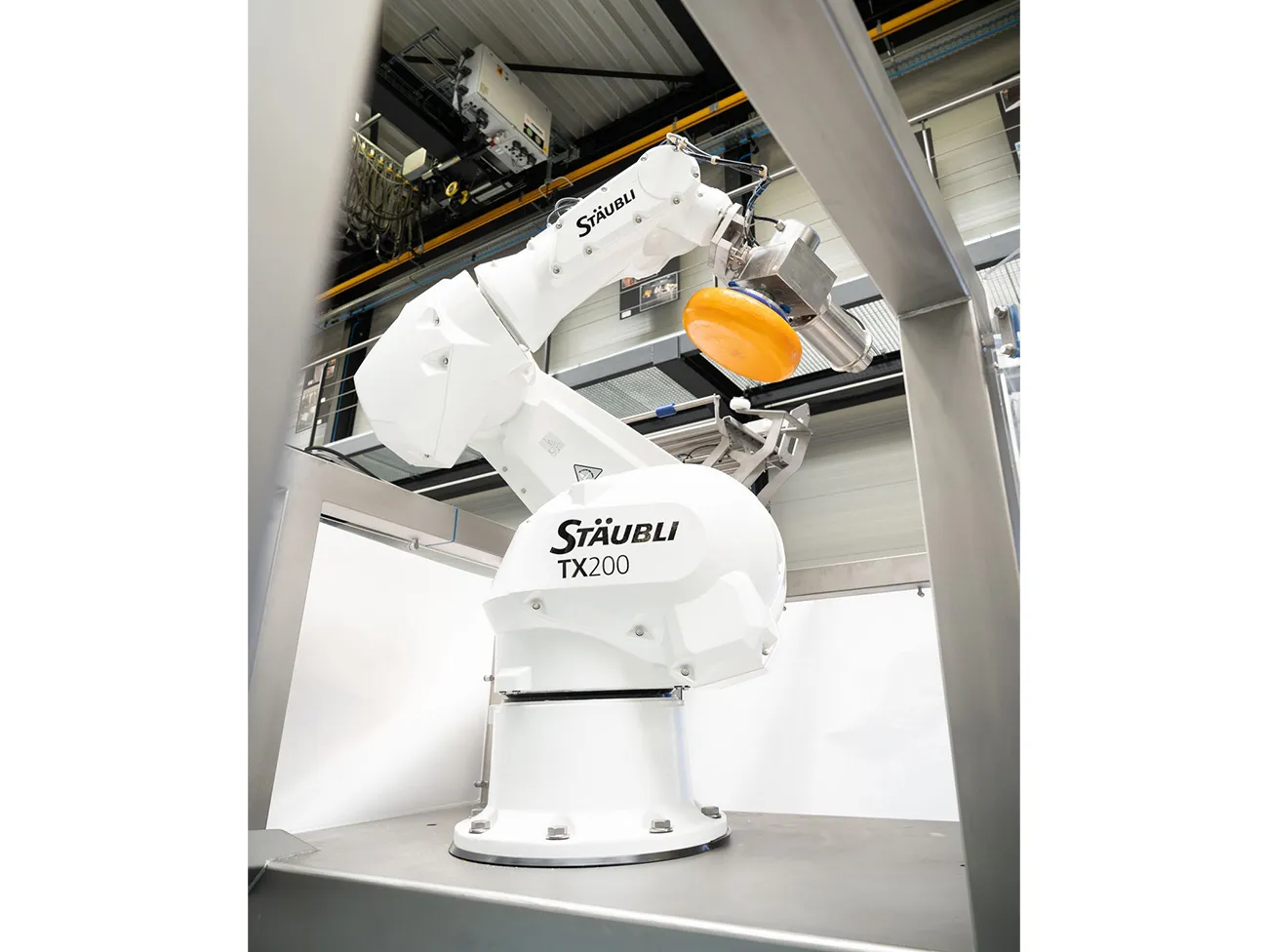
DERO developed a new machine to overcome these challenges. A round cheese arrives on the conveyor belt. A Stäubli TX200 six-axis robot in HE version, designed for humid environments and resistant to cleaning processes to ensure the highest possible hygiene, picks up the cheese from above with a large suction cup. Since the specially developed rind-removal tool is fixed in place, the robot performs a combined multi-axis movement, including rotating the cheese, removing the rind from precisely half of it in less than 15 s. The robot then moves to a transfer position, where a second robot grips the other side of the cheese and the process is repeated. As both robots can work simultaneously, the cycle time is approximately 30 s. The machine is highly open and hygienic, as the waste falls directly into plastic bins that can be easily removed.
Speed, productivity and flexibility
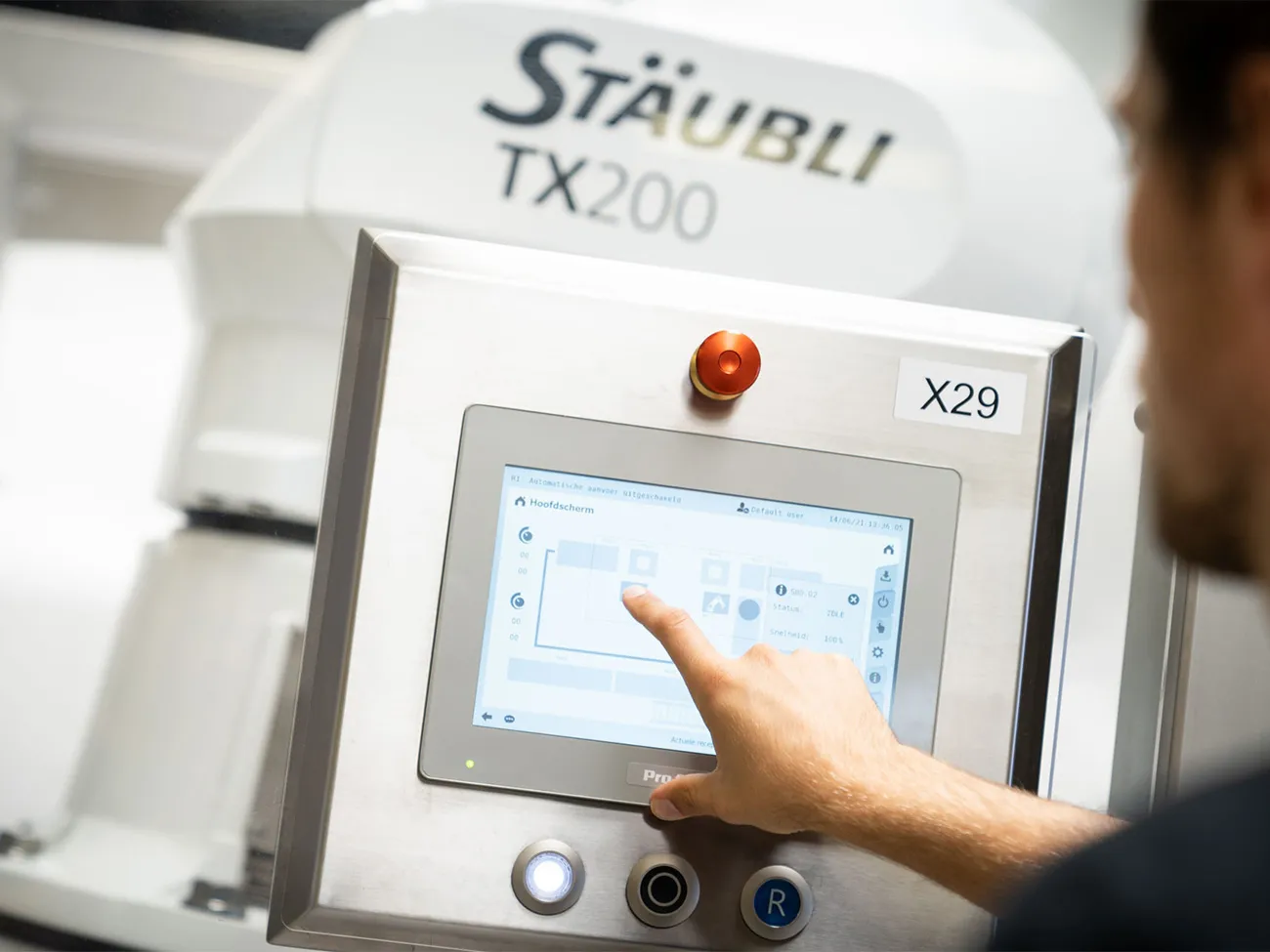
Alongside its speed and productivity, the machine stands out for its flexibility. “It is very easy to operate because we have programmed recipes tailored to the shape, type and firmness of the cheese. Whether it is six-week-old Gouda or 100-week-old Edam, the robots know what to do,” says Bouman. Since the first prototype was built in 2020, several machines have been built and sold, and are operating to their owners’ full satisfaction. The rind-removal robots are now being introduced to the market. They can also be equipped with an inline vision system to monitor the process. After each side has been processed, cameras inspect the cheese. If the rind has not been removed, the robot can move the cheese back to the rind-removal unit or to a separate rework station.
An easy choice: Stäubli HE robots
Asked about DERO’s criteria for choosing a robot, Bouman lists several: “First, we often use Stäubli robots because they meet the stringent hygiene requirements of cheese processing and food production in general. In HE versions, they can be cleaned every day with water or chemicals without affecting their service life.” In addition, the entire Stäubli TX range offers high precision and accuracy. Programming is also straightforward: the entire cell is controlled solely by the robot controller, with no additional PLC. DERO’s engineers chose the flagship of the TX six-axis robot range for its reach, and because the contact pressure between the rotating cheese and the tool requires a very rigid construction. The substantial stainless steel motor that rotates the cheese also makes the arm heavier, of course. Bouman says: “The next step is a similar machine for rectangular cheese blocks.”
Question about this story? Ask your question
Companies in this story

Keep following this
Get an email when a new story is published. No account needed.
- SubjectSolutions
- CompanyStäubli







