












Sustainable flooring for the food industry
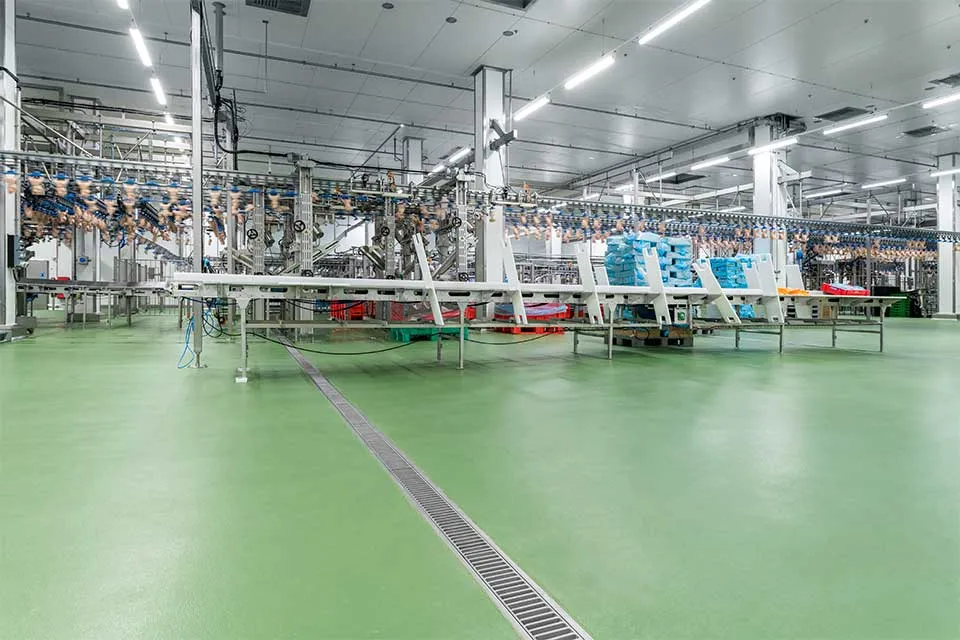
Sustainability is now an integral part of modern life. It is also becoming increasingly important in the construction sector.
When your food processing business needs an extension or renovation, your architect will increasingly recommend sustainable materials, including for the flooring.
Which floor for the food industry, required to meet so many demands such as chemical resistance and resistance to high temperatures and heavy forklift traffic, is also a sound long-term investment?
Ucrete industrial flooring from Master Builders Solutions
Ucrete industrial flooring contributes to sustainability in many ways throughout its entire life cycle.
The long service life of Ucrete floors, which are often still in use after 20 to 30 years, helps conserve valuable resources. After all, few things waste more raw materials, time and energy than floors that have to be broken up and discarded after 5 to 10 years.
Climate protection
Ucrete floors contribute to climate protection and energy savings, as demonstrated by an independent environmental impact assessment.
BMG Engineering in Zürich carried out such an assessment of Ucrete floors. It examined the scenario of a commercial kitchen, for example in a hospital or school, and compared a Ucrete UD200 floor with a typical tiled floor for the same application. The results are compelling: per square metre, a comparable tiled floor was found to require up to 50% more cumulative energy, have a 70% higher global warming potential and a 200% higher ozone depletion potential, and consume 50% more water than a 9 mm-thick Ucrete UD200 floor.
Sustainable construction
Building sustainability assessment systems are becoming increasingly important in the construction sector and confirm that Ucrete floors are a sustainable choice.
The Leadership in Energy & Environmental Design Green Building Rating System LEED® includes a process for assessing whether a project has been designed and built sustainably. This process measures key factors affecting human health and the environment: sustainable site development, water efficiency, energy efficiency, materials selection and indoor environmental quality.
Points can be earned for materials selection by using more sustainable and environmentally friendly materials. A Product Information Statement for LEED® New Construction (NC) Version 3.O Credit Documentation is available for all Ucrete flooring systems.
Healthy indoor air quality
Clean air is becoming increasingly important. Emissions that affect air quality are regulated by various national laws and voluntary standards.
Eurofins’ Indoor Air Comfort Gold certificate combines the strictest requirements of all relevant European regulations and voluntary labels. Production audits and quality checks ensure that Ucrete complies with all emissions standards for indoor flooring, including AgBB in Germany, M1 in Finland and Afsset in France. Measurements under Afsset give Ucrete an A+ rating, the highest French emissions rating.
This demonstrates that Ucrete is a clean product, free from volatile substances that could contaminate food or jeopardise staff wellbeing.
Ensuring our safety
In practice, Ucrete floors help our customers across numerous industries operate sustainably. For example, when manufacturers use aggressive and harmful chemicals, Ucrete provides a barrier that prevents them from entering the environment.
The different non-slip profiles available for Ucrete ensure that everyone can work safely and help prevent accidents.
More information about Ucrete industrial flooring
Question about this story? Ask your question
Keep following this
Get an email when a new story is published. No account needed.
- SubjectSolutions







