












Upgraded frozen fries production line: Farm Frites brings in Heveco and Siemens for expansion
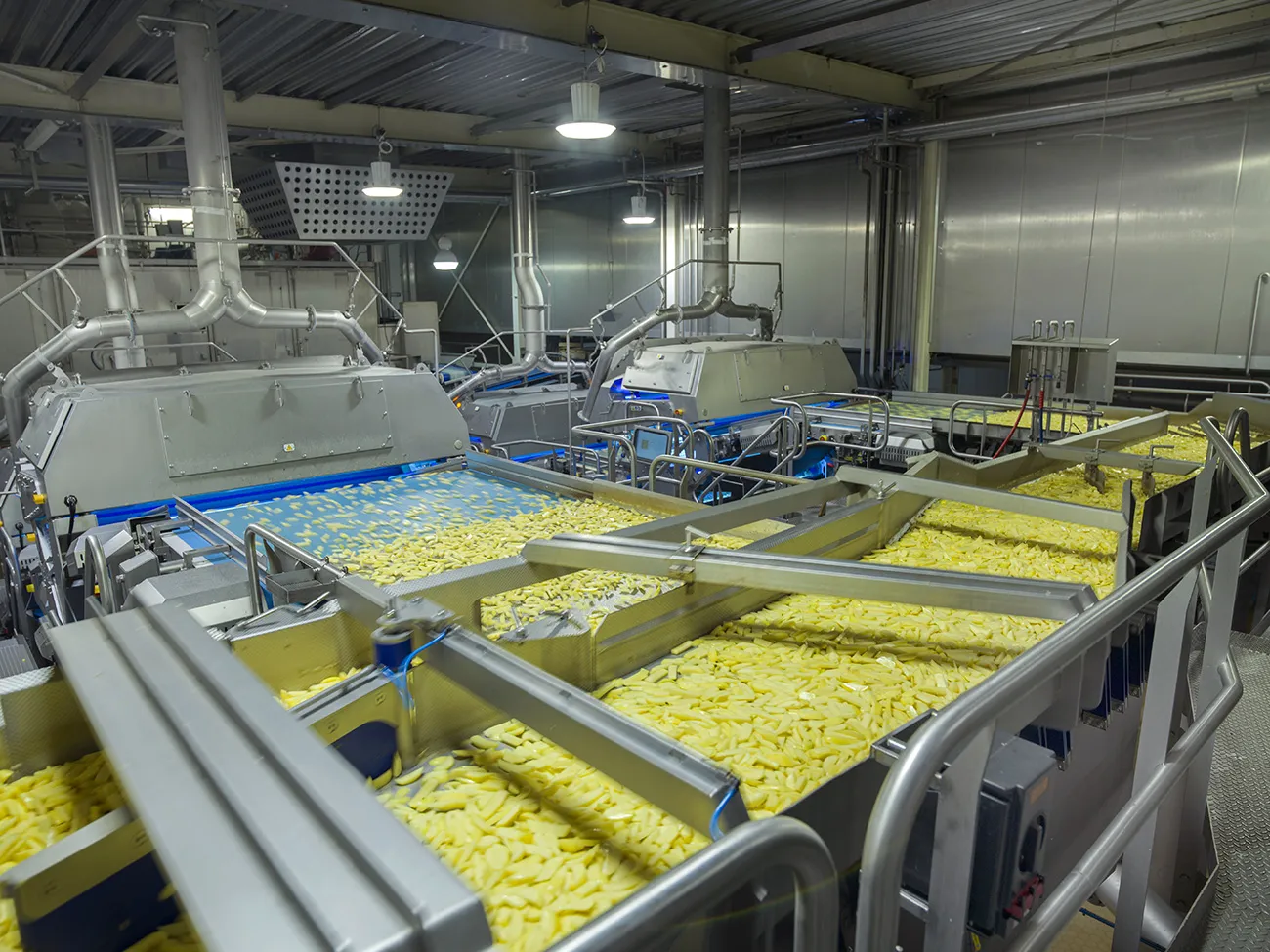
To continue meeting its customers’ needs, Farm Frites upgraded its operational unit for producing pre-fried, frozen fries in Lommel. Processing capacity was doubled, and a coating applicator was also integrated into the process line. Heveco of Genk carried out all the electrical engineering for this expansion project. As a Siemens solution partner, the integrator used numerous products from the technology supplier, from variable speed drives to PLCs and HMIs.
Frozen fries
Farm Frites is headquartered in the Netherlands and also has four production sites in Belgium, Poland and Egypt. The Lommel site is the group’s largest and comprises four operational units producing potato flakes, frozen or chilled fries, and purée specialities. The flakes are supplied to industry for further processing into finished products such as crisps; the other products are sold mainly to wholesalers and the foodservice sector. Markets extend as far as Southern Europe and South America, depending on whether the fries are chilled or frozen.
Coatings
The ‘triple A’ line in operational unit 3 was recently equipped with coating capabilities. “These are high-quality frozen fries, intended mainly for fast-food chains,” says Sven Cardinaels, E&I project manager at Farm Frites Lommel. “The coating is an extra layer that lets us add colour or flavour to the fries. Alternatively, it can be an invisible coating that keeps the fries warmer and crisper for longer after cooking. This allows our customers to maintain optimal product quality and reduce food waste by avoiding the need to throw away cold or limp fries.”
Capacity
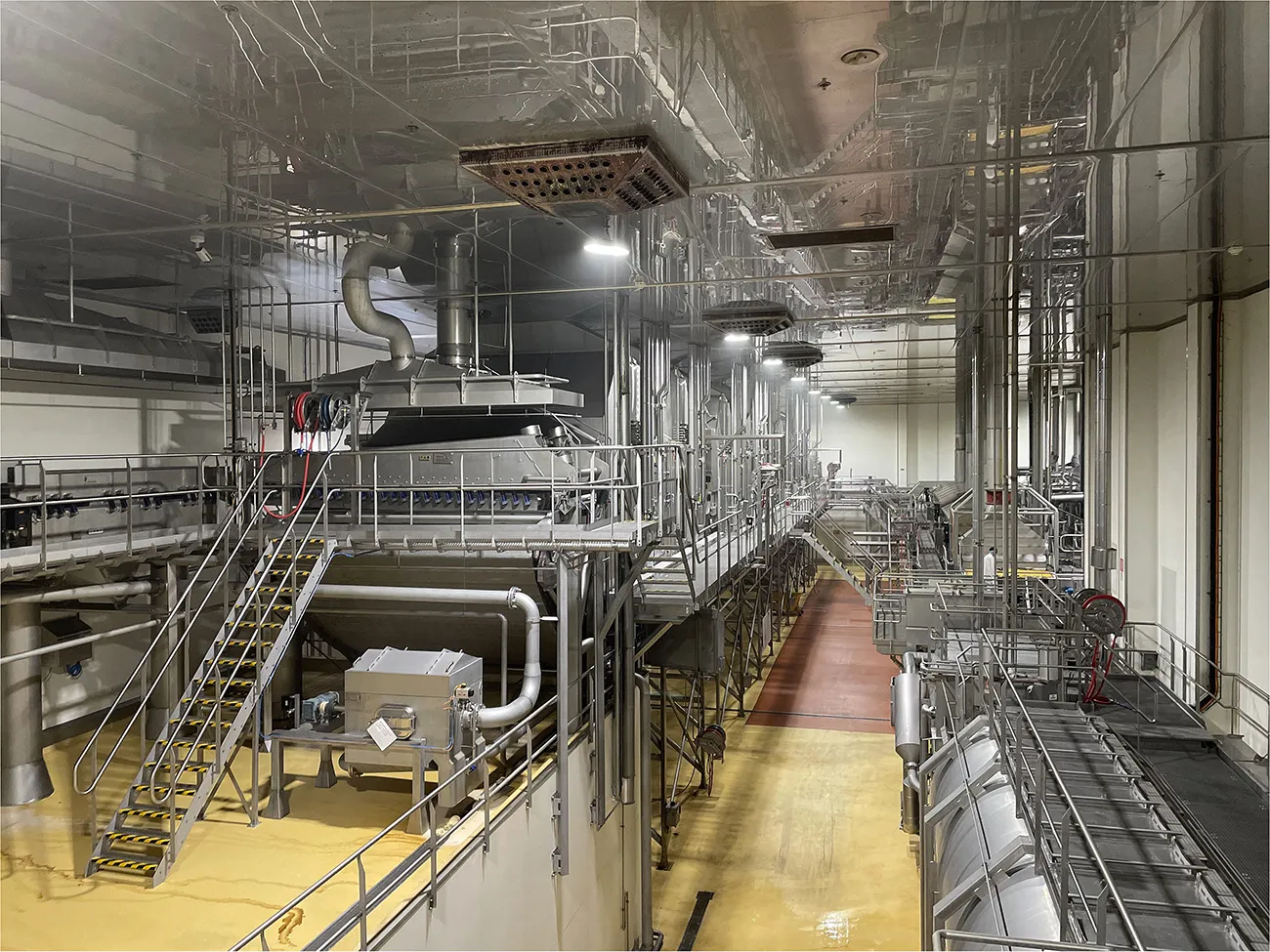
The project also significantly increased the capacity of the production line, in keeping with the global group’s expansion plans in Western Europe. “To achieve this, we completely rebuilt and extended the existing line, apart from a few process steps. Most of it is now installed in a new production hall,” says Cardinaels.
Upgraded process line
Drying tunnel
One example is a new drying tunnel installed before the fryer. Fans circulate conditioned outside air above a conveyor belt inside it. “This drying step is important for achieving a crisp finished product. Sustainability was a key consideration, as we recover heat from the fryer to warm the dryer. We can also limit the amount of heat required thanks to the tunnel’s large surface area. The dryer is controlled by humidity rather than temperature, giving us a more stable drying process with lower energy consumption. Together, these measures deliver significant energy savings,” says the project manager.
“Our capacity has doubled, and we now have an extra ace up our sleeve”
Bypass coating applicator
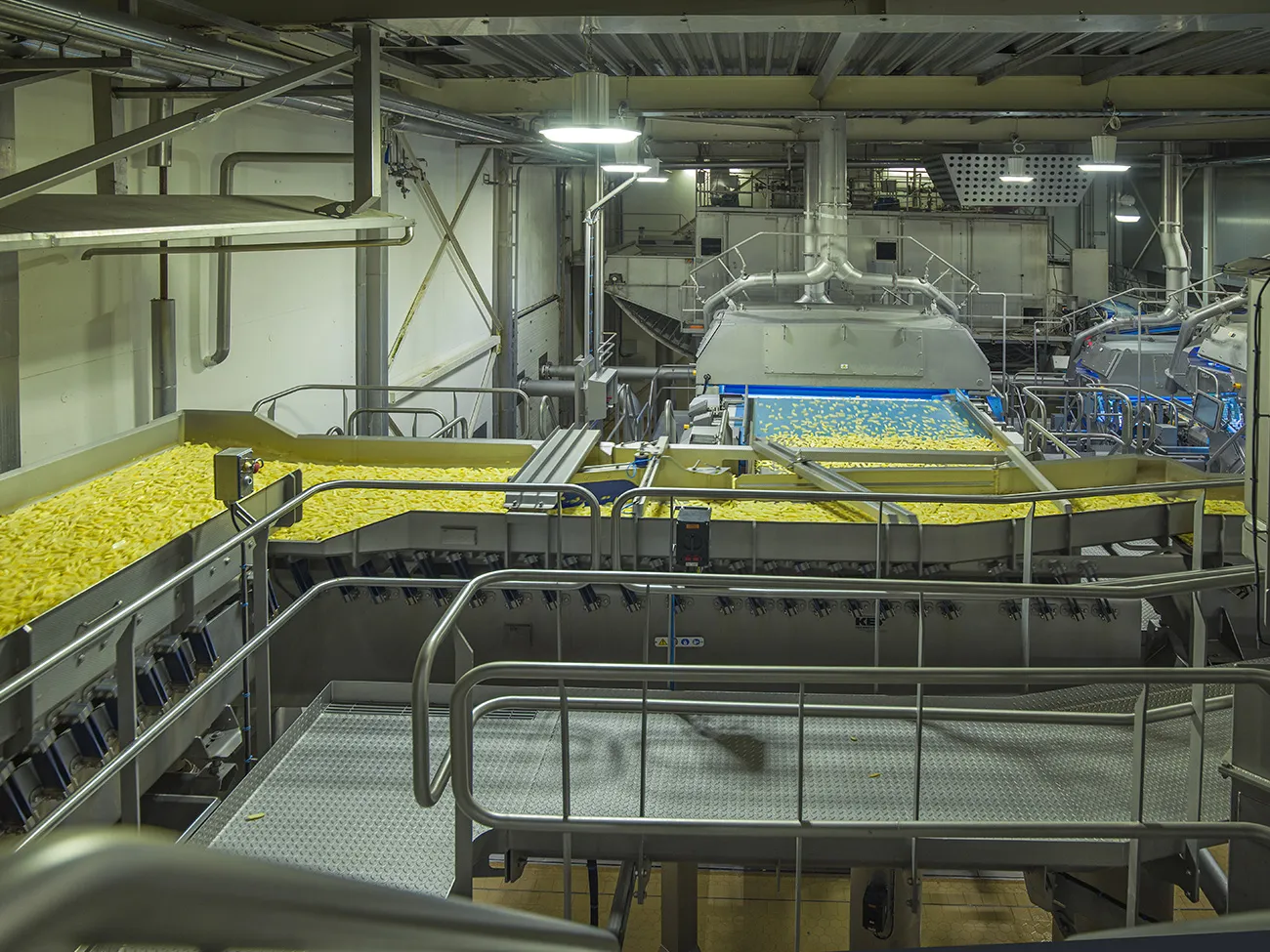
The line also includes an optional coating step in a bypass arrangement before frying. The fries are dipped in a batter, some of which drains off during the subsequent transfer. Here, too, some of the coating is recovered using air knives, just as excess oil is recovered after the fries pass through the two stages fryer.
“In the final process steps, the pre-fried fries are first chilled and then frozen. They then pass through a mechanical sorter, which ejects any fries that may have broken, become misshapen or clumped together during the preceding steps. Finally, the frozen products are packed in various formats and transported to our cold store by automated internal transport,” says Cardinaels.
Electrical engineering
Heveco, a long-standing partner from Genk that has been working at the site for more than thirty years, was brought in for the E&I work and automation for this expansion. “For this project, we not only handled the electrical work for the utilities, but also built the control panels and wrote the PLC software, for example. We provided central control for all the machines on the upgraded production line, including the coating applicator. We also made a number of safety-related modifications to several machines,” says Bart Huygen, co-owner of Heveco.
Service
As a Siemens solution partner, the integrator opted for more than a hundred of the supplier’s variable speed drives. “They are all the same G120 model, so standardisation makes it easier for Farm Frites’ technical team to deal with any faults. This helps them become familiar with the drives more quickly and also brings benefits in terms of spare parts. The modular design of these drives, with separate power and control sections, also makes maintenance easier.”
“We also felt it was important for the selected variable speed drives to remain serviceable for at least another ten years, which is why we chose Siemens over another technology supplier. We were not familiar with these drives ourselves, but our staff received the necessary support from Siemens’ specialists. We then worked with Siemens to train the Farm Frites technicians. They were quickly convinced of the ease of use and reliability during a demonstration session. At commissioning, all the drives were configured without errors, with just one exception, whereas in our experience you would normally expect a failure rate of 3 to 5%,” he says.
“This is a major project, with more than 100 variable speed drives“
Timing
Alongside the technological challenge, not least because of the project’s scale, there was also a tight schedule: the upgraded line had to be up and running as quickly as possible. “We were able to install everything neatly in the new hall, but the existing line remained operational while we worked in the old building. We therefore had to complete the entire job during short production stoppages, using the necessary changeovers, which called for a degree of creativity and flexibility from our team. Integrating the two main PLCs, the HMIs and the variable speed drives on the same TIA Portal platform, nevertheless enabled us to save a considerable amount of time,” Huygen continues.
Cleanability
To meet food hygiene and cleanability requirements, as much cabling, decentralised panels, distribution cabinets and electronic components as possible was concealed above a suspended ceiling made of stainless steel sandwich panels. “This gives us an easily accessible technical space, 3 metres high, above the 11-metre-high production hall, where the various process steps are arranged in a cascade. We also carried out the control work for the CIP system serving the entire production line,” he says.
Safety
ET200SP I/O islands are also used in this technical space for the decentralised peripherals. Their main advantage is the flexibility they offer for future expansion, thanks to the modular design of the components. This was necessary because the engineering work was still under way during implementation.
Communication is via Profinet, using Scalance X switches, and the variable speed drives are connected via Profisafe. “The safety programming is fully integrated into the S7-1500 fail-safe PLCs. This greatly reduces the amount of cabling required.”
Conclusion
“Our capacity has doubled, and the coating capability gives us an extra ace up our sleeve. This puts us in a stronger competitive position as a supplier to fast-food chains, exactly as we had intended,” says Cardinaels, assessing the expansion project.
Question about this story? Ask your question
Companies in this story
Keep following this
Get an email when a new story is published. No account needed.
- ThemeSmart production with data
- SubjectSolutions
- CompanySiemens







