4 ways to put sustainability into practice
Sustainability strategies are becoming increasingly common among food businesses. But turning those ambitious plans into concrete action and real innovation is often a major challenge. Anouk Van de Meulebroecke of slidingdoors to the rescue! Through a coaching programme delivered in collaboration with Fevia Vlaanderen and supported by VLAIO, she guides food businesses such as Soubry, Inex and Breydel step by step. We spoke to her to hear 4 tips on how food businesses can become more sustainable while preparing for future obligations.
1. Identify relevant topics so you know what to measure
“Fifteen years ago, food businesses were mainly focused on operational efficiency in their factories. Today, there is greater emphasis on sustainability throughout the supply chain. Food businesses want to know how they are performing themselves, but also how their supply chains work. Who are their suppliers and how do they operate? Is their production environmentally and animal-friendly, and what are the social conditions like?”, explains Anouk of slidingdoors.
“Of course, there are also growing consumer expectations for food produced more sustainably. Measurement plays an important role here, and soon more and more businesses will also be required to report on their sustainability efforts under the European Green Deal. But then the question is, ‘what exactly should I measure?’. What you measure needs to match what you want to know and what you want to learn from the data.”
With Anouk’s guidance, pasta producer Soubry divided its sustainability efforts into four categories: product, respect for the planet, raw materials and people. This gives the company a clear structure for its sustainability story: “We are convinced that our product is not only tasty and high quality, but also fits into a sustainable meal.
We are already taking various steps to reduce our CO2 emissions, including through the Energy Policy Agreements, which encourage us to consider energy efficiency. We are also focusing on efficient water use and reducing wastewater. In addition, we are looking at more efficient and sustainable packaging, such as bulk packaging. Finally, we work with cooperatives for our wheat. We visit them to learn about their way of working”, explains managing director Matthieu Soubry.
2. Involve people and give them an incentive
“You can fill in all sorts of Excel files, but if nobody looks at them, measuring has little point. Set up working groups or make people responsible for a particular topic. And why not include the number of accidents you prevent or achievement of a food safety certification in pay, or link them to a bonus? In short, involve people in monitoring your efforts and give them an incentive to make sure they move in the desired direction”, says Anouk.
Inex works exclusively with local dairy farmers to process its milk. The family business places great importance on naturalness and authenticity. “The coaching programme helped us see the wood for the trees. In developing our sustainability strategy, we took inspiration from the four pillars of the Belgian food industry’s sustainability roadmap. For the first pillar, consumer trust, we appointed internal leads to develop initiatives that would help us make progress in the short, medium and long term. We are also investing in training and education, and involving our people in our charitable activities. For example, every year we cycle for Kom op tegen kanker, which also helps bring people together”, explains managing director Steven Dierickx.
Matthieu Soubry also believes that sustainability must be “embedded in the structure of the entire organisation so that it reaches everyone.” Soubry therefore set up a sustainability working group, with a sustainability coordinator. The pasta producer also communicates each month on a particular topic to raise awareness among employees and inform them about its efforts.
3. Set yourself a target
“It is important to set yourself a target. This allows you to assess your performance against a higher-level goal and learn from experience. Some businesses set themselves highly ambitious targets, while in other business cultures it is more appropriate to celebrate interim successes through realistic and achievable milestones. Both approaches work, and the choice is up to the business”, Anouk explains.
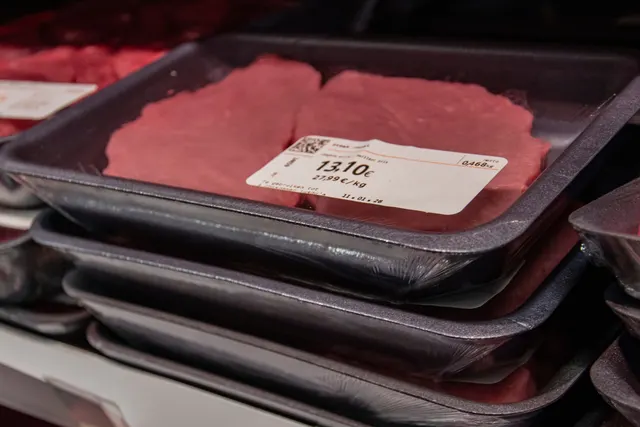
Meat producer Breydel has also been taking significant steps for some time, but it too needed coaching. Breydel decided to set up its own short supply chain, based on four pillars that matter to consumers: animal-friendly, healthy, local and sustainable. “For each pillar, we try to do at least one thing exceptionally better than what the market has to offer. Among other things, we provide a stress-free environment for our animals. We play music so that the animals become accustomed to it, from the barn to the abattoir. And because we operate very locally, we can cut the number of kilometres travelled on the road considerably. We chose a ‘5-star’ approach to tell our own story”, says director Yvan De Keyzer.
Discover in these food.be snacks how Breydel operates sustainably, from farm to fork
Inex also takes a targeted approach: “We have set up a number of KPIs to measure our progress, including against the Nutri-Score. Above all, we want to be able to show how we put our efforts into practice. For example, we were the first in Belgium to launch a growing-up milk product with no added sugars. We believe this can set us apart over the long term. We also have action plans to use more recycled packaging, and now want to communicate this externally too.”
Discover in these food.be snacks how Inex is moving towards more sustainable packaging
4. Dare to tell your story publicly
For Breydel, the sustainability report serves as an “excellent calling card” for its authenticity and local commitment. At Soubry, the sustainability report is also an important tool for attracting new employees and checking whether it has achieved its targets. For Inex, it is primarily a framework for communicating with all stakeholders and understanding where the company stands: “a report like this helps you see everything you are working on at a glance”.
“We help businesses understand how they are performing against particular targets. But we also look at which relevant topics they should focus on, depending on their sector and processes, and how they can then measure this. Finally, we look at how they can stand out from competitors by making their actions concrete and demonstrable in a sustainability report. The Flemish food businesses I work with mainly want to tell their story authentically and avoid ‘greenwashing’. That is a good thing, but they are often too modest. We help them find the confidence to speak out and tell their story honestly”, Anouk concludes.
About the coaching programme
• supports businesses based in Flanders
• takes 5 days and is tailored to your business
• offers a straightforward way to map, measure and demonstrate your sustainability efforts in the form of a sustainability report
• is offered at the price of 2 days instead of 5, thanks to support from VLAIO under the industry partnership
Interested? You can take part through Ann Nachtergaele
For more information about the coaching programme, consult our brochure here
Question about this story? Ask your question
Keep following this
Get an email when a new story is published. No account needed.
- SubjectSustainability