Energy transition: how can your production become CO2-neutral?
Text Valérie CouplezImage Actemium
You have three options for reducing your greenhouse gas emissions. Work more efficiently and therefore consume less. Electrify processes, such as steam production, so they no longer require fossil fuels. And, of course, generate your own green energy with solar panels or a wind turbine. There is a good chance you will need to use all these options to meet the targets already in place, which will undoubtedly become more demanding. It is best to choose a partner who knows how to balance everything in line with supply and demand. Actemium, then. Who else brings together expertise in industrial (automated) processes, cooling and heating, and energy solutions under one roof?
The energy transition is well under way. But this transformation is far from straightforward. “In yesterday’s industry, a gas-fired steam boiler was running and a single large chiller provided heating and cooling throughout the entire factory. That approach no longer works today. We are seeing a shift towards more modular systems, designed not for the entire plant but for specific applications. Taking this approach as efficiently as possible requires a holistic view. Waste heat recovered from one process can then be used in another … And, to make things even more complex, energy will no longer be a static factor in the future. The necessary flexibility must be built in to keep supply and demand perfectly balanced.”
Data as the foundation of sustainability
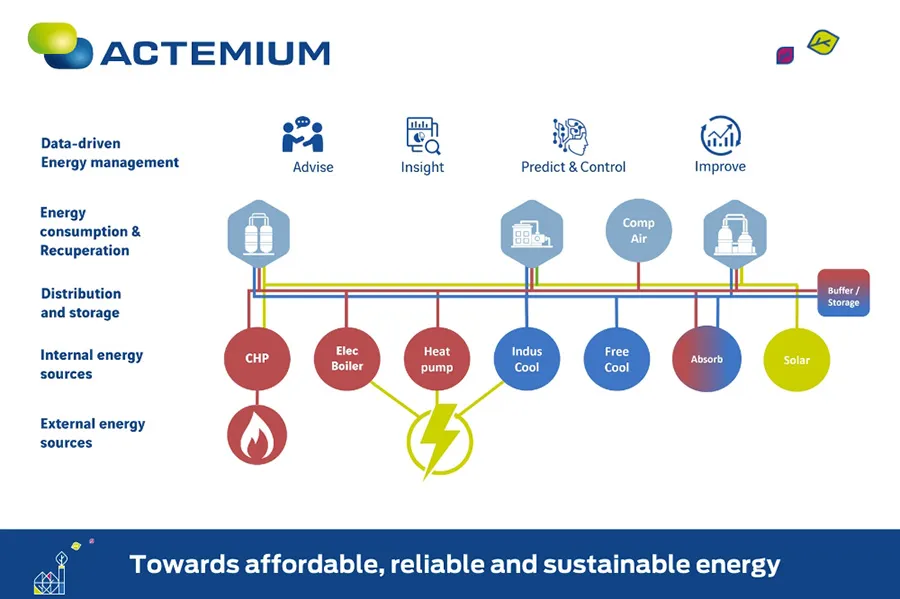
Burt Battel, Head of Energy for Industry at Actemium, is speaking. His LinkedIn job description says it all: combining digitalisation and sustainability. Data is the foundation for building carbon-neutral production. “It all starts with data capture to gain insight into the customer’s energy flows. In the second step, we do ‘energy engineering’. What concepts are available? What do they cost? What do they deliver? And how can we best put the pieces together for the customer and their production process?” Actemium’s strength is that it has the bright minds to do all the calculations, as well as equally bright minds to put the plan into practice down to the last detail. “Then we add a layer of software to balance everything. But the work is never done, because the data generated when the system is running provides the basis for further optimisation.”
Taking optimisation further
In time, this optimisation will also mean that food companies align production with energy availability. When solar panels are generating plenty of power, for example, equipment can be ramped up. When the market price of energy peaks, certain production lines can be switched off. “You can see that energy is going to become a complex tangle of parameters and external factors. That is why Actemium launched a chair at Ghent University last year to develop optimisation models that help customers make better decisions, including proactively,” says Buttel, summing up the next steps.
Linking cooling and heating
The fact that the food industry is set to lead the way in these processes has everything to do with the nature of the sector. “Many food companies need both cooling and heating. Linking the two creates plenty of opportunities to improve efficiency. Driven by Europe’s targets and customer requests, most food companies are also actively drawing up plans. And although a holistic approach is essential, that does not mean everything has to be tackled at once at a brownfield production site. Together with our customers, we draw up a roadmap for the coming years.” ■
Energy offering in practice: Belcolade factory operates without fossil fuels
The new Belcolade production site shows how this all works in practice. The Puratos group set itself the ambitious target of achieving fully CO2-neutral production. Actemium is a partner throughout the various project phases for the new production site, providing expertise in design, build, operate & optimize, as well as energy. “The challenge lay in the dynamic nature of a system like this. It must be able to respond flexibly while always guaranteeing production continuity and energy efficiency,” says Burt. The result is a number of different temperature networks, from chilled water to hot water, and the technology needed to draw off energy and feed it back in. “Chillers, e-boilers, heat pumps … you name it, as well as all the automation around them to keep the installation balanced. A great example of how to future-proof your energy supply.”
Een zakelijke vraag aan Actemium België? Get in touch
Companies in this story
Keep following this
Get an email when a new story is published. No account needed.
- ThemeSaving energy and water
- SubjectSustainability
- CompanyActemium België