












Inertia and moment of inertia have a major impact on the drive
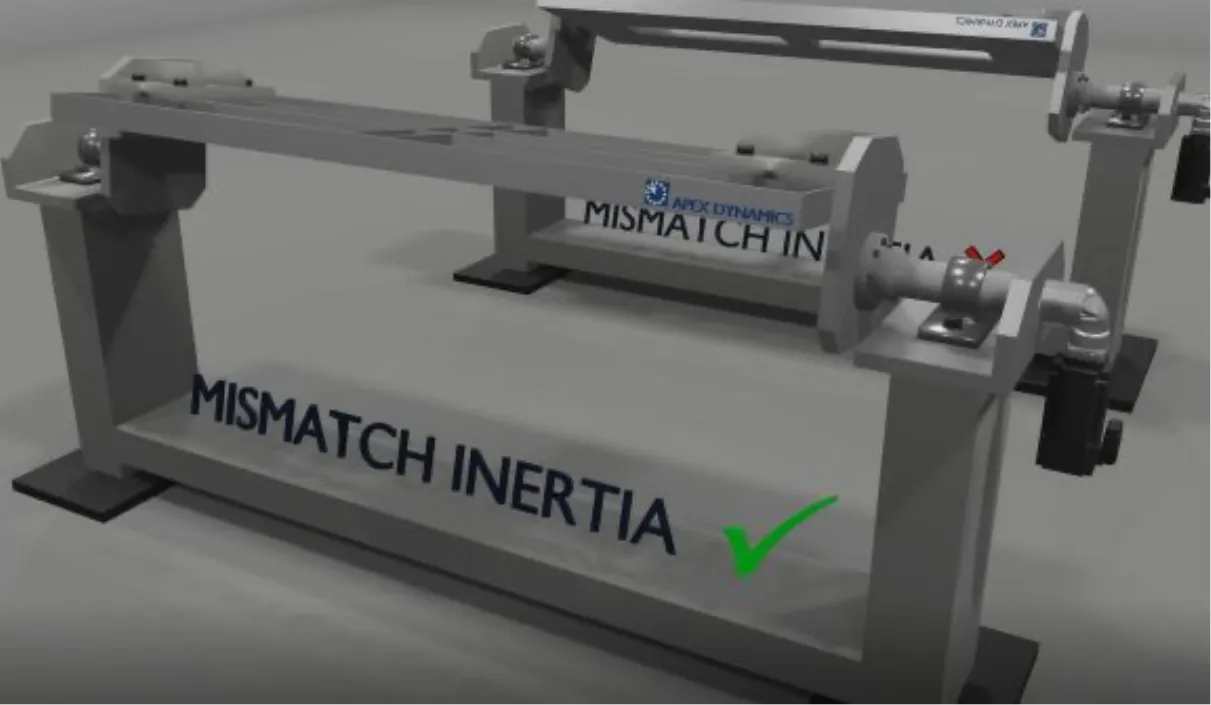
What if there is a large difference between load inertia and motor inertia? In this article, we use a video to explain why it is important to have a good ratio between the two.
A gearbox is an effective solution, with the added benefit that a lighter, more accurate drive can be used.
One of the energy conversions used in almost all machines is the conversion of electricity into motion. The device that performs this conversion is known as an “electric motor”. Broadly speaking, applications using electric motors are divided into S1 (continuous-duty motors) and S5 (intermittent periodic duty with electric braking, with a duty cycle of less than 60% and less than 20 minutes of continuous operation). In S5 operation in particular, it is important to pay close attention to the moment-of-inertia ratio.
Video: inertia mismatch
The video on moment of inertia shows an S5 application. Have you ever experienced something like what happens with machine 1? This problem occurs because there is a large difference between the IL (load inertia) and IM (motor inertia). What is a good ratio between IL and IM to achieve smooth movement, as with machine 2? This can be confusing, as there are several possible answers: make the load lighter, use a heavier motor, introduce a gear ratio, add dampers, and so on. We calculate it as follows:
Calculating the optimum moment of inertia
The empirical, dimensionless rule for an optimum moment-of-inertia ratio is:
JL/ i^2 <= 4 JM.
JL = moment of inertia of the load, JM = moment of inertia of the motor and i = gear ratio. The ideal situation for the system is when: JL/ i^2 = JM
Many people interpret the equation above to mean that increasing the motor size or setting JL in the servo motor parameters can solve the problem. That is only the right decision if the difference in inertia is not too great. But what if the difference between JL and JM is much greater? How large an electric motor should we choose?
The formula JL/ i^2 <= 4 JM allows us to achieve maximum performance with a relatively small motor by using a gearbox with a gear ratio (i).
Practical example of moment of inertia
The application in the video has a load of approximately 200 kg and must rotate it through 180 degrees in 1 second. Machine 1 is driven by a motor alone, while machine 2 uses a motor with a gearbox. The latter has a motor rated at just 750 watts and 3,000 rpm. A light, accurate and stable drive. Interesting, isn’t it?
Get in touch with Apex Dynamica for advice on problems with your application. We will be happy to help.
Question about this story? Ask your question
Keep following this
Get an email when a new story is published. No account needed.
- ThemeReliable machinery and drives
- SubjectTechnology







