












More than just palletising
Text Astin de ZeeuwImage SigmaControl
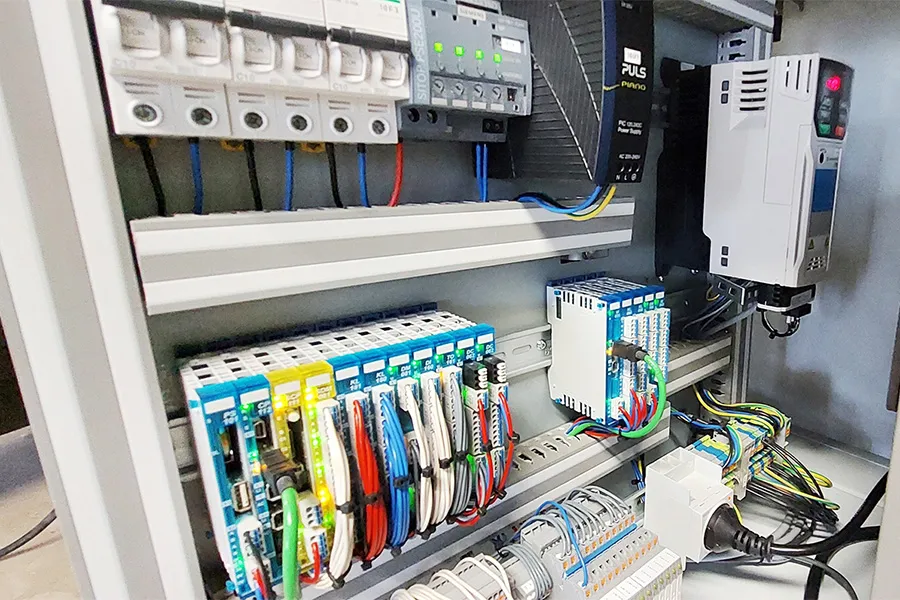
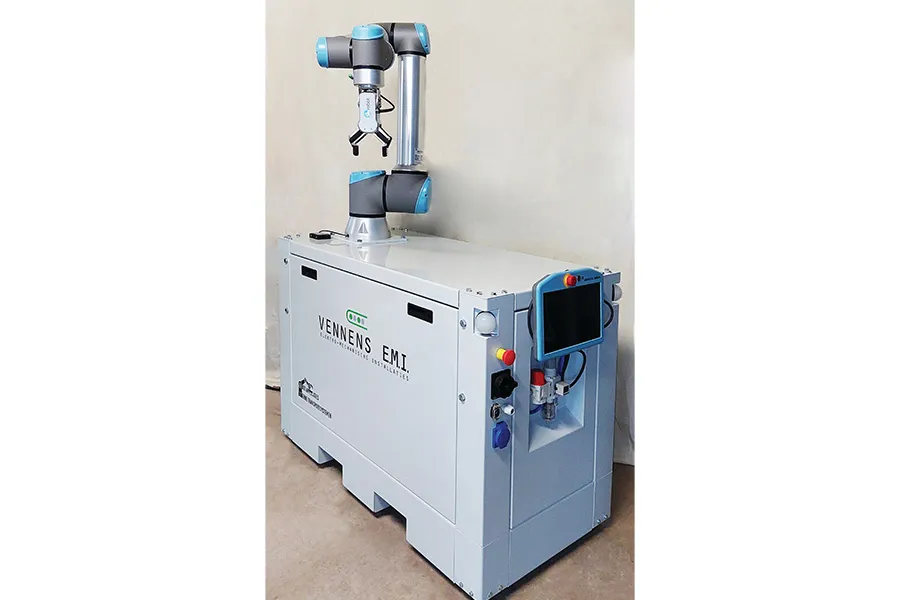
Cobots, short for collaborative robots, are a specific type of robot designed to work alongside people in a supportive role. In Sint-Niklaas, we find a company that builds multifunctional, custom-made applications in-house that can do more than just palletise. These so-called Flexstackers can also be used for welding, assembly, folding and packaging. Managing director and engineer Kristof Vennens designs and builds these cobots using hardware and software from SIGMATEK, distributed and supported by SigmaControl. Engineering is carried out using the all-in-one, object-oriented programming package LASAL.
Of course, we could list all the specific advantages cobots offer compared with conventional robots. They are generally more flexible and responsive, enabling interactive collaboration with human workers. They have intuitive interfaces and programming methods, including graphical interfaces that make programming straightforward without extensive technical knowledge. They are generally smaller and have a lower payload than conventional robots. They are also seen as a cost-effective automation solution that can boost productivity without significant changes to infrastructure. But, of course, we will not do that. Instead, we speak to Kristof Vennens, someone who knows where things are heading in today’s machine-building landscape.
History
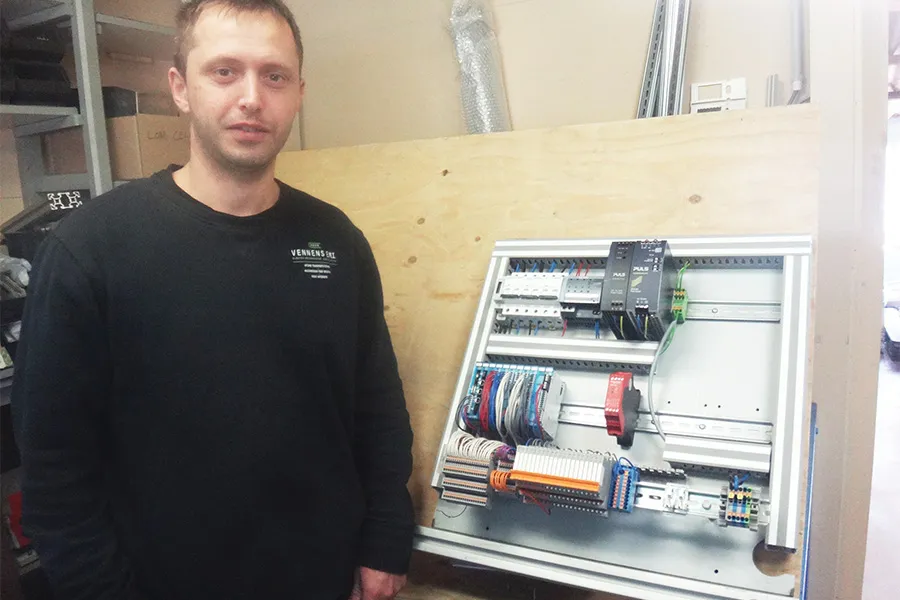
Vennens has been active in machine building for some time. He previously worked for TG Packaging before going freelance: “I think I left my previous employer about eight years ago. Back then, I kept Fridays for myself. I was getting more and more work of my own, so I cut back to three days and decided to start my own business in 2011.”
Vennens E.M.I. started out with electrical installations in homes and commercial buildings. This developed seamlessly into automation and robotics. “Actually, I’d already started working on simple applications, conveyor belts, industrial maintenance… That’s how I began finding my own way.” From 2014 onwards, machine building took off, and it became Vennens’ definitive focus market. Today, he is not only managing director, responsible for sales and administration, but also the machine engineer. He can leave drawing up schematics and mechanical and electrical assembly in the workshop to a colleague.
Challenging, varied projects
It would be an understatement to say that ideas are bubbling and new projects are getting underway. But Vennens only started programming with the SIGMATEK PLC two years ago. “One of my first projects was programming a machine to print a LOT number on the caps of milk cartons. The cartons came out of the filling machine from two directions and had to be turned onto a single sorting conveyor.” His new experience of comfortable object-oriented programming with the LASAL Engineering Tool also led to automating feed supply for a pig barn, involving the automatic filling and mixing of feed. “With the PLC, we can control as many as 400 valves in the barn using field islands with MQTT communication.” There was already considerable interest at the recent trade fair in Ghent in a solution like this for accurately dosing dairy products.
Cobots that can do it all
So how did Vennens come up with a product like the Flexstacker? He knows he is not the only one in this segment to offer a solution. He noticed that various brands demonstrate all the things a cobot can do, but manufacturing companies in particular do not know what is actually possible. “In practice, you see cobots used mainly for palletising, even though they can be used for so many other applications.”
He came up with a modular unit the size of a Euro pallet (1200x600mm), making it easy to automate production tasks. It is an application that can serve several purposes in a small company. Modular and universally deployable, it can be fitted with power, compressed air and all possible data protocols, as well as different types of robots. “I know several manufacturing companies in the area that have to shut down a particular production line simply because they don’t have the staff. With the Flexstacker, for example, we combine a punching machine, a press brake and a welding application in one, so metalworking companies can use all three. If there’s no welding to be done today, there’s bound to be a batch of parts to bend.”
Application under construction
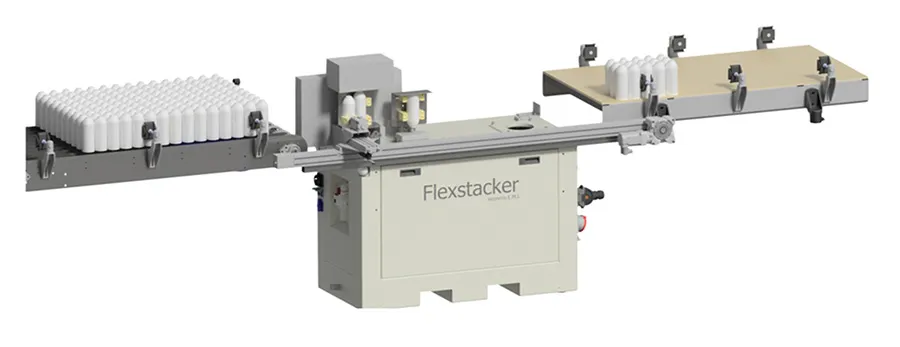
One real-world example is particularly striking. A production line is being built in which the Flexstacker will be used to fill spray cans with paint. It is almost hard to believe that this kind of production is still done manually. Vennens says: “Here, we’ve connected a linear guide to our application to fill empty spray cans. We pick up a can, which goes into a filling station. The filling channel is then cleaned and blown clear. The plan is to add a cobot to snap the caps on. And, of course, to put the cans into boxes at the end.”
The line will fill 600 cans a week on demand, although the station can already process five cans a minute. “It’s being built with exactly the same control system we would use for our cobot application. It has eight conveyors and a number of pneumatic cylinders. The software needs to know when each object should be started. We still have to write that for each project. Or we can add another programme to adapt it for a different application,” he says with a laugh.
Question about this story? Ask your question
Keep following this
Get an email when a new story is published. No account needed.
- ThemeSmart production with data
- SubjectTechnology







