












Safe zone monitoring: laser scanners or radar
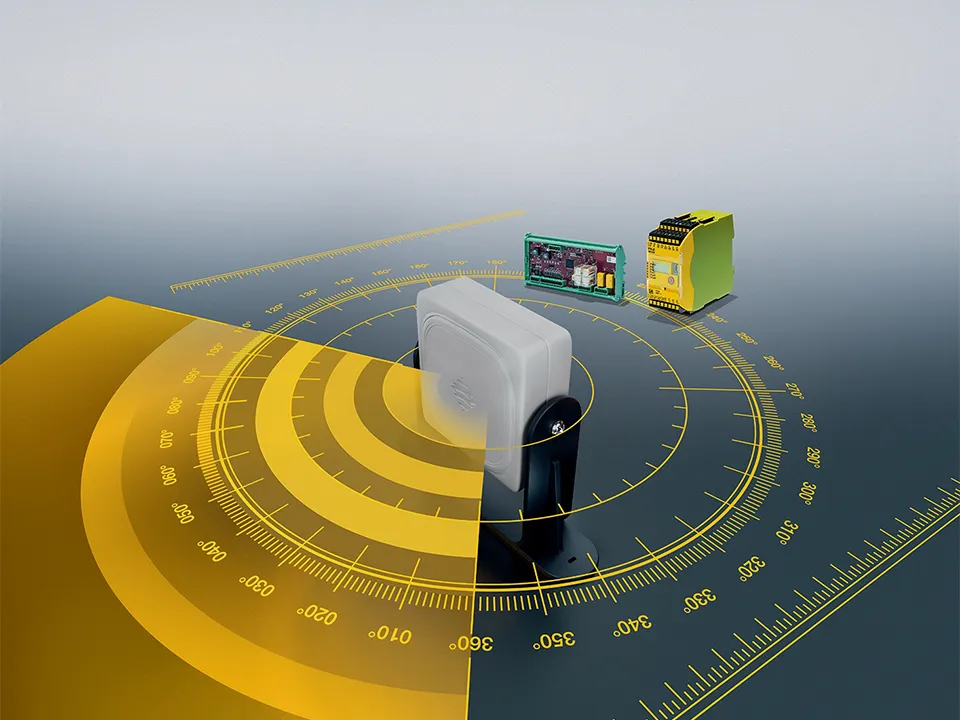
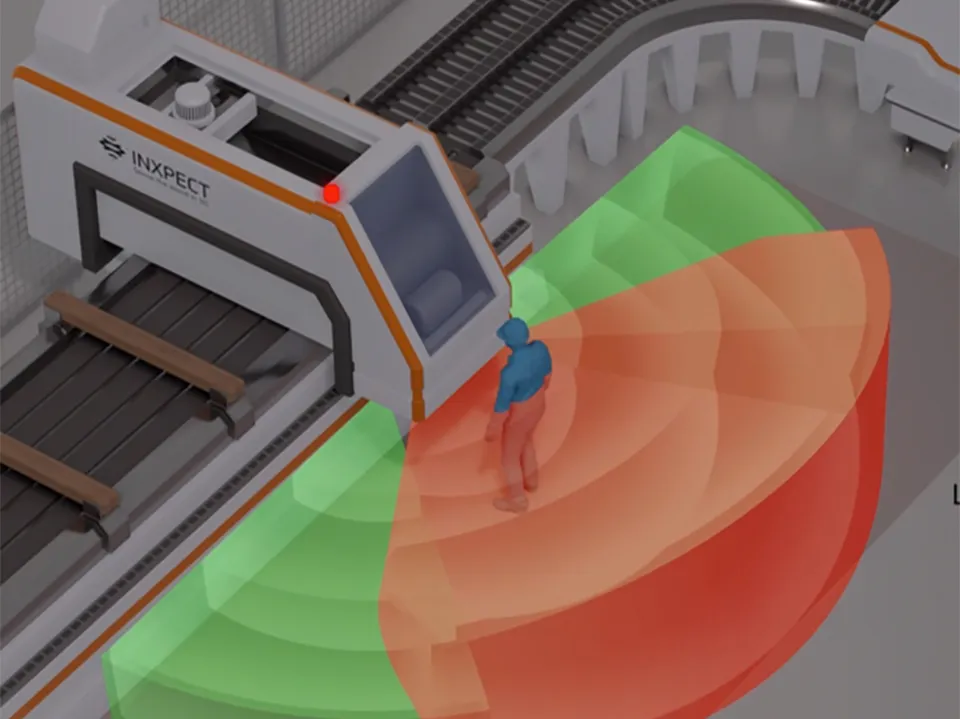
The laser light therefore constantly scans the area to monitor the zones. When the laser beam hits an object, it is reflected back. By measuring the time between the beam being emitted and received again, the scanner can determine the distance exactly and establish whether the object is in the monitored zone. Three zones are generally defined, depending on your application and the safety requirements.
Protective field: a radius of approximately 8 m around the safety laser scanner. If someone enters this zone, the potential danger must be neutralised immediately by switching off the machine. This is also known as the shutdown zone.
Warning field: a radius of approximately 20 m around the safety laser scanner. If someone enters this zone while the machines are running, they will slow down and an alarm will sound.
Measurement field: a radius of up to 50 m around the safety scanner. There is no danger here, but the scanner can still be used to determine contours. This can be useful, for example, in mobile applications.
Points to consider with laser scanners
The safety laser scanner works by means of diffuse reflection. In applications involving reflective materials such as glass, mirrors and shiny metals, the laser light is not reflected diffusely, but in a single direction. This creates a risk that the object will not be detected. A second important consideration is resolution, which indicates the minimum size of an object that can be detected safely. The greater the distance, the lower the resolution. Another factor is the sampling rate. This can be adjusted to increase the resolution, but this will also slow down the response time. There are also several other factors that can interfere with safety laser scanners: smoke, vapour or dust, electromagnetic interference, intense light sources and other laser scanners in the same zone. Filters and techniques are available to counter these environmental conditions and make the scanner less sensitive, but this will affect the response time and therefore the safety distances.
Safe radar system
Radar technology for safety applications has also been available for about a year. Whereas laser light operates in two dimensions, radar waves (frequency 24 GHz) have a conical range. The principle is otherwise the same: radar wave reflections can be used to determine the exact distance to an object. The advantages of radar over laser scanners are that sound waves are unaffected by reflective surfaces and are less sensitive to dust and vapour. On the other hand, they are less effective with plastic and wood. Radar’s biggest advantage, however, is that it can be configured to respond only to movement. This means objects can be allowed in a protected zone, while the micro-movements characteristic of the human body, such as a heartbeat, ensure that people are always detected safely. The main drawbacks are its precision, with a tolerance of +/- 30 cm, and the minimum required distance of 1.3 m. As this is a relatively new technology, further developments are still expected.
High-performance solutions
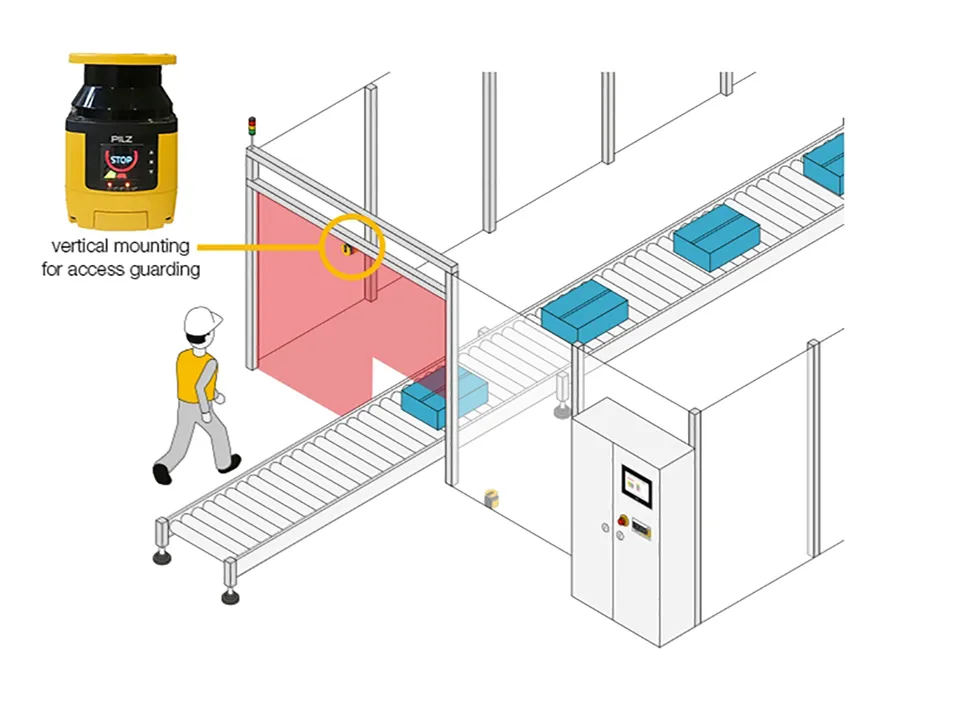
PILZ offers a high-performance solution for both technologies. The PSENscan is a safe 2D laser scanner suitable for applications up to PL d, Type 3 and SIL 2. It detects a safety zone of 3 or 5.5 m, at a resolution of 40 or 70 mm respectively. It is also equipped with a display, so you can see immediately which zone it is detecting and exactly where the detection is coming from. Another advantage is its replaceable memory. This makes it easy to replace the scanner or give several scanners the same configuration. Other features include muting, EDM and override. Up to four laser scanners can be connected using the master-slave principle. The LBK system consists of a radar sensor with an evaluation unit for applications up to PL d and SIL 2. Up to six radar sensors can be connected via CANbus, each capable of detecting up to 15 m x 4 m. They are synchronised so that they do not interfere with one another. This allows flexible, unobstructed configurations.
Wondering which solution would work best for your application? Contact the safety specialists at PILZ for a clear overview.
Question about this story? Ask your question
Keep following this
Get an email when a new story is published. No account needed.
- ThemeReliable machinery and drives
- SubjectTechnology







