












Safety zone monitoring: laser scanners or radar
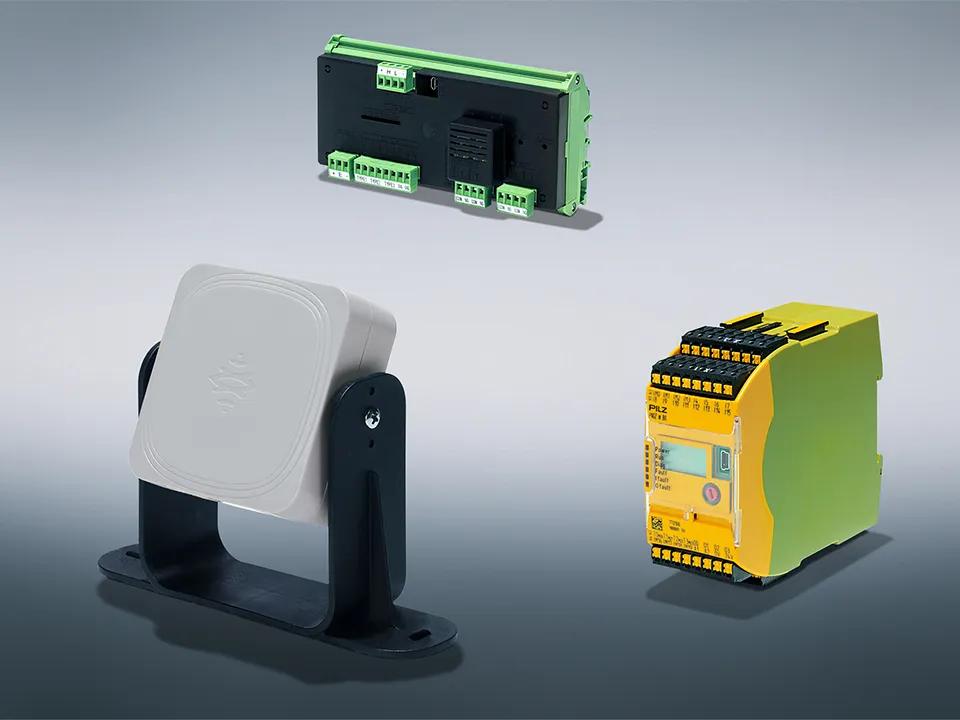
Safety is crucial in every factory. Laser scanners are often used to monitor zones where machines are operating safely.
But like every technology, this one has advantages as well as limitations. In such cases, radar technology can often be an interesting alternative. In an informative webinar, PILZ highlighted how both technologies work and when one is preferable to the other for zone monitoring.
Safety laser scanners are already well established in zone-monitoring applications. Inside the scanner, a laser beam is generated and directed at a rapidly rotating mirror. The laser light then continually scans the area to monitor the zones. When the beam hits an object, it is reflected back. By measuring the time between the beam being emitted and received again, the scanner can determine the distance precisely and establish whether the object is in the monitored zone. Three zones are typically defined, depending on the application and safety requirements.
Protection field: a radius of approximately 8 m around the safety laser scanner. If someone enters this zone, the potential hazard must be neutralised immediately by switching off the machine. This is therefore also known as the shutdown zone.
Warning field: a radius of approximately 20 m around the safety laser scanner. If this zone is entered while the machines are operating, they will slow down and an alarm will sound.
Measurement field: a radius of up to 50 m around the safety scanner. There is no danger here, but the scanner can still be used to determine contours. This can be useful, for example, in mobile applications.
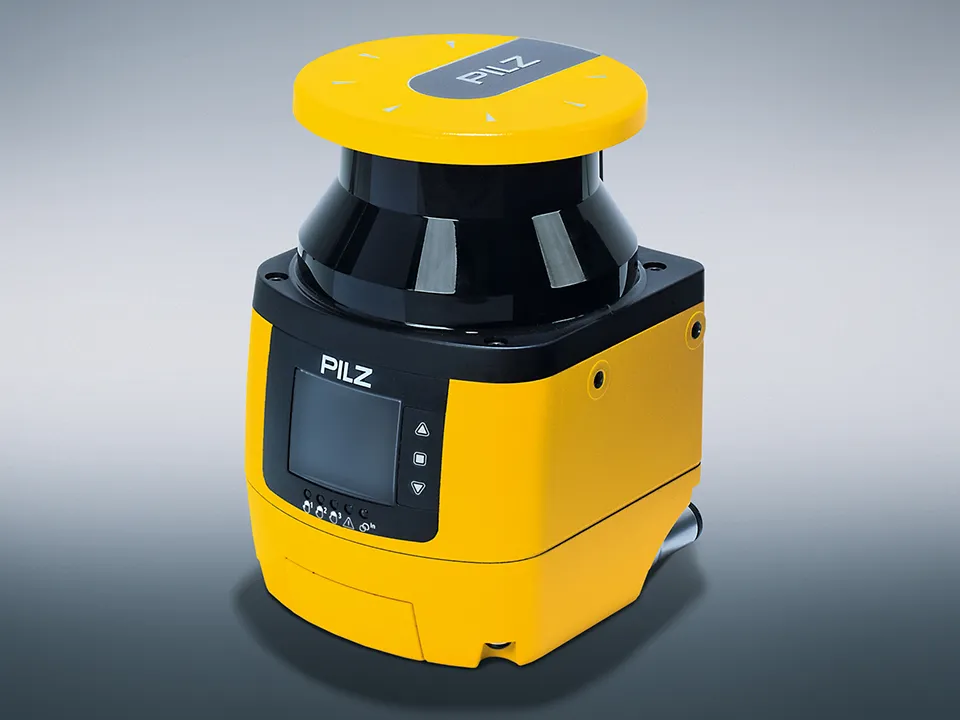
Points to consider with laser scanners
The safety laser scanner works on the basis of diffuse reflection. In applications involving reflective materials (glass, mirrors, shiny metals, etc.), the laser light is not reflected diffusely, but in a single direction. This creates a risk that the object will not be detected. A second important point to consider is resolution. This indicates the minimum size of an object that can be detected safely. The greater the distance, the lower the resolution. Sample rate is another factor. It can be adjusted to increase the resolution, but this will slow the response time. Thirdly, a number of other factors can interfere with safety laser scanners: smoke, vapour or dust, electromagnetic interference, intense light sources and other laser scanners in the same zone. Filters and techniques are available to counter these environmental conditions and make the scanner less sensitive, but this affects the response time and therefore the safety distances.
‘The advantage of radar over laser scanners is that sound waves are unaffected by reflective surfaces and are less sensitive to dust and vapour’
Safe radar system
Radar technology for safety applications has also been available for about a year. While laser light operates in two dimensions, radar waves (frequency 24 GHz) have a conical range. In other respects, however, the principle is the same: radar-wave reflections can be used to determine the distance to an object precisely. The advantage of radar over laser scanners is that sound waves are unaffected by reflective surfaces and are less sensitive to dust and vapour. However, they are less effective with plastic and wood. Radar’s greatest strength is that it can be configured to respond only to movement. This allows objects to be present in a protected zone, while the tiny movements inherent to the human body, such as a heartbeat, ensure that people are always detected safely. The main drawbacks are its precision, with a tolerance of +/- 30 cm, and a minimum required distance of 1.3 m. As this is a relatively new technology, further developments are expected.
High-performance solutions
PILZ offers a high-performance solution for both technologies. The PSENscan is a safe 2D laser scanner suitable for applications up to PL d, Type 3 and SIL 2. It detects a safety zone of 3 or 5.5 m, with a resolution of 40 or 70 mm respectively. It is also equipped with a display, allowing you to see immediately which zone it is detecting and exactly where the detection is coming from. Another advantage is its replaceable memory. This makes it easy to replace the scanner or configure several scanners identically. Other features include muting, EDM and override. Up to four laser scanners can be connected using the master-slave principle. The LBK system consists of a radar sensor and evaluation unit for applications up to PL d and SIL 2. Up to six radar sensors can be connected via CANbus, with a detection range of 15 m x 4 m. They are synchronised so that they do not interfere with one another. This allows flexible layouts with no restrictions.
Wondering what the best solution might be for your application? Contact the safety specialists at PILZ for a clear understanding of the options.
Question about this story? Ask your question
Keep following this
Get an email when a new story is published. No account needed.
- ThemeReliable machinery and drives
- SubjectTechnology







