












Smart filling machine packed with Festo components
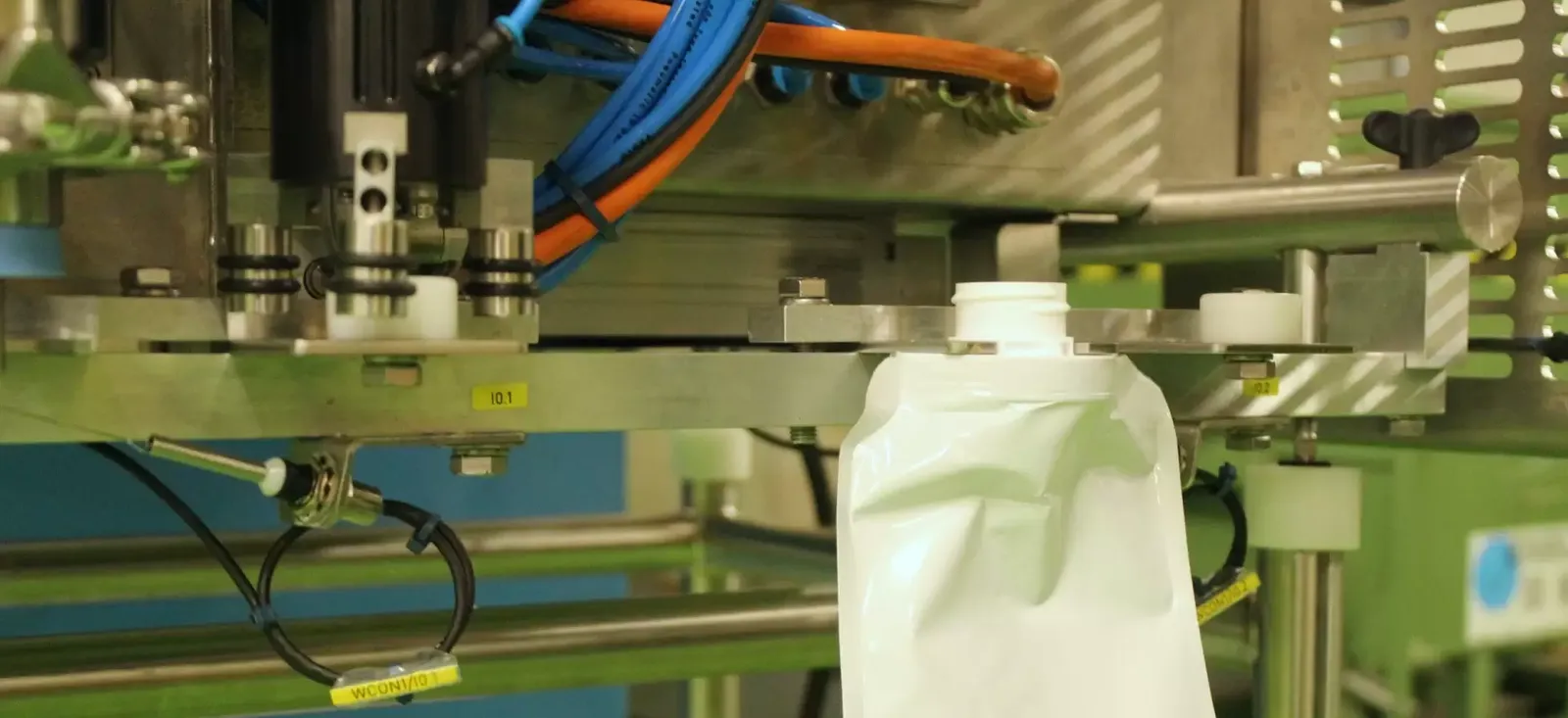
Businesses want certainty today, particularly in sectors where hygiene plays a key role. Reliability is something many of these companies are keen to invest in. Machine builder Scaldopack is well placed to meet these needs and is firmly committed to quality.
On the outskirts of Kortrijk, machine builder Scaldopack is building a remarkable success story. The specialist in filling and capping machines, including for the drinks industry, continues to grow strongly despite fierce competition from countries such as China and Italy. The formula? A clear-cut choice of quality components and a no-nonsense approach.
The recent development of the Smartfiller fits seamlessly with this philosophy. Festo components play a key role in the machine. But before we introduce it, let’s hear more about the company’s activities from managing director Harald Saelens: “We manufacture machines for pouch packaging. We develop and produce advanced machines for welding spouts into pouches. The key factor in our approach is high-quality machine building, based on advanced mechatronics. This results in a high-quality, reliable machine that gives customers peace of mind.”
Machine for small batches
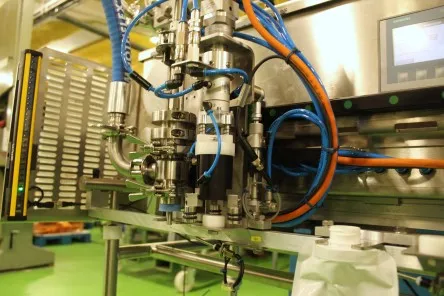
“Most of the machines we develop are designed to process large volumes quickly and reliably, but customers have occasionally asked whether we could also design smaller machines. They might want to use them in laboratories or to produce small batches, for example. We also saw opportunities for a compact machine in the SME market. So we put our knowledge and technology to work on a smaller model. The result is the Smartfiller, a machine with a small footprint that delivers the same quality as the larger machines we normally develop. It can process small batches of vials, jerrycans and bottles for various sectors and applications, including cosmetics, technical products and food. Even the stringent requirements of the retail sector are no problem. Its capacity is around 10 units per minute.”
“Sales are going very well, much to our satisfaction. We have found that companies are using the machines for a wider range of applications than we had envisaged. Multinationals, for example, use them to produce small batches for marketing purposes. The machine was launched in February last year and we have already sold around 30.”
Two versions
“We made 2 versions of the machine. With the first model, users can partially dismantle the machine themselves for cleaning. The second model goes a step further: it is equipped with an EHEDG-certified Alfa Laval pump that manages the CIP circuit (Clean In Place). We have found that this high level of hygiene really appeals to customers in sectors where it matters.”
The machine’s technical design also reflects this commitment to quality. The operating principle is relatively simple. The liquid to be processed is placed in the reservoir, either directly or fed in from an external tank. At the bottom of the reservoir, a pneumatically actuated DFPD quarter-turn actuator doses each vial. A level sensor monitors the tank’s fill level. The Festo EPCC is central to the rest of the process. This ready-to-use component consists of a servo motor that moves the cylinder linearly via a ball screw. Harald Saelens explains: “We used to buy these components separately, but our total cost of ownership calculations showed that switching to the integrated EPCC solution was the better option.”
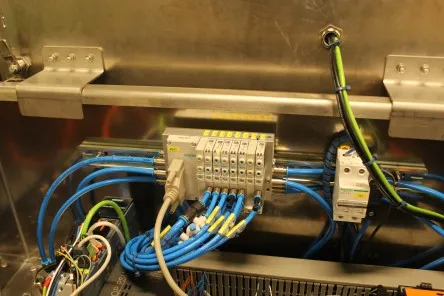
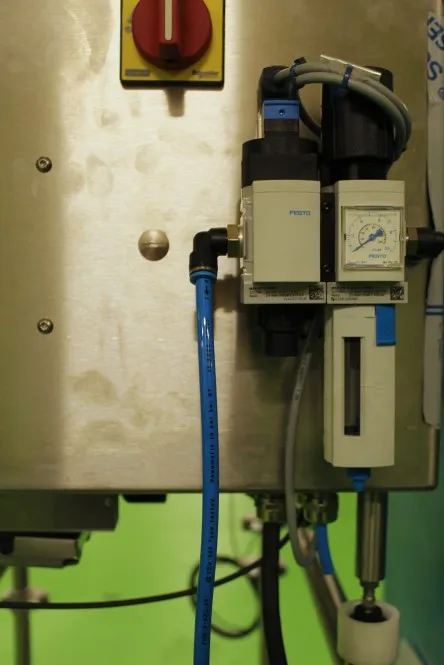
“The pneumatics are controlled via a valve terminal with IO-Link. The PUN-H tubing and QS fittings are also from Festo, as is the MS air preparation unit. This component ensures that the air is suitable for the valves. Interchangeable filling heads spray the liquid into the vials. A 3-finger gripper then screws the caps onto the vials. The filling heads can also be cleaned thoroughly, either manually or using the CIP method. To start processing a different product batch, all that is needed in the filling section is to change the needle and dosing head. To switch packaging type, only the rail that holds the packaging and cap holder needs to be changed. Switching to bottle filling is also straightforward. We developed the heads ourselves and customise them to meet each customer’s needs.”
Why Festo?
“Quality is paramount to our customers. They want assurance not only that the machine is of high quality, but also that they can get back up and running quickly if a problem arises. We aim to meet these expectations. For example, we can remotely check the machine’s status by reading the PLC. The machine’s success therefore starts with the choice of components.
We know that Festo is synonymous with quality, and we are very pleased with the service and support they provide. The company also has a global presence, which is an advantage when you offer your machines worldwide. Another major benefit for us is that customers recognise the brand. When you present your machine and they see that it is packed with Festo components, you immediately have an edge. We also make extensive use of Festo components in our other machines.”
Watch the Smartfiller on YouTube
For more information: www.festo.com/nl/nl
Question about this story? Ask your question
Keep following this
Get an email when a new story is published. No account needed.
- ThemeFood safety from design to audit
- SubjectTechnology







