25 g of residual waste per employee per month: Nestlé becomes the first 'Zero Waste' company in Belgium
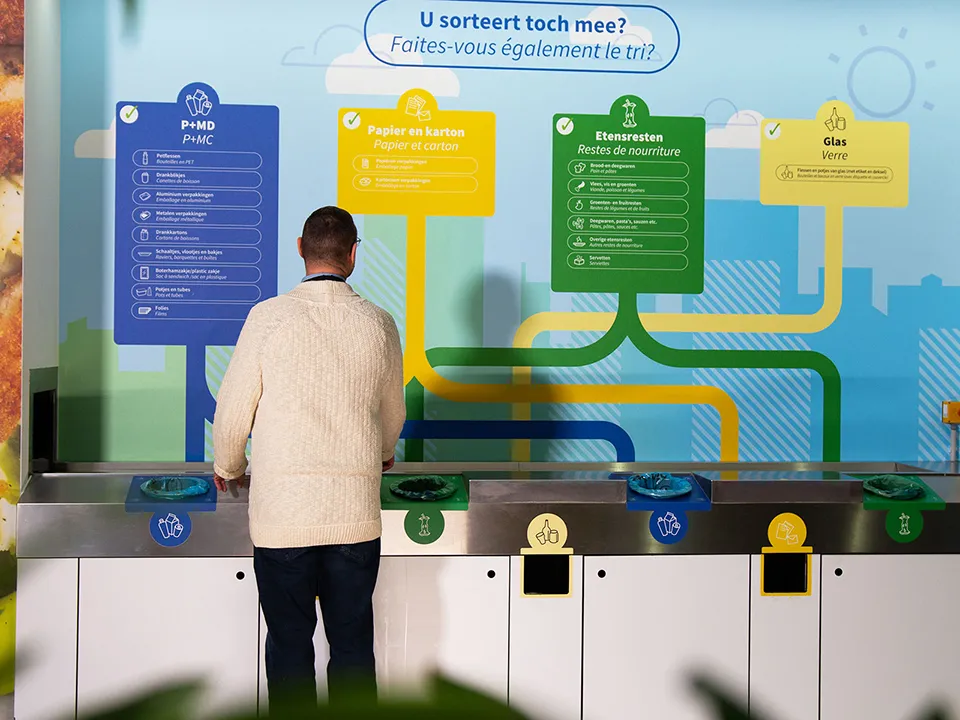
No more grey rubbish bags at Nestlé's Belgian head office in Brussels! With residual waste at just 0.6% of the total, the food company is a top performer when it comes to circularity. A painstaking effort to valorise all of the company's waste streams has been rewarded with the 'Zero Waste' certificate. The key to this success? The commitment of the employees and a healthy dose of creativity.
Today, Nestlé employees at the Brussels head office have only three types of waste bin at their disposal. A bag for residual waste is no longer needed, as this now accounts for just 0.6%! To get there, the company had to mobilise its entire ecosystem: employees, suppliers and the catering service. The waste management company Renewi provided support at every step.
The first audit, carried out in 2019, identified the residual fractions so that an action plan could be drawn up. It took the company from 11.5 tonnes of residual waste in 2019 (or 2 kg per employee per month) to just 1.8 tonnes in 2022 (62 g per employee per month), and from November 2022 to the exceptional result of 25 g per employee per month.
This is a major challenge for all companies, especially those in Brussels, where only 35% of waste is recycled… a figure the Region wants to see rise to 70% by 20301.
Kris Veirier-Peeters, General Services Manager at Nestlé, explains how the project began: 'We followed the principles of the circular economy: avoid, reduce, valorise. The first step was to eliminate all single-use plastic, and then to look for alternatives to non-recyclable packaging or products entering our site.' .
Reusable, recyclable or compostable… nothing else
Which pens are recyclable? How can we meet food safety standards while having the ingredients for our restaurant delivered in a circular way?
These are all questions that Nestlé and its suppliers had to consider. One rule applies: everything that enters the company's head office must be reusable, recyclable or compostable.
'We had to rethink our entire supply chain with all our suppliers, but also with our employees,' continues Kris Veirier-Peeters. Everyone played along and came up with ideas, some of them creative. Because this project is above all a matter of behavioural change.'
For example, the food prepared in the company restaurant is presented in reusable or 100% recyclable packaging. All organic waste from the building is composted. Office supplies must be 100% recyclable. Gone are spiral-bound notebooks, multi-material packaging that cannot be recycled and even the laminating of internal documents. New solutions have also been proposed internally: 'No more bubble wrap to send our samples and promotional material to our customers! We shred our cardboard boxes on site and use the shredded material to protect our fragile products.' .
A hologram to train employees in the new sorting system
The success of this initiative undoubtedly lies in the mobilisation of the 480 employees at the Brussels head office. Long before the project started in 2019, a playful awareness programme on proper sorting was set up: a sorting competition per floor, information days in the form of a game, quizzes and internal communication across multiple channels.
By the time of the final step, abolishing the residual waste bin, employees were already sorting very well. To ensure the transition to waste in three streams (PMD+, cardboard and organic waste), Nestlé called on an unusual trainer: a hologram!
The trainer, played by actress Line Elligiers, stood close to the sorting bins and explained the purpose of each bin to employees, in particular that of the PMD+ bag, recently introduced in Belgium. This innovative approach meant the right habits could be absorbed much more quickly.
Belgium's first 'Zero Waste' certificate
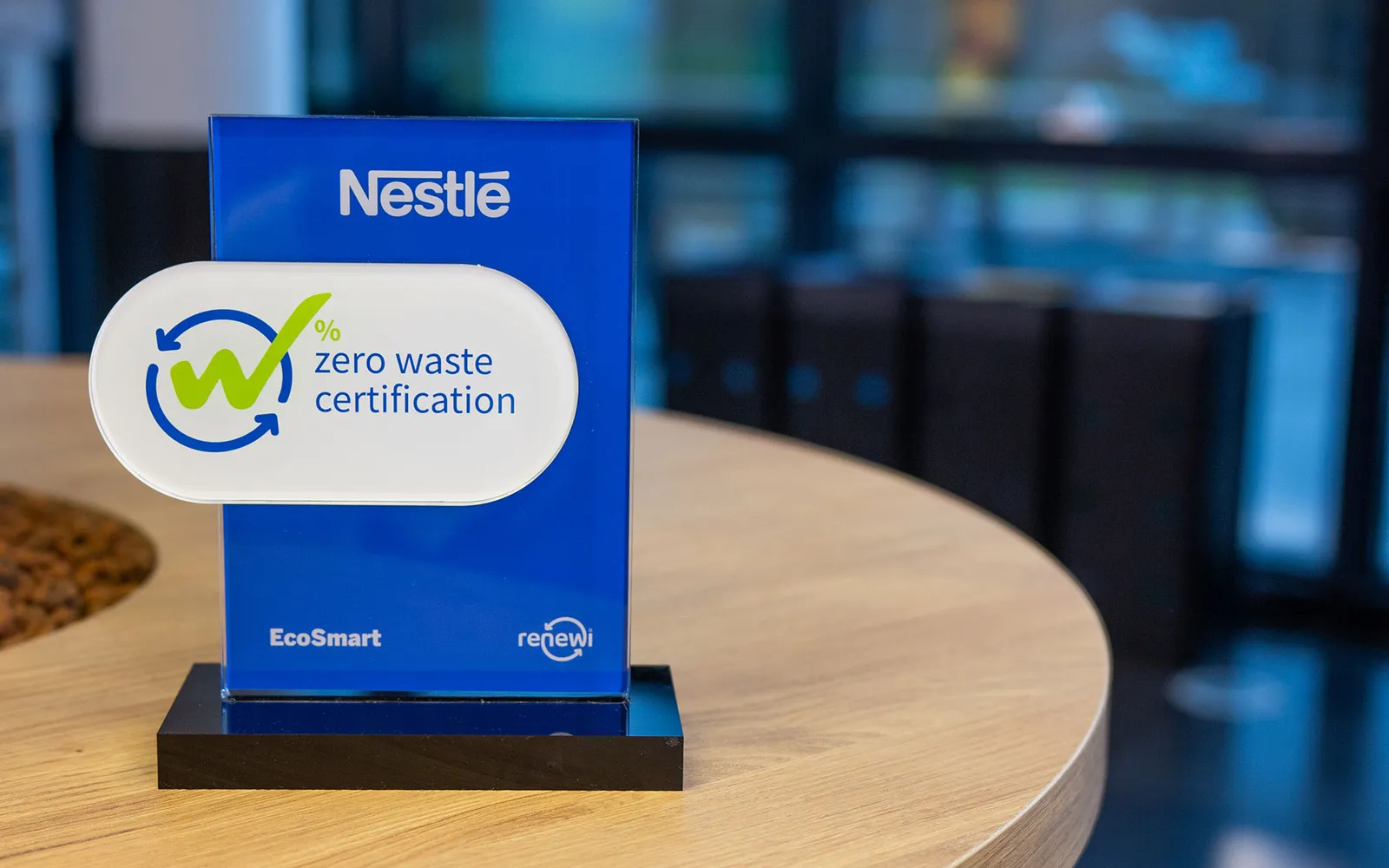
Thanks to its efforts and results, Nestlé Belgium has received Belgium's first 'Zero Waste' certificate. The certificate, issued by the independent audit body Keurmerk Nederland2, aims to encourage companies to become more circular and to give due recognition to the considerable efforts of certain organisations. It is awarded on the basis of very strict criteria and is checked annually at the offices to ensure they remain eligible.
What happens next? Nestlé's efforts do not stop here. The company will continue to reduce incoming streams and tackle food waste in its restaurant even more intensively.
This initiative is a concrete illustration of Nestlé's determination to work at every level of the company, from the design of its products and their packaging to logistics and the management of its infrastructure, to halve greenhouse gas emissions by 2030 and reach Net Zero by 2050.
1 Figures from the interim report of the Regional Resources and Waste Management Plan
2 There is currently no Belgian certification system.
Question about this story? Ask your question
Keep following this
Get an email when a new story is published. No account needed.
- SubjectNews