EFSA annual report reveals overall rise in zoonoses and foodborne disease outbreaks
Despite the turbulent times we live in, hygiene and food safety remain of paramount importance in the food industry. The industry is seeking to cut costs to cope with rising raw material and energy prices and maintain its margins. Despite all this, hygiene, including the cleaning and disinfection of equipment, and food safety remain just as important in ensuring that food reaches our tables with the highest possible safety guarantees. Only in this way, alongside policies to monitor animal health, can the increase in human diseases caused by the consumption of spoiled food be addressed.
EFSA annual report
The recent annual report published by EFSA (the European Food Safety Authority) and ECDC (the European Centre for Disease Prevention and Control) contains detailed data on the occurrence of the main zoonoses reported by EU Member States and other European countries. It shows an overall increase in zoonosis cases and foodborne disease outbreaks in 2021 compared with the previous year. This may be related to the COVID-19 control measures that were still in force in 2021. And, not least, to the UK’s departure from the European Union, which means that UK data are no longer included in this report.
In 2021, the 27 EU Member States and Northern Ireland reported 4,005 foodborne outbreaks, 29.8% more than in 2020, and 32,543 human cases, a rise of 62.6% on the previous year. These figures are close to those reported in the period 2017-2019, before the pandemic. In terms of the transmission of foodborne pathogens, EFSA says this points to a possible gradual return to pre-COVID-19 eating habits in 2021.
Although the report shows outbreak figures comparable to those before the pandemic, this trend is bucked by foodborne listeriosis outbreaks, which were more numerous than in 2019 and reached their highest level to date. According to the EFSA report, this increase in cases caused by Listeria monocytogenes is probably the result of the use of whole genome sequencing techniques, which make it possible to detect and define the bacterial species responsible for an outbreak with great precision.
However, an analysis of the outbreaks recorded in Europe in 2021 shows that Salmonella was the most common cause of outbreaks, particularly S. Enteritidis, which accounted for 19.3% of the total. A total of 773 detected salmonellosis outbreaks were caused by the consumption of eggs and egg products. In addition, outbreaks associated with the consumption of products in the “vegetables and juices and other derived products” category increased significantly in 2021 compared with previous years, according to EFSA. These were followed by Campylobacter outbreaks, which reached 249, and 23 Listeria outbreaks, the latter resulting in the deaths of 12 people. This figure rises to 208 when ECDC data not linked to local outbreaks are included.
The two most commonly reported diseases
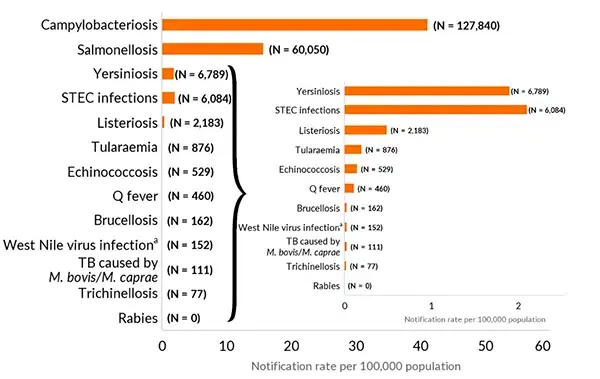
The report also gives the total number of reported zoonosis cases, which are not necessarily linked to outbreaks. In 2021, the two most commonly reported diseases in humans were campylobacteriosis and salmonellosis, both associated with gastrointestinal problems, with 127,840 and 60,050 cases respectively. Campylobacteriosis remains the most commonly reported zoonosis. The number of reported cases rose by 7,000 last year compared with 120,946 in 2020, with chicken and turkey meat the most common source of the disease. Salmonellosis was the second most commonly reported disease. These two diseases were followed by yersiniosis, with 6,789 cases, which is often associated with the consumption of undercooked pork or vegetables; infections caused by Shiga toxin-producing Escherichia coli, with 6,084 cases; and listeriosis, with 2,183 cases across Europe. Both agents can cause serious and even fatal disease, especially in high-risk groups such as people with weakened immune systems, children, pregnant women and older people.
EFSA Journal 2022.20:e07666
The results show that good hygiene in facilities and a biosecurity policy on livestock farms are of paramount importance in reducing the risk of foodborne infections. In this respect, it is essential to highlight the importance of, among other things, implementing and strictly complying with hygiene monitoring programmes, and introducing specific programmes targeting certain pathogens, for example Salmonella in poultry populations such as breeding hens, laying hens and broilers. In short, cleaning and disinfection protocols need to be reviewed and updated to reverse the trend identified in the EFSA annual report.
Author
Joan Estornell
Marketing Manager Food Hygiene at Christeyns. Bachelor’s degree in Information Sciences. Master’s in Advertising Account Management. Strategic Innovation in Marketing and Advertising (UAB). Master’s in Digital Business. Digital Marketing (ESIC Business & Marketing School). Food industry hygiene course (Betelgeux).
Een zakelijke vraag aan Christeyns NV? Get in touch
Companies in this story

Keep following this
Get an email when a new story is published. No account needed.
- ThemeFood safety from design to audit
- SubjectNews
- CompanyChristeyns NV