Partnership brings Vanadium Redox Flow technology to industry
Text Jan De Nul / Kris Vandekerckhove –Image Jan De Nul
Pooling forces for a battery energy storage system
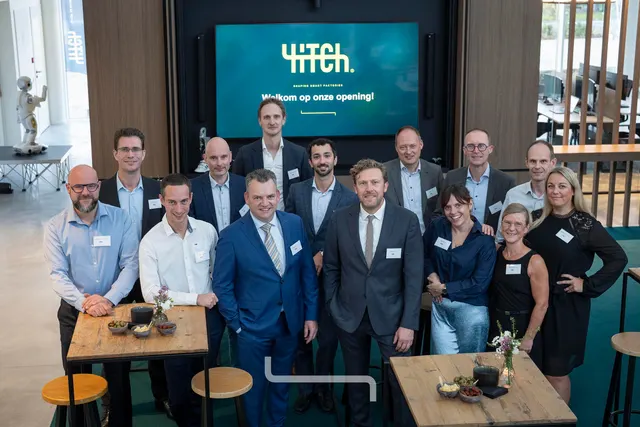
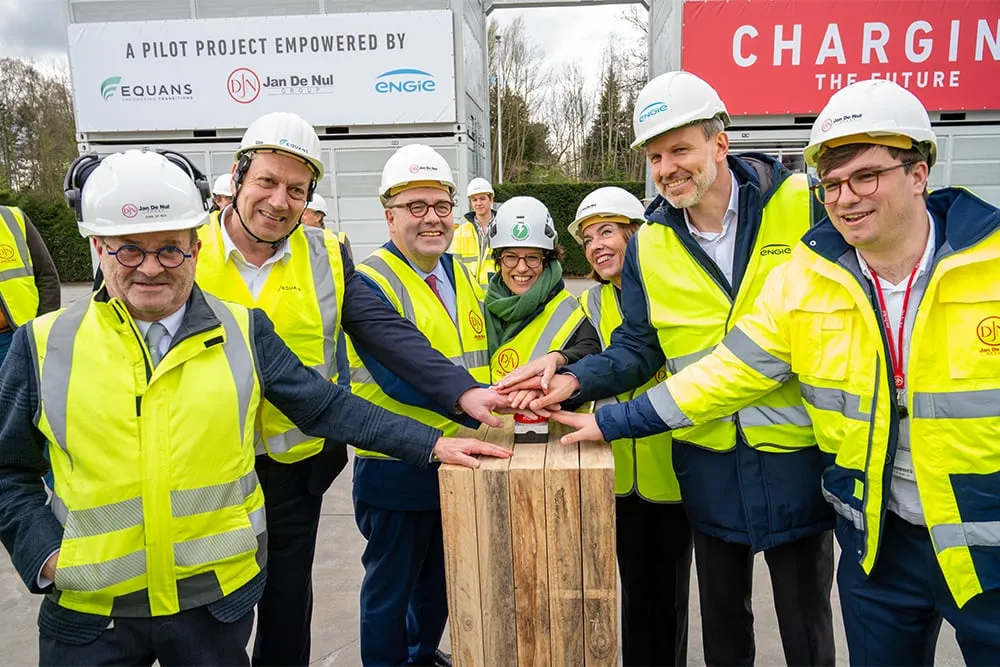
When a group of ‘captains of industry’ join forces, you know something is in the works. Expectations were therefore high ahead of the official press presentation at Jan De Nul in Aalst, where the partnership working towards the energy transition to a carbon-free economy was unveiled.
Jan De Nul Group, ENGIE Belgium, Equans BeLux and Invinity have recently launched a pilot project to explore the use of Vanadium Redox Flow batteries at industrial scale. Relatively unknown to the general public, this type of battery offers a safe and sustainable alternative to conventional lithium-ion batteries. The companies will investigate how these batteries can improve electricity management in an industrial setting and contribute to the shift towards a zero-carbon economy. The project was officially inaugurated in the presence of Energy Minister Tinne Van der Straeten.
The potential of Redox Flow batteries
Research centre ENGIE Laborelec successfully conducted laboratory tests with a Redox Flow battery in 2019, and is now testing the control and maintenance of this technology at industrial scale for the first time. ENGIE, Equans and Jan De Nul have partnered to install the industrial-scale Redox Flow battery. Equans installed a Vanadium Redox Flow battery manufactured by Invinity Energy Systems, with a capacity of 800 kWh, at Jan De Nul’s site in Hofstade (near Aalst), alongside its 578kW solar panel installation. The installation comprises four 20ft containers, stacked in pairs, and is managed by ENGIE’s smart Energy Management System (EMS), which controls the battery to optimise the installation’s self-consumption.
First to speak was Frederik Van Praet, BESS (Battery Energy Storage Systems)-Project, Jan De Nul: “Jan De Nul is continuing its own energy transition and is fully committed to innovation. With this project, we are taking another step towards more sustainable operations. This Vanadium Flow battery will enable us to balance energy supply and demand more effectively at this site. It will allow us to assess and learn how widely applicable these solutions are across our sites and operations in Belgium and around the world. Jan De Nul has always been committed to taking a pioneering role in the energy transition.”
Strengthening cities and industries
Equans designs, installs and delivers tailored solutions that optimise installations, systems and technical processes and make them easier to use. In doing so, the company helps its clients with their industrial, digital and energy transitions. It supports cities, industries and buildings in areas including HVAC (heating, ventilation and air conditioning), cooling and fire safety, facilities management, digital and IT, electrical engineering, mechanical engineering and robotics. Equans is a market leader in France, Switzerland, Belgium, the Netherlands and the United Kingdom.
“We were responsible for the conceptual study, tendering and integration of the various modules, and will maintain the battery system throughout the four-year test period. We see Redox Flow battery technology as a sustainable, robust and future-proof solution, and are therefore particularly proud to be involved in this first test at industrial scale,” says Mark Dirckx, CEO of Equans BeLux.
Industrial testing of a battery energy storage system
Vanadium Redox Flow batteries are innovative batteries that are now sufficiently developed, both technically and commercially, to play an important role in the energy transition. They can replace or complement lithium-ion batteries in applications including local renewable energy generation at industrial sites and centralised installations. Unlike lithium-ion batteries, Redox Flow batteries have a service life of at least 25 years, capacity that degrades very little, and inherently provide several hours of storage. They are also safer, as there is no risk of uncontrolled combustion (thermal runaway), making them suitable for warmer climates, and are easier to recycle at the end of their service life.
“As pioneers of the energy transition, we look beyond conventional lithium-ion batteries and are willing to embrace innovation. There are currently few examples in Europe of large-scale projects using Vanadium Redox Flow batteries. This pilot project puts Belgium on the map as a pioneer in energy-sector innovation. We aim to become a major player in energy storage, with the ambition of developing 10GW of storage capacity worldwide by 2030,” concludes Vincent Verbeke, CEO of ENGIE Belgium.
Een zakelijke vraag aan Equans Digital? Get in touch
Companies in this story

Keep following this
Get an email when a new story is published. No account needed.
- ThemeSaving energy and water
- SubjectNews
- CompanyEquans Digital