Recyclability and functionality of coated paper and board for food packaging
Paper and board are ideal packaging materials thanks to the renewable origin of cellulose fibres, their high specific strength and low weight. To improve the quality and shelf life of packaged foods, paper performance needs to be enhanced with barrier coatings that protect against water, limit gas permeability or help preserve aromas. But what about the recyclability of these coated materials? Can they be used again in paper production? The Repac2 project aims to evaluate the functionality and recyclability of paper for food packaging.
Packaging plays a crucial role in the food supply chain, protecting quality, ensuring safety and extending the shelf life of food. The environmental impact must also be taken into account when choosing packaging materials.
Every day, the food packaging industry faces the challenge of choosing the most suitable packaging material for specific food products. The food and packaging industries are also under pressure to demonstrate the recyclability of their packaging materials. Ambitious targets have been set at both European and Belgian level. EU legislation stipulates that 65 per cent of all packaging waste must be recycled by 2025, rising to 70 per cent by 2030 (under EU Directive 2018/852). In Belgium, the Belgian Food Industry Federation (FEVIA) states that all food packaging must be recyclable, reusable or biodegradable by 2025. Recyclability is also an important feature in the transition to circular packaging.
To make them suitable for food packaging, paper and board materials are finished with one or more coatings that provide good sealing and barrier properties against gases and/or moisture. Many coated paper and board materials for food packaging applications are currently on the market. Traditionally, plastic films have been laminated onto paper, but in recent years alternative coatings based on aqueous polymer dispersions have been developed. However, it is not always clear whether these coatings meet the required specifications or are fit for purpose. It is generally assumed, though, that a coating must account for no more than 5 per cent of the packaging to ensure recyclability. New procedures for assessing the recyclability of coated paper and board packaging materials have recently been developed in line with European recommendations, but they still need to be incorporated into a universal method for existing and new products.
Introducing REPAC²
The Cornet-Tetra project REPAC² (‘Functional & recyclable coated paper packaging for food products’), which started in January 2022, brings together European research partners, including UHasselt, Sirris, Fraunhofer, Pack4Food, Flanders’ FOOD, Natureef and West Pomeranian University of Technology. The steering group also includes around 16 Flemish companies from various sectors, including material suppliers, packaging manufacturers and food retailers. The project aims to support industry partners in accelerating the adoption of coated paper and board materials that provide good barrier properties in contact with food and are also recyclable under current legislation. The knowledge generated by the project will help businesses choose these materials and accelerate their potential uptake in the food industry.
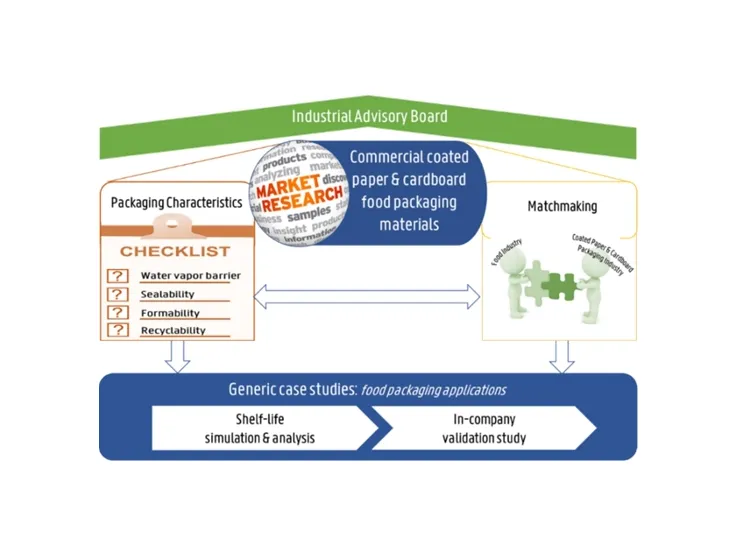
The first item on the agenda is a market study of commercially available coated paper and board for food packaging. A method will be developed to determine the recyclability of coated paper and board, and will be used to assess commercial packaging materials. A matchmaking event will also be organised for food businesses and the coated paper and board packaging industry, with the aim of developing generic case studies for further research. A shelf-life simulation tool will initially be used for these case studies, followed by joint shelf-life studies. Finally, in-company validation studies will be set up.
Sirris, together with MPR&S, will compile an inventory of existing materials: both coatings and coated materials currently on the market or expected to enter it in the short term. Sirris’s research will also focus on the recyclability of these materials in line with the latest European recommendations. This work will be carried out in Sirris’s coating lab in Diepenbeek, where an experimental test line will be set up to pulp the materials and assess the quality of the recovered paper fibres.
Target group
REPAC² targets the food industry, manufacturers and processors of coated paper and board packaging, and recycling companies. Strong interaction with this target group is essential to maximise the project’s industrial relevance.
Your contribution makes a difference!
Through a survey, we aim to build a broad overview of coated paper-based packaging and coatings for paper and board food packaging applications that are currently commercially available, as well as new developments expected to reach the market within 1 to 2 years.
Taking part in the survey is worth your while! By completing the questionnaire, you will help raise product awareness internationally. The products will be listed in an online inventory accessible to everyone and included in a white paper on coated paper-based packaging, which will be widely distributed across the industry. Your coating or coated packaging may also be selected as one of the 15 materials to be evaluated in the project for functionality and recyclability. You will then also gain access to international matchmaking with potential end users.
You can find the questionnaire here!
This project is being carried out with financial support from VLAIO.
Question about this story? Ask your question
Keep following this
Get an email when a new story is published. No account needed.
- ThemePackaging and product traceability
- SubjectNews