Sustainable dairy: why is it essential for a resilient food system?
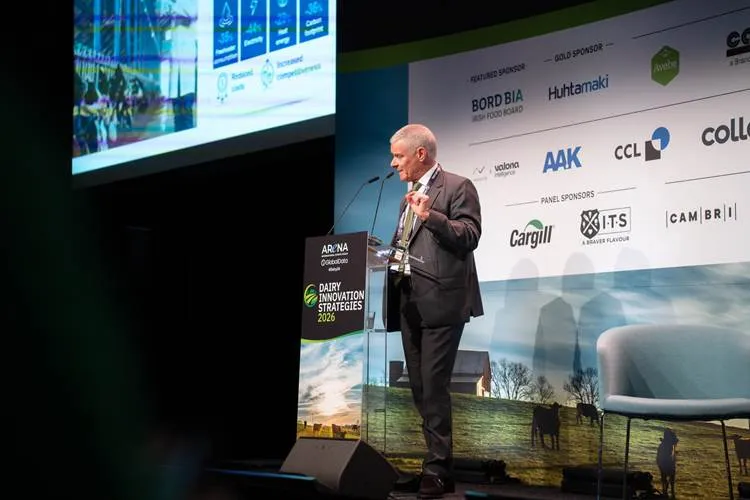
With more than 8 billion people worldwide, our food systems are under pressure to keep food safe and accessible for everyone. In the European Union alone, consumers drink around 154 billion litres of beverages with a limited shelf life each year, equivalent to about 300 litres per person. At the 12th edition of the Dairy Innovation Strategies Conference, Lorenzo van Haelst, Managing Director at Tetra Pak France and Benelux, explained why sustainable dairy plays a key role in strengthening resilient food systems.
The 12th edition of the Dairy Innovation Strategies Conference took place on 25 and 26 March 2026 at the Postillion Hotel & Convention Center in Amsterdam. The annual event brings together dairy experts, producers, policymakers and innovators to discuss the future of the sector, with sustainability, technological advances and more efficient production and processing strategies among the key topics.
Food systems under pressure
At the event, Lorenzo van Haelst, Managing Director at Tetra Pak France and Benelux, took a closer look at how our food systems work today and why they need to change. After all, food does not simply appear on our tables. It must first be grown, processed, packaged and transported before it reaches us. The choices made by businesses and policymakers at every stage determine how much food is lost, how much energy we consume and the scale of the impact on the climate and nature.
Our food system is currently responsible for more than a third of global greenhouse gas emissions, while the population continues to grow. To keep feeding everyone without putting additional pressure on natural resources, we need food systems that waste less and remain reliable, including during conflicts, climate shocks and more challenging economic conditions.
The role of dairy
The dairy industry plays a key role in this. In the European Union alone, more than 23 million tonnes of milk were consumed in 2025. At the same time, milk and other liquid beverages are highly perishable. The challenge is clear: how can food safety be guaranteed while also reducing the carbon footprint of the entire value chain?
Aseptic processing and packaging solutions offer an answer. Aseptic means free from microbiological contamination. Thanks to this technology, food remains safe and flavourful for six to twelve months without the need for refrigeration or preservatives, while retaining its colour, texture and nutritional value. This improves access to nutritious food worldwide and reduces food loss.
This approach also has a direct impact on energy consumption and costs. Products that do not need to be refrigerated can be transported and stored at ambient temperatures. This cuts energy use in transport and storage and makes distribution more efficient, particularly in regions where a reliable cold chain cannot be taken for granted.
Working together for resilience
Aseptic technology plays an important role, but sustainable dairy requires a broader approach across the entire production chain. Tetra Pak works with dairy producers throughout Europe to improve the efficiency of production lines, use fewer raw materials and reduce waste. “For example, we helped a Dutch customer expand into UHT milk and plant-based beverages,” says Lorenzo. “With integrated processing, packaging and automation solutions, the company was able to reduce operating costs by 20 to 40 per cent while also strengthening production resilience.”
He says projects like these show what is already possible. “To achieve this progress on a larger scale, we have also set specific targets. By 2030, we aim to reduce emissions from equipment used for dairy processing at ambient temperatures by 50 per cent compared with 2019. With a 42 per cent reduction to date, we are well on track. We are also aiming to halve product losses on best-practice processing lines. But progress of this kind requires collaboration across the entire chain, from producers to retailers and policymakers.”
Question about this story? Ask your question
Keep following this
Get an email when a new story is published. No account needed.
- SubjectNews