Why conveyor belts are essential in food production
Text Valérie CouplezImage iStock
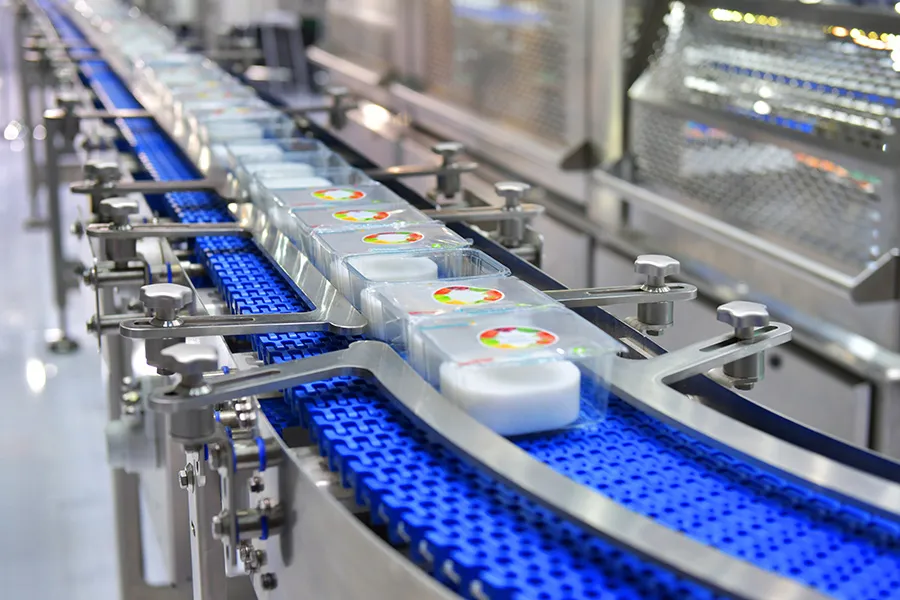
Products of all shapes and sizes pass along them. When they were introduced, conveyor belts revolutionised the food industry. For the first time, production could really step up a gear. Materials reached their destination without human intervention. This was faster and more hygienic than anything that had come before. And even today, their role is far from over.
Conveyor belts date back to 1795. They were primitive, consisting of a wooden frame and a leather belt, with manual drive, but the Industrial Revolution, the first one, would change that. The military led the way. From 1804, the British Navy began using steam-powered conveyor belts to load its ships. Soon afterwards, they began appearing in every industrial sector. Their capabilities continued to expand: wood was replaced by steel, leather gave way to rubber and canvas, and eventually even combinations of synthetic materials. Fast-forward to today, and mechanical conveyor belts are used in food businesses to improve efficiency, productivity, quality and safety. More than 80 types have been defined. But today’s technology also makes it possible to tailor systems to the distance, speed and type of product. Everything moves smoothly and without interruption from the starting point to its destination.
Minimising manual labour
In the past, manual labour was needed to move materials from one level to another. But even when labour costs were still relatively low, investing in conveyor belts had already proved more attractive. Automating the internal transport of products made it possible to cover long distances and different levels with ease. By choosing the right system for your specific application, conveyor belts can still help cut costs by reducing manual labour. They can move raw materials from storage to the production line, or take finished products to the packaging line and from there to dispatch. Introducing conveyor belts also improves safety. Employees can focus on their tasks without having to rush back and forth across the production area.
Greater efficiency and productivity
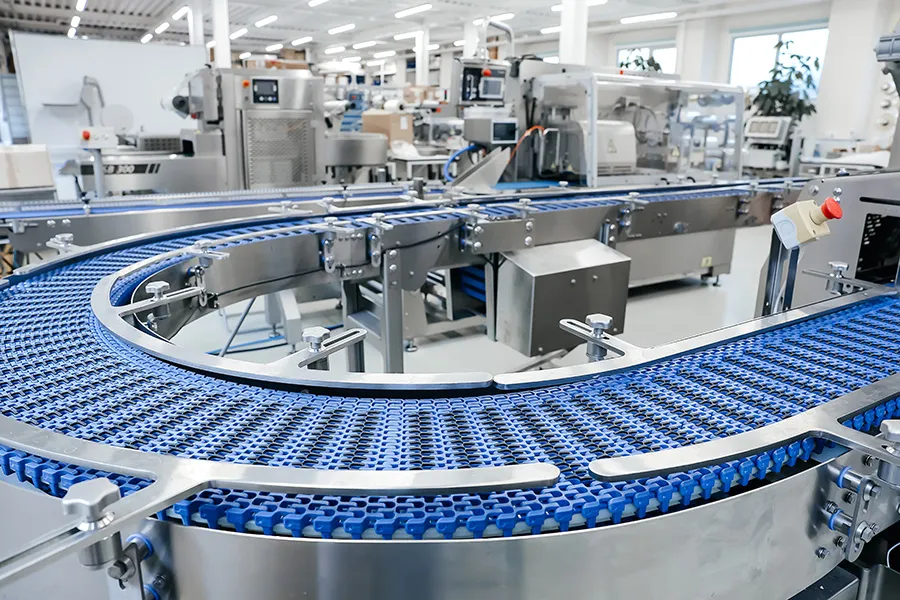
Conveyor belts are particularly effective at saving time. They do this by moving materials quickly from one level to another. They can transport products in any direction, even from one far end of the food factory to the opposite end. This can save a great deal of time-consuming manual work. One of the best-known examples is the first moving assembly line, installed by Henry Ford in 1913. It reduced the time needed to build a car from 12 hours to half an hour. The key is to think carefully about how a conveyor belt will best fit into your production process. With the modern technology now available to control conveyor belts, you can ensure the optimal speed in every section, preventing food loss.
Food safety first
Another advantage is improved hygiene. A conveyor belt is much safer for food than manual handling, provided the right hygienic choices are made for the application. Some types are better suited than others to direct contact with food. There are also plenty of material options with the appropriate food-grade certificates. Cleaning, of course, remains a key consideration. Make sure there are not too many corners and crevices that are difficult to clean, or choose additional options such as scrapers to remove any dirt that may stick to the belt. ■
Question about this story? Ask your question
Keep following this
Get an email when a new story is published. No account needed.
- ThemeFood safety from design to audit
- SubjectNews